
Rwanda: Ksh.2B invested in community projects around national parks
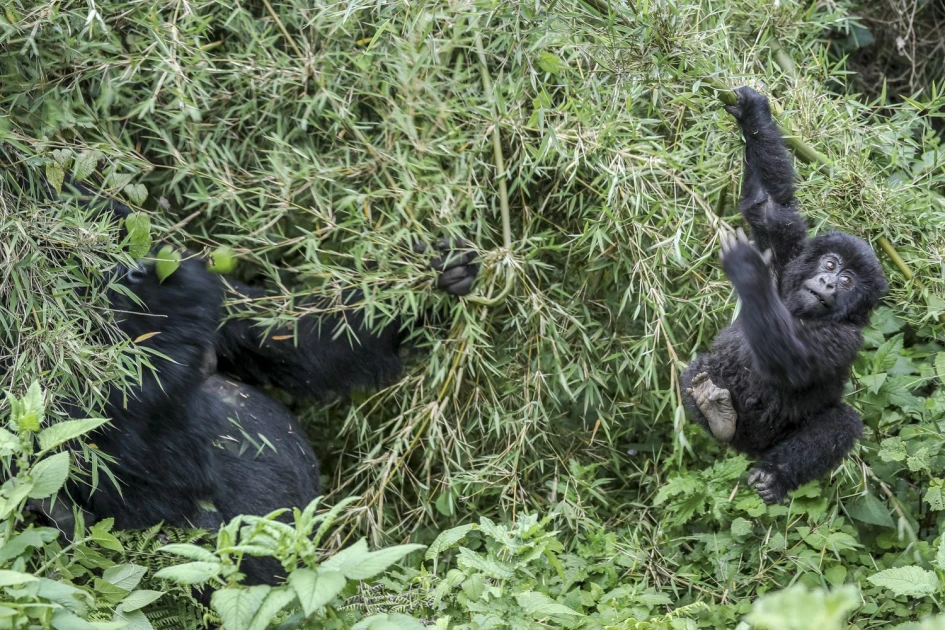
A baby mountain gorilla plays as its mother keeps watch. Photo I File

Audio By Vocalize
The Rwanda Development Board (RDB) has announced that so far RWF 23 billion, equivalent to more than Ksh.2 billion, has been invested in nearly 1,300 community projects near the country’s national parks, supporting schools, health centres, water infrastructure, livelihood initiatives and other community priorities.
The community projects are funded through Rwanda’s Tourism Revenue Sharing Programme, an initiative that allocates 10% of tourism revenue to community development projects in areas surrounding the country’s protected areas.
The announcement came during the unveiling of plans for the 21st edition of Rwanda’s flagship conservation event commonly known as Kwita Izina, an annual ceremony that brings together household names representing conservation, business, sports, entertainment, philanthropy and public service from Rwanda and around the world to give names to baby gorillas.
Themed “Conservation is Life: Sustaining the Future”, this year’s ceremony is scheduled for September 4 in Musanze District, Northern Province, and will see 22 baby mountain gorillas receive names from distinguished Namers whose list is yet to be announced.
Over the past 21 years, Kwita Izina has evolved into one of the world’s leading conservation events, celebrating newborn mountain gorillas while highlighting Rwanda’s conservation achievements and the role of communities and partners in protecting the country’s natural heritage.
According to Maombi Antoinette, one of the beneficiaries of the community development programme, families living near national parks can now afford decent livelihoods.
“Speaking from my own experience, my husband used to be a poacher. When this revenue sharing programme was introduced, we got a SACCO through which my husband and I got loans that enabled us to buy small livestock. Today, my husband is no longer a poacher. We own two cows and five sheep, and even managed to build our own house,” she explained.
Maombi continued to say that the livestock helps her family to get manure, which they use to grow potatoes and vegetables.
According to Eugene Mutangana, Executive Secretary of the Rwanda Nature Foundation, Rwanda’s experience demonstrates the connection between protecting nature and creating sustainable economic opportunities.
“For over two decades, Kwita Izina has showcased Rwanda’s belief that conservation is not simply about protecting wildlife. It is about creating opportunities for people, supporting communities, growing tourism and ensuring that future generations inherit a healthy and thriving natural environment. This year’s theme, ‘Conservation is Life: Sustaining the Future,’ reflects exactly that vision,” he noted.
Today, close to 1,100 mountain gorillas live in the wild across the Virunga Massif and Bwindi ecosystem. They remain the only great ape whose population continues to grow, reflecting decades of conservation efforts involving governments, conservation organisations, researchers, veterinarians, rangers and communities.
Rwanda’s growing tourism sector.
In 2025, Rwanda generated a record US$685 million in tourism revenues, up from US$ 647 million in 2024, supported by 1.49 million visitor arrivals, representing a 9 per cent year-on-year increase.
The country’s national parks alone welcomed 155,394 visits in 2025, generating US$ 40.8 million in park revenues. Volcanoes National Park, which is home to the endangered mountain gorillas, remained the largest contributor, accounting for US$ 35.8 million, while Nyungwe National Park recorded the fastest growth in visitation following the introduction of new tourism products, including the zipline and rope course.
Domestic tourism also maintained growth, with park visits increasing by 8.1 per cent to more than 59,000 visits, demonstrating growing appreciation of Rwanda’s natural heritage among Rwandans.
The country’s tourism sector has also become increasingly diversified. A case in point is the MICE (Meetings, Incentives, Conferences and Events) sector, which generated US$ 94.7 million in revenues in 2025, an increase of 11.8 per cent.
During the same period, Rwanda hosted 165 international and regional meetings and events that attracted more than 61,000 delegates.
Join the Discussion
Share your perspective with the Citizen Digital community.
No comments yet
This discussion is waiting for your voice. Be the first to share your thoughts!