
Ruto promised Ksh.700B in Nyanza, where will the money come from? Controller of Budget explains
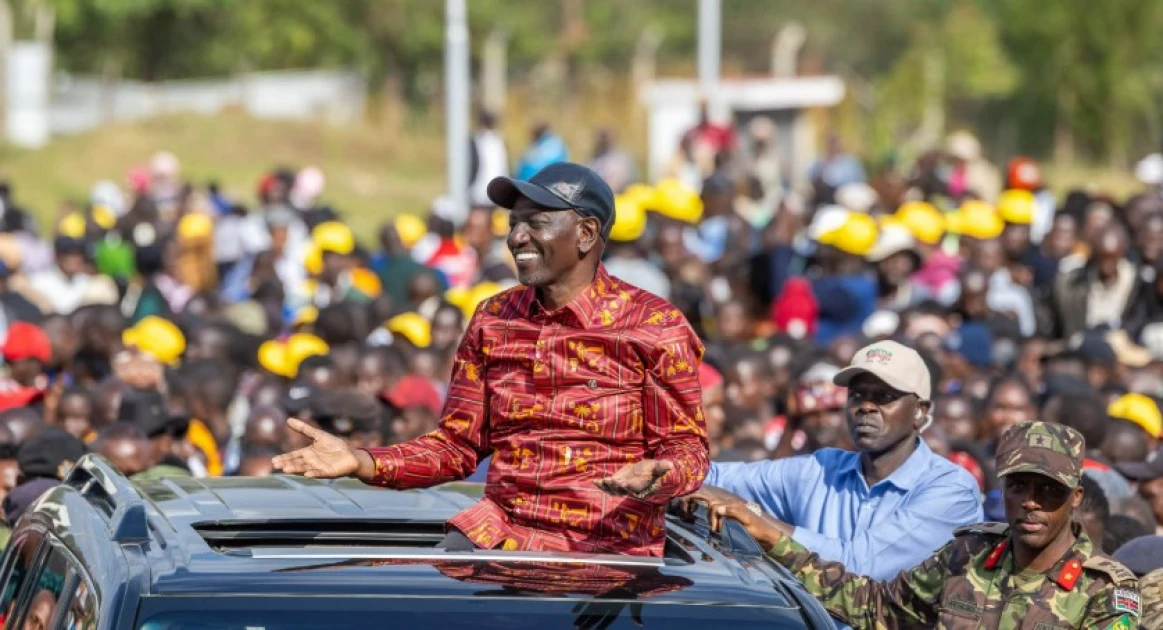
President William Ruto addresses the people of the Youth Farmers shopping centre in Longisa on September 9, 2026. Photo/PCS

Audio By Vocalize
President William Ruto promised residents of the
Nyanza region projects worth an estimated Ksh.700 billion during last week's
extensive tour of the area.
But what does it take to turn presidential
promises into reality, complete with the budgets required to facilitate their
implementation?
Controller of Budget (CoB) Dr. Margaret Nyakang’o
stated that the pronouncements must first be translated into funded projects, a
process that could require budgetary shifts where possible or emergency funding
were justified.
This comes at a time when reports from the
Controller of Budget have shown that some government agencies proceeded with project implementation without
approved budgets.
During last week’s tour of the Nyanza region,
President Ruto launched, inspected and commissioned a series of
multi-billion-shilling projects, while pledging billions of shillings in new
investments across the region.
In Kisumu, for instance, the President announced
the revival of the Ksh.19 billion Sondu-Soin Dam, the Kisumu Marine School and
the Lumumba Affordable Housing Project.
In Homa Bay, he rolled out a Ksh.3.5 billion plan
to construct 21 modern markets across the county.
On the final day of his Nyanza tour in Migori, the
President launched several projects, including the construction of the
Kanyawanga-Kuoyo-Madiaba Road at a cost of Ksh.2.2 billion.
He also announced the upgrading of the
Sibuoche-Gogo Bitumen Road and the construction of the Masaba Substation,
estimated to cost Ksh.1.2 billion.
In total, the President estimates that the
government’s investment in the region could reach Ksh.700 billion.
In the Controller of Budget’s report for the
financial year ending June 2026, the national government spent up to Ksh.889
billion on development projects across all ministerial departments.
The announcement that projects worth Ksh.700
billion could be implemented in a four-county region has therefore raised
questions about how the projects will be financed.
"All the pronouncements by the President are
taken up by the Office of the Head of Public Service. They cannot be picked by
the verbal pronouncements and be implemented," Nyakang'o revealed.
In the Controller of Budget’s report for the
financial year ending June 2026, the office conducted a monitoring and
evaluation exercise on the implementation of government projects.
Nyakang’o’s team found that some projects in the
Nyanza region had either been underfunded or implemented without corresponding
budgetary allocations.
The report, for instance, flags Phase Two of the
Got Rabuor-Homa Bay Pier Corner-Kodoyo Road and the realignment of the Homa
Bay-Rongo Road at Kabunde Airstrip, both projects being executed by the Kenya
National Highways Authority (KeNHA).
Nyakang’o noted that KeNHA facilitated the
contractor to mobilise resources on the ground in readiness for the works,
despite lacking corresponding budgetary allocations in the approved budget for
the 2025/2026 financial year.
This explains a situation where contractors report
to the ground, but works never begin.
"If they do not have the resources, then they
reach out and say, for us to implement, we need one, two, three, then the
National Treasury advises," she added.
The law allows for the reorganisation of budgets.
In instances involving emergency demands, Article 223 of the Constitution can
be used to fund unforeseen needs.
And while presidential pronouncements are not
illegal, Nyakang’o pointed out that they must ultimately be translated into a
budget, even where this requires a supplementary budget and the shifting of
funds from previously allocated areas.
"New items have to go through the
supplementary budgets, which pass through the COB."
For now, affected residents will have to wait for
the implementation of the promised projects as the government handles the
necessary paperwork, identifies funding, reallocates resources and seeks the
required approvals.
Join the Discussion
Share your perspective with the Citizen Digital community.
No comments yet
This discussion is waiting for your voice. Be the first to share your thoughts!