
Ruto: Kenya on course for first-world status through digitisation, infrastructure push
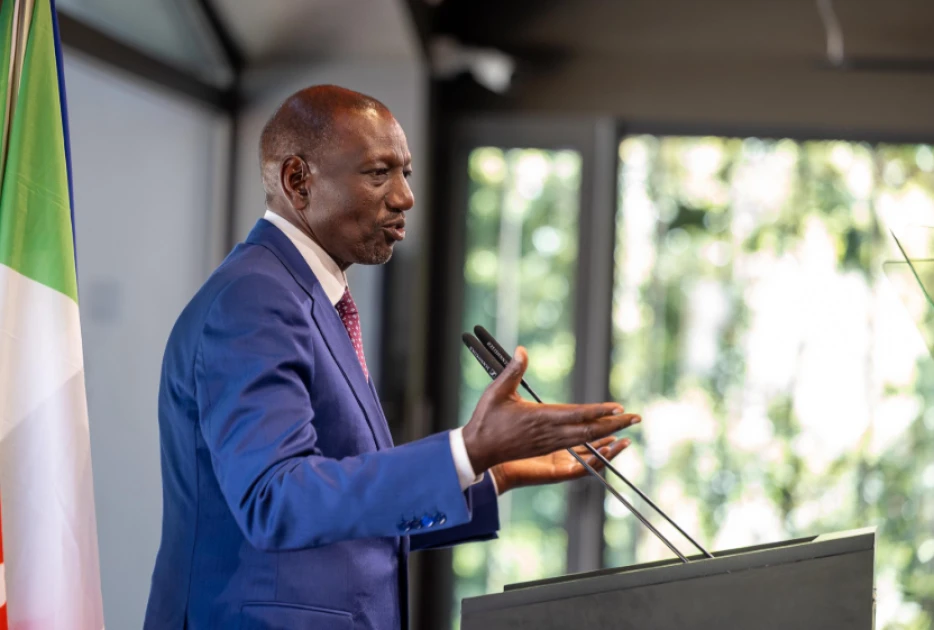
President William Ruto delivers a public lecture at the LUISS School of Government in Rome, Italy, on April 21, 2026. PHOTO | PCS

Audio By Vocalize
President William Ruto delivered a public lecture in Rome,
Italy, on Kenya and Africa's investment possibilities and the place of the
continent in the emerging global order.
Speaking at the Luiss School of Government on Tuesday on the
theme, 'Kenya: A Country Looking Towards the Future', the President said Kenya
is redesigning government systems through digitisation of services in an effort
to make them more accessible, transparent, and responsive.
"For too long, especially in leadership, have tolerated
the average and constrained our ambition. That era has come to an end," he
said.
The President pointed out that his administration is raising
the scale of its ambition, with a clear objective to transform Kenya into a
first-world economy within our lifetime.
He explained that the government is undertaking rapid
expansion of critical transport and connectivity infrastructure, including
roads, rail, airports, and seaports as one of its three critical priority
areas.
Noting that government is also strengthening export-led
agricultural transformation and food security through large-scale irrigation,
he said this would be anchored in the construction of at least 50 mega dams to
bring more than 2.5 million acres of land into productive use.
"Indeed, a key outcome of my visit to Italy is to advance
the development of at least three of these strategic projects," he said.
Additionally, President Ruto said the government plans to more
than triple the country's installed electricity capacity in the next seven
years to uptake modern technology, power industrial growth and sustain economic
expansion.
"Industrialisation requires energy that is reliable,
affordable, and sufficient to match the pace of enterprise," he said.
To deliver on this ambition, President Ruto said Kenya is
adopting innovative financing models anchored in partnership with the private
sector and other investors.
Through the recently established National Infrastructure Fund
and Sovereign Wealth Fund, the President pointed out, Kenya is mobilising
public and private, domestic and foreign capital to finance major priority
projects worth an estimated €33 billion (Ksh.5 trillion).
On the role of Africa in global affairs, the President said
efforts are being made to deepen intra-African trade, expanding manufacturing,
and accelerating value addition across our economies.
"Africa is not merely the next frontier of global trade
and investment; it is one of the defining opportunities of our time," he
said.
Through the African Continental Free Trade Area (AfCFTA)
President Ruto pointed out that Africa is unlocking a single market of 1.4
billion people with a combined GDP of $3.7 trillion.
"According to the World Bank, AfCFTA has the potential to
increase Africa’s exports by over $560 billion by 2035, with substantial gains
in manufacturing and industrial goods," he explained.
For partners such as the European Union, the President pledged
that African growth and expansion
represents a strategic opportunity.
"The EU is already Africa’s largest trading partner,
accounting for up to 30 per cent of total trade, with volumes exceeding €400
billion annually. Yet much of this trade remains concentrated in raw materials,
an imbalance we must urgently address together. Now!" he said.
He lamented that today, manufactured goods account for less
than 20 per cent of Africa’s exports compared to over 70 per cent in more industrialised
regions.
"Across the continent, and certainly in Kenya, we are
investing in industrial parks, special economic zones, and regional value
chains to build a competitive manufacturing base," President Ruto pointed
out.
At the same time, the President revisited his call on the
international financing system, saying it was biased especially in regard to
climate change and action.
He said African countries face disproportionately high costs
of capital not always due to underlying fundamentals, but as a result of
structural biases in global risk assessment.
"Credit rating systems, largely calibrated to advanced
economies, frequently fail to reflect the resilience, growth potential, and
reform trajectories of African markets," he noted.
He noted that institutions such as the World Bank and the
United Nations Development Programme have acknowledged that African countries
and across the Global South often pay significantly higher interest rates than
advanced economies even where debt levels are comparable or lower.
"In times of crisis, we have witnessed abrupt credit
rating downgrades, sometimes preceding actual debt default, triggering capital
flight and further constraining fiscal space. This is not merely a market
outcome; it reflects a deeper structural imbalance.
He said a more just, balanced, and responsive global financial
system reflects not only past performance but also future potential.
"This is not a call for concession. It is a call for
fairness, for accuracy, and for a system that is truly global in both design
and outcome," he said.
Without such reform, President Ruto said, the world risks
perpetuating a cycle in which those who most need capital to grow remain the
least able to access it.
"That outcome is neither sustainable nor just for Africa
or for the world. Nowhere is this imbalance more evident, or more
consequential, than in the global response to climate change," he
explained.
Earlier, President Ruto said Kenya, in collaboration with the
development partners, is investing in knowledge through agreements on higher
education, training, and research.
He said the government is strengthening digital
infrastructure, through the Blue-Raman cable delivered by Telecom Italia
Sparkle, connecting Kenya seamlessly to Europe and Asia.
"We are advancing frontier capability, with the Luigi
Broglio Space Centre evolving into a hub for artificial intelligence satellite
and earth observation. This is a partnership built not merely on intent, but on
delivery," he said.
He made the remarks at 'The Growing Together Through
Partnership: How Venture Capital in Italy and Kenya Can Drive the Next Wave of
Innovation" in Rome on Tuesday.
He said the Nairobi International Financial Centre provides a
clear institutional entry point for global capital.
"Our legal architecture, through investment agreements
and tax treaties, ensures certainty," the President pointed out.
And during a meeting with the International Fund for
Agricultural (IFAD) President Alvaro Lario, President Ruto said the agriculture
sector is critical in securing food security and is the largest employer in
Kenya.
The President thanked IFAD for the institution’s $40 million
(Ksh.5.2 billion) support for the dairy sector.
He also met Italian Chamber of Deputies President Lorenzo
Fontana, with their discussions focusing on strengthening cooperation between
the parliaments of Kenya and Italy.
Join the Discussion
Share your perspective with the Citizen Digital community.
No comments yet
This discussion is waiting for your voice. Be the first to share your thoughts!