
Ruto assents to Tax, KRA Bills targeting fuel prices and revenue governance
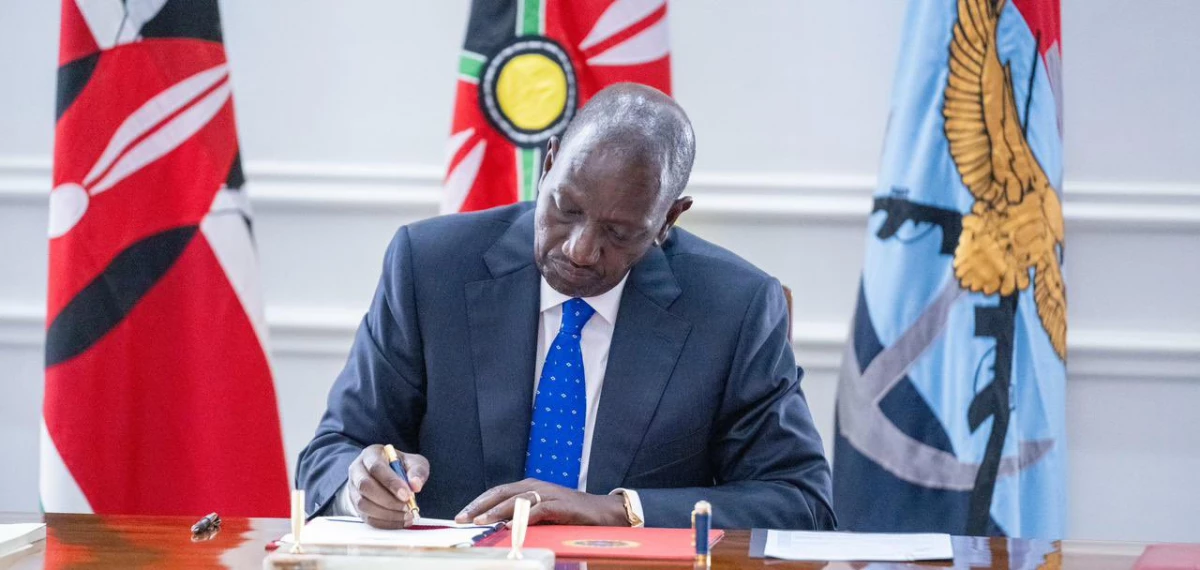
President William Ruto signs into law the Ksh.5 trillion National Infrastructure Bill, 2026, in State House, Nairobi on March 9, 2026.

Audio By Vocalize
Ruto assented to the two Bills at Eldoret State Lodge in Uasin Gishu County on Friday, October 16, 2026, following their passage by the National Assembly.
The Tax Laws Amendment Bill retains the eight per cent VAT rate on petrol, diesel and paraffin for an initial 90 days, with provision for a further 90-day extension through a Gazette notice by the Cabinet Secretary for the National Treasury.
Briefing the President, Deputy Chief of Staff Josephat Nanok said the measure was intended to cushion Kenyans from the effects of disruptions in the international oil market linked to the Middle East crisis.
“The Bill first sustains the 8 per cent VAT application on petroleum products, that is, petrol, diesel, and paraffin, to ensure that the effect of the crisis that has been seen in the part of the Middle East does not affect the Kenyan economy without the public being cushioned,” Nanok said.
Nanok added that consultations with the Energy and Petroleum Regulatory Authority (EPRA) and the Ministry of Energy had ensured the reduced rate was factored into fuel price calculations.
"Had that 8 per cent not been factored, the price of fuel announced by EPRA was going to be higher than announced,” Nanok said.
The legislation also changes excise duty on tiles to Ksh.400 per square metre, replacing weight-based taxation, and reduces duty on ceramic sanitary ware, including sinks, from Ksh.50 to Ksh.30 per kilogramme.
It also revises the description of imported flat glass to align with East African Community (EAC) protocols.
The Kenya Revenue Authority (Amendment) Bill revises provisions governing KRA’s board composition and membership.
It removes the “ex-officio member” designation from provisions covering specified government officials and provides for the managing director of the Kenya Ports Authority (KPA) to join the KRA board.
“It therefore brings the managing director of KPA into the board so that that relationship is sustained and decisions made in KRA are also felt at the port,” Nanok said.
The amendment also provides for KRA to receive at least two per cent of its estimated annual revenue collections, as reflected in the financial estimates, and updates the list of laws administered by the Authority.
The changes are intended to cushion consumers against fuel price pressures, ease some construction costs and strengthen coordination between revenue collection and port operations.
Join the Discussion
Share your perspective with the Citizen Digital community.
No comments yet
This discussion is waiting for your voice. Be the first to share your thoughts!