
Prize money 'critical' for athletics, says World Athletics boss Coe
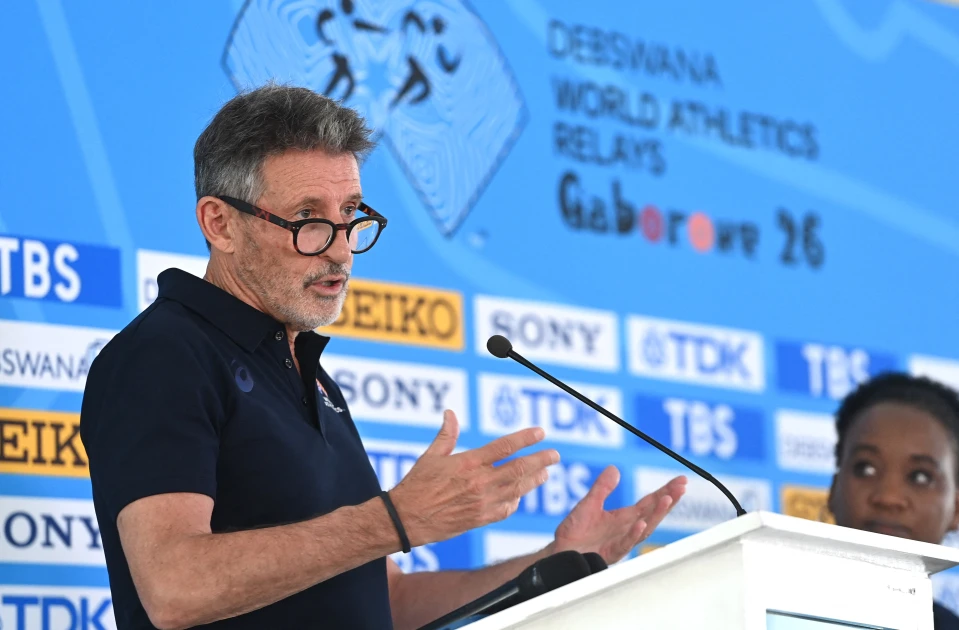
World Athletics President Sebastian Coe speaks to the media ahead of the Gaborone 26 World Athletics Relays in Gaborone on May 1, 2026. (Photo by AFP)

Audio By Vocalize
Two years ago, World Athletics announced that winners in the French capital would each receive $50,000, the governing body becoming the first international federation to introduce such prize money.
The unilateral decision sparked a backlash.
Although the move was widely welcomed by athletes, the hierarchy of the International Olympic Committee (IOC) and other federation chiefs argued that it broke with the tradition of the Olympic spirit.
"Prize money for the Olympics is probably why I'm sitting here talking to you and not in (IOC headquarters in) Lausanne," Coe joked Friday.
The 69-year-old Briton who won two Olympic 1,500m golds stood in last year's IOC presidential election won by Kirsty Coventry, who happens to be an opponent of prize money at the Olympics.
The IOC, though, in June announced a $10,000 grant ('Fit for the Future Olympian Grant') for which "every athlete at the Olympic Games will be eligible".
Coe announced in 2024 the creation of the World Athletics Ultimate Championships, a new three-day biannual global event with the first edition to be held in Budapest next month.
It boasts a $10million (£7.5m) prize pot.
"I've always believed in prize money," Coe told journalists on the sidelines of the European Athletics Championships.
"The importance of prize money is critical.
"My view has always been that we talk about athlete welfare, and quite rightly, we talk about physical welfare, we talk about mental welfare.
"We should, but those two are often inextricably underpinned by financial welfare because that financial welfare often gives you the peace of mind to continue to train and want to be involved in a sport that's not putting undue stresses and strains on families and friends' networks."
-No big 'philosophical divide'-
Prize money, Coe argued, "allows you to maybe pause, to contemplate properly the next move when your career actually does come to an end".
"We talk about prize money as though it's some sort of big philosophical divide. It's not.
"It practically supports the welfare of the athletes and the ecosystem, which is the support, the sport.
"I've never benchmarked my views about that on other sports because I've held those views for 50 years and I'm too old to change."
Coe said that World Athletics had consistently increased prize money at world championships and leapt on the chance to shake things up for the Ultimate Championships.
"I said if we're going to do something different, let's make it feel different for the athletes," he said.
"And prize money, the $10 million prize pool, was important."
One change from the Olympic prize money is that each athlete competing in Budapest between September 11-13 "will leave with some financial reward".
"It won't be the winners' total, but there are 16 competitors in the track events, and every one of them will leave with something from that championship," said Coe.
Join the Discussion
Share your perspective with the Citizen Digital community.
No comments yet
This discussion is waiting for your voice. Be the first to share your thoughts!