
Paris Olympics promise climate action, experts remain sceptical
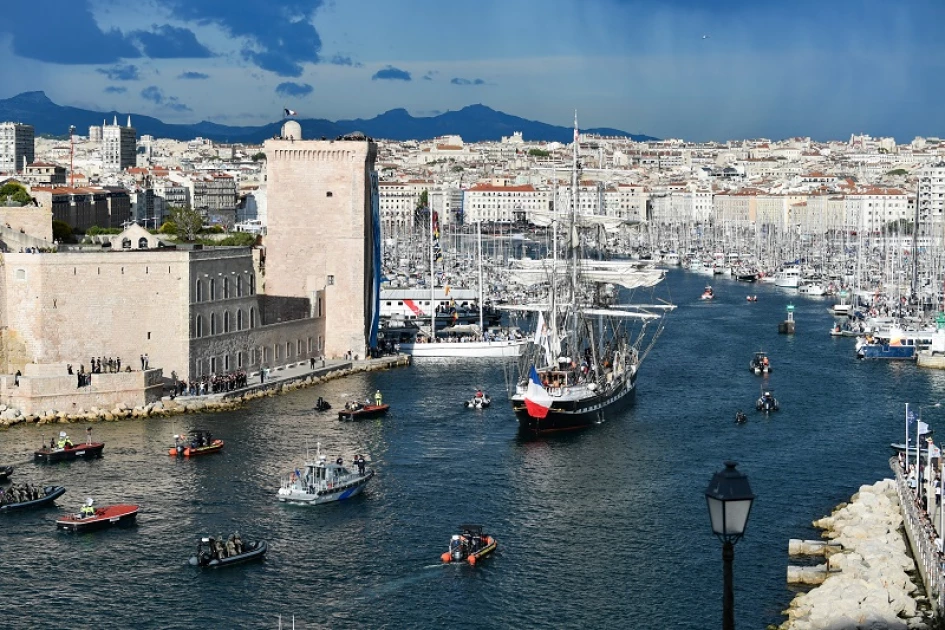
(FILES) French 19th-century three-masted barque Belem (C) sails past the Fort Saint-Jean (L), as it arrives at the Vieux-Port (Old Port) during the Olympic Flame arrival ceremony, as part of its journey ahead of the Paris 2024 Olympic and Paralympic Games, in Marseille, southeastern France, on May 8, 2024. After the Greeks, a sardine, the Count of Monte Cristo and more recently the flame in Marseille aboard the Belem, the harbor of Marseille will host the sailing events of the Paris Olympic Games this summer. (Photo by Sylvain THOMAS / AFP)

Audio By Vocalize
Organisers of the 2024 Paris Olympics promised to take
"unprecedented" action for the climate by halving the carbon
footprint of previous Games and financing projects to reduce planet-heating
greenhouse gases.
But experts remain sceptical, especially after organisers dropped
a pledge to set a hard limit on its overall carbon cost.
About one-third of the heat-trapping emissions from the three-week
spectacle is expected to come from transport, with millions of athletes,
spectators, staff and journalists flying into Paris.
Organisers opted mostly for pre-existing or temporary infrastructure
to host the event, avoiding the significant environmental cost from
carbon-intensive building materials like concrete and steel.
But the Games' sustainability credentials took a hit when an
initial commitment to set a definite ceiling on emissions at 1.58 million
tonnes of CO2 equivalent was dumped.
"The quantified target, which was the big step forward
compared to previous Games and was announced with great fanfare, has been
abandoned," said Martin Muller from the Institute of Geography and Sustainability
at Lausanne University.
"Without a quantified goal, there is no verifiable
obligation."
Organisers instead promised that the Olympics would emit half the
average emissions of the 2012 and 2016 Games in London and Rio de Janeiro -- an
amount Muller said would be 3.9 million tonnes of CO2.
Paris 2024 could "emit 1.95 million tonnes and still say they
have achieved their objective" despite "an increase of more than 20
percent compared to the initial target," he said.
- Climate contribution -
Organisers said the Games would make a "positive contribution
to the climate" through the purchase of carbon credits, which offset
pollution by funding projects that reduce or avoid greenhouse gas emissions.
This language was also criticised and amended, and organisers now
say the Games will "support climate contribution projects that cut and
capture CO2 at levels which match the Games' emissions that can't be
avoided".
This could include projects which protect forests, plant trees or
roll out renewable energy, organisers said, without providing further details.
"Framing their investments in credits as 'climate
contribution' not offsets is a great way to stay honest about an organisation's
own footprint while supporting and financing progress to global net zero
goals," said Kaya Axelsson from the Smith School of Enterprise and the
Environment at the University of Oxford.
Benja Faecks from Carbon Market Watch, a nonprofit industry
watchdog, also said that amended phrasing "doesn't mislead the public into
believing that the Games have no impact on the climate".
"Carbon credits should be used to support projects that are
worth financing, but never to 'compensate for emissions'," he said.
Carbon Market Watch previously found that the Games' climate
strategy was "incomplete and falls short of achieving transparency",
citing the lack of detailed methodologies and monitoring.
- 'Unjustified plastic pollution' -
Activists have voiced concern about the level of plastic waste
during the Games, and the involvement of major corporate sponsor Coca-Cola.
Under pressure, organisers said an estimated 9.6 million drinks
would be distributed from fountains or glass bottles, 6.2 million poured into
reusable cups, and 2.2 million recycled plastic bottles given to athletes.
France Nature Environnement (FNE), a network of advocacy groups,
accused Coca-Cola of "unjustified plastic pollution" and attacked
plans to pour drinks from recycled plastic bottles into reusable plastic cups
as "subterfuge".
"Recycling is not the solution: Coca-Cola should have reduced
its plastic," Axele Gibert, of FNE, told AFP.
In 2023, Coca-Cola topped a ranking of brands responsible for the
worst plastic pollution carried out by NGO Break Free From Plastic, based on an
audit of waste collected by volunteers in 41 countries.
- Greener Games -
Researchers like Muller have proposed solutions to make the
Olympics more sustainable.
"First, greatly reducing the size of the event; second,
rotating the Olympics among the same cities; third, enforcing independent sustainability
standards," he co-wrote in a study published in Nature Sustainability in
2021.
To limit air travel, NGO The Shifters proposed to "maximise
in future the sale of tickets to local spectators and those coming from
neighbouring countries, whose journeys are less emission intensive".
This
could be coupled with "decentralised fan zones managed by the organising
country and located in different continents to welcome spectators travelling
shorter distances".
Join the Discussion
Share your perspective with the Citizen Digital community.
No comments yet
This discussion is waiting for your voice. Be the first to share your thoughts!