
OPINION: Why Kenya must stop treating oral health as an afterthought
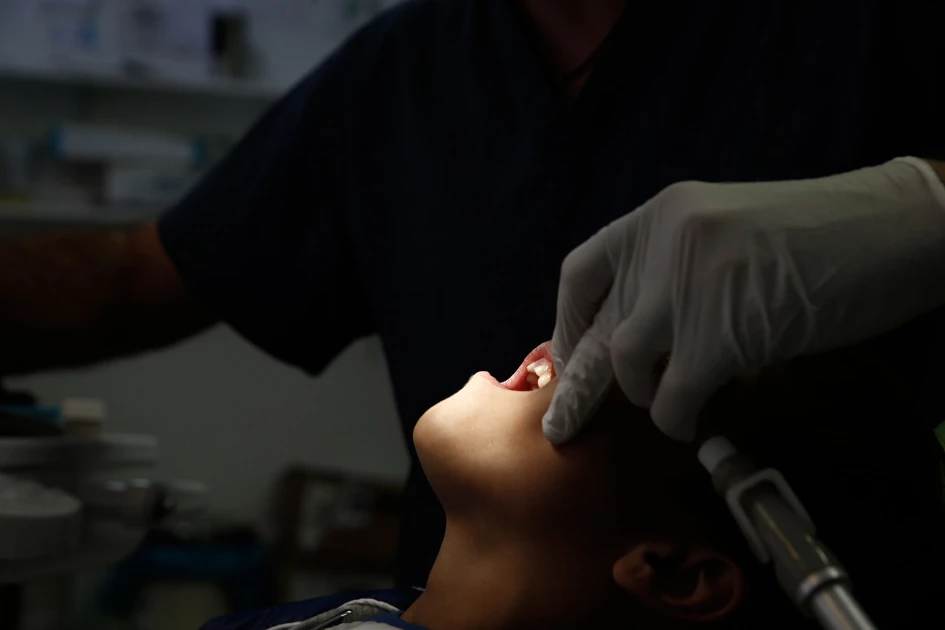
Dentist Christos Naoumis treats a young boy at a Doctors of the World clinic in central Athens last week. The medical humanitarian group helped 7,754 children with free dental care last year. REUTERS/Alkis Konstantinidis

Audio By Vocalize
Kenya is pursuing one of the most consequential health system transformations in decades: expanding primary healthcare, strengthening community-level prevention, and redesigning health financing around Universal Health Coverage.
So, it's worth asking an uncomfortable question: Why does oral healthcare still sit largely at the margins of this transformation?
Not because oral disease is uncommon. Quite the opposite.
In Kenya, the first National Oral Health Survey revealed an
equally troubling picture. Periodontal disease affected 98.1% of adults, dental
caries affected 34.3% of adults, while dental fluorosis affected more than 40%
of children.
Oral healthcare is not niche because oral disease is rare. It
has become niche because our health system has historically organised, financed
and delivered it that way.
Oral diseases share important risk factors with major non-communicable diseases, while the management of patients living with diabetes, cardiovascular disease, renal disease and cancer can require close coordination between medical and dental teams.
Kenya's own policy framework recognises this. The Kenya National Oral Health Policy 2022–2030 acknowledges the limitations of managing oral health in isolation and calls for its integration into non-communicable disease programmes, primary healthcare and Universal Health Coverage.
The problem, therefore, is no longer principally one of policy
recognition. It is one of implementation and health-system design.
Most common oral diseases are largely preventable, and many
can be managed relatively simply when detected early. Yet preventive and
promotive oral-health programmes remain limited, while much of our interaction
with patients occurs after disease has already become symptomatic.
The result is predictable.
An adult delays treatment because there is no accessible
service nearby or because the immediate out-of-pocket cost is unaffordable. By
the time that patient eventually presents, treatment is more complex and often
more expensive.
This is not merely a clinical problem. It is an inefficient
way to purchase healthcare.
A health system that spends too little identifying and managing preventable disease early inevitably creates greater demand for curative and rehabilitative care later.
That should concern not only dentists, but also government, the Social Health Authority, insurers, employers and every institution attempting to control healthcare expenditure.
The infrastructure available to respond to this burden remains inadequate. The 2023 Kenya Health Facility Census found that only 13% of health facilities provided dental services, with substantial gaps particularly in rural and primary healthcare settings.
The Ministry of Health has also reported a
dentist-to-population ratio of just 0.27 dentists per 10,000 people.
And the problem is not simply the absolute number of oral-health professionals. It is also where they are located, how facilities are equipped and where oral healthcare sits within the referral system.
The greatest opportunity for prevention exists at the community and primary-care level. Yet this is precisely where access to oral healthcare remains weakest.
The consequence is a system in which many patients bypass
prevention altogether and enter the oral-health system when they already
require curative treatment.
The ongoing transformation of Kenya's health-financing architecture provides an opportunity to reconsider what constitutes essential healthcare. Oral health should be part of that conversation.
The Ministry of Health has already indicated that oral-health benefits under the Social Health Authority are under review as part of efforts to improve access through UHC.
The question should not simply be whether SHA can afford to cover dentistry. A more useful question is: What package of oral-health interventions can Kenya afford not to provide?
There is an important distinction between attempting to finance every possible dental procedure and defining a cost-conscious essential oral-health benefit.
Kenya needs a baseline package that prioritises prevention, early diagnosis and essential treatment and that is available to the general population, rather than oral healthcare being predominantly dependent on a patient's ability to pay out of pocket.
The package can be phased according to available resources.One rational starting point would be children. A paediatric essential dental benefit could prioritise screening, prevention, early management of dental caries and treatment of common childhood oral conditions.
That financial protection should operate alongside
school-based oral-health education and screening.
Expanding dental benefits, however, will achieve little if
oral healthcare continues to operate as an isolated vertical service.
Consider maternal and child health. A pregnant woman already attending an antenatal clinic should have access to basic oral-health education and screening, with clear referral pathways where treatment is required.
When parents bring children for immunisation and routine child-health services, those encounters provide an opportunity to discuss sugar exposure, feeding practices, toothbrushing and early childhood caries.
The same logic applies to NCD clinics. Patients receiving care for diabetes, renal disease, cardiovascular disease and cancer should have appropriate oral-health screening and referral pathways embedded within their care.
Schools offer another existing platform for prevention,
education and early identification.
Community Health Promoters are already entering households, collecting health information and linking communities to care through the electronic Community Health Information System.
Oral health should ride on that infrastructure rather than attempt to recreate it.
Community Health Promoters do not need to become dental practitioners. They need the capacity to deliver basic oral-health promotion, identify obvious disease and red flags, and refer patients appropriately.
The data they collect through eCHIS should then do more than
populate dashboards. It should tell counties where disease is occurring, where
services are absent and where resources should be deployed.
There is, however, an obvious limitation. There is little value in identifying disease at household, school or primary-care level if the referral facility has no dental professional, no functioning dental unit or no materials with which to treat the patient.
National and county governments need clear and predictable oral-health budget allocations. Facilities need appropriate equipment and supplies. The oral-health workforce — including dentists, community oral health officers and dental technologists — needs to be deployed according to service needs and levels of care.
Health facilities should also be encouraged to use available facility financing mechanisms appropriately to meet recurrent costs associated with providing oral healthcare, while governments address the capital investment necessary to expand capacity.
The private sector has an equally important role.
Strategic purchasing, contracting, and public-private collaboration could allow existing capacity to contribute more effectively to population oral-health needs rather than requiring government to replicate every service itself.
The question is not who owns the dental chair. The question is whether a Kenyan who needs essential oral healthcare can reach one at the right time and at a sustainable cost.
Dental fluorosis illustrates why the solution cannot reside exclusively inside dental clinics.
In some Kenyan communities, excessive fluoride exposure remains a significant public-health problem. By the time a child presents to a dentist with established fluorosis, the opportunity for primary prevention has already passed.
Addressing the underlying problem requires collaboration between health authorities, county governments, the water sector and other stakeholders to strengthen surveillance and develop appropriate water interventions in affected communities.
The same principle applies across oral health. If we wait for every problem to reach the dental chair before we intervene, we have intervened too late.
Kenya does not suffer from an absence of policy intent.
We have public dental facilities, a significant private dental sector, insurers and an evolving social health insurance system.
In other words, many of the pieces already exist.
The next phase of oral-health reform should therefore be judged not by how many stand-alone dental initiatives we create, but by how effectively oral health becomes embedded within the systems Kenya is already building for UHC.
That means moving prevention closer to households.
Ultimately, this debate is about much more than dentistry. It
is about what we mean when we say Universal Health Coverage.
A child unable to concentrate in school because of dental pain
has a health problem.
For too long, oral healthcare has occupied the margins of our
healthcare system despite an enormous burden of disease.
The mouth was never separate from the body. It is time our
health system stopped treating it as though it were.
[The writer is a dental surgeon and
healthcare management consultant.]
Join the Discussion
Share your perspective with the Citizen Digital community.
No comments yet
This discussion is waiting for your voice. Be the first to share your thoughts!