
OPINION: Why FKF must convene AGM amid league kick off standoff
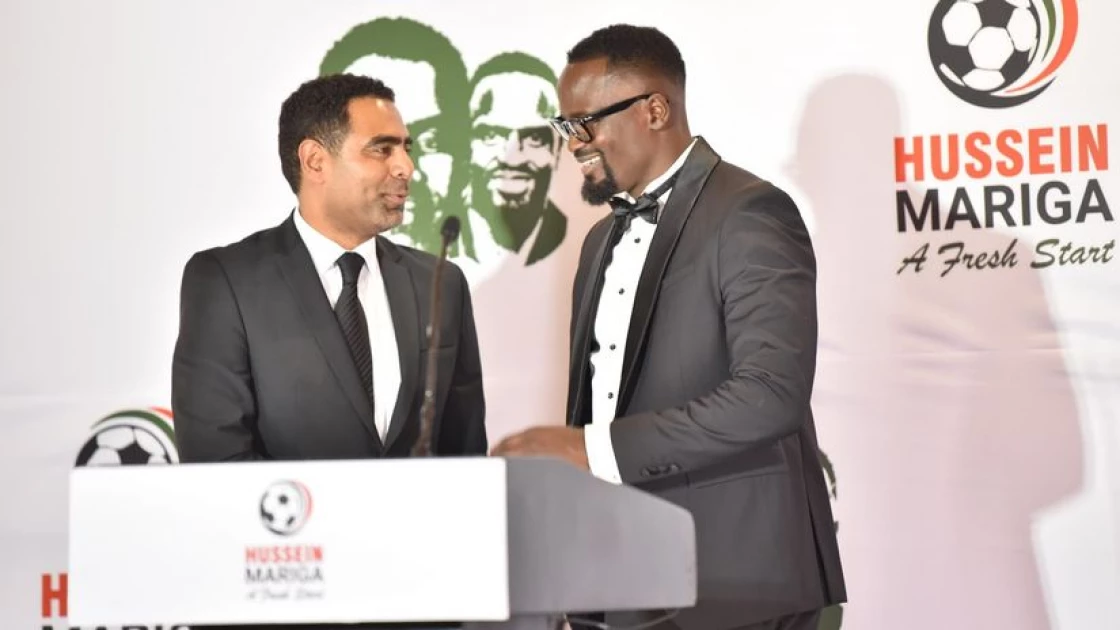
FILE: Hussein Mohammed (L) and McDonald Mariga during a campaign event under the tag Fresh Start in the run up the the 2024 FKF elections.

Audio By Vocalize
The dark clouds of administrative paralysis have once again
gathered over Kenyan football. For the second time in three weeks, the kickoff
of the 2026/27 SportPesa Premier League season was halted at the eleventh hour.
As the Federation’s President, Hussein Mohammed, addressed
during his press conference in Nairobi on Monday, conflicting court orders
originating from Murang’a, Milimani, and Kiambu have frozen the domestic
calendar over the contentious promotion-relegation standoff involving
Kariobangi Sharks and Mombasa United.
Amid the finger-pointing between Kandanda House and
disgruntled clubs, one stark reality remains overlooked: The Football Kenya
Federation (FKF) has not held an Annual General Meeting (AGM) since May 2025.
While Mohammed defends his record by citing informal
"Kamukunjis," political consultations, and roundtables with
stakeholders, the institutional vacuum created by the absence of a supreme
governing body is precisely what has left Kenyan football exposed to endless
civil litigation.
To break the deadlock and prevent a total breakdown of the
game ahead of AFCON 2027, FKF must urgently convene a formal, constitutionally
compliant AGM.
Addressing the press following the latest postponement,
Mohammed rejected accusations of institutional inertia, pointing to his
persistent attempts to bring warring factions to the negotiating table.
Responding to a question by Mike Okinyi over what was so
difficult convening meetings with his National Executive Committee, Mohammed
was blunt, claiming he had tried to do so “four times” but the members were
“not willing to sit at the table."
“I have convened several times; I have sat down with the
government, with FIFA, with CAF, and with the members in previous meetings to
articulate and discuss those matters.”
Mohammed insists he remains open to mediation from other
parties as long as they follow the correct legal procedures within the statutes
of FKF.
I'm still open to
more routes, more conversations, and more discussions. The doors are not
closed... But at the same time, you cannot be held hostage indefinitely on
certain key issues.”
While the president's willingness to consult is noted, his
reliance on informal gatherings and executive summits misdiagnoses the disease.
Informal roundtables and "Kamukunjis," as he
described a meeting initially convened to oust him last April, do not carry
binding statutory weight.
Under the FKF Constitution, policies governing league
structures, rules, and executive appointments cannot be validated through
informal consensus; they require the explicit, ratified approval of the
congress—the supreme legislative organ of Kenyan football.
Because the FKF has gone nearly 16 months without an AGM,
every major administrative policy, from the controversial 2025 relegation rules
scrapping playoffs to the expired mandate of Acting CEO Dennis Gicheru, remains
legally vulnerable to challenge in civil courts.
While FKF's executive sought to enforce the 2025 rules,
claiming clubs acquiesced to them all season, aggrieved parties challenged the
move in court, arguing the 2025 changes were never lawfully communicated or
ratified before the season began. High Court orders subsequently halted the
2026/27 season until the promotion/relegation dispute was determined.
In a hard-hitting press statement released on September 22,
2026, members of the FKF National Executive Committee (NEC) explicitly broke
ranks with President Hussein Mohammed.
The NEC members insisted that the 2026/27 season must
commence under the 2019 FKF Rules and Regulations, strictly honoring court
directives that demand the implementation of the prescribed
promotion-relegation playoffs.
Because the 2025 regulations were never formally presented
to and adopted by the congress, their legal enforceability remains fragile. An
immediate AGM is the only bulletproof platform to formally table, deliberate,
and vote on the binding league rules for the 2026/27 season.
Establish an unassailable, legally sound consensus on
promotion and relegation criteria and strip civil courts of the jurisdiction to
issue injunctions based on procedural nullities.
Understanding the Kariobangi Sharks 2019 vs. 2025 Rules
Loophole
At the center of the current league postponement is a legal
quagmire: Did the FKF lawfully replace the 2019 Rules (which mandate a playoff
between the 16th-placed Premier League team and the 3rd-placed NSL team) with
the 2025 Regulations (which enforce direct relegation for three teams)?
Because the 2025 rule changes were passed by the National
Executive Committee (NEC) but never formally presented to and adopted by a
supreme AGM, aggrieved clubs like Kariobangi Sharks, who happen to be owned by
immediate former FKF boss Nick Mwendwa, successfully argued in the High Court
that the rules were procedural nullities.
President Mohammed rightly noted that football disputes
should be resolved within football's structures rather than civil courts.
However, clubs are flooding civil courts precisely because FKF’s internal
judicial structures are currently non-existent.
As highlighted by the recent circular from NEC members, the
federation currently operates without a functioning Disciplinary Committee,
Ethics Committee, or Appeals Committee.
Under Article 30 of the FKF Constitution, members of these
independent judicial bodies can only be elected or ratified by the General
Assembly during an AGM.
Until an AGM is convened to officially install these bodies,
clubs have zero internal recourse for grievances, making civil court
injunctions their only operational option.
The lack of an AGM has extended beyond league rules into
executive operations. The recent petition by NEC members challenging the legal
standing of Acting CEO Dennis Gicheru—whose six-month acting tenure officially
expired without NEC or AGM extension—underlines the crisis of governance. This
is especially as former CEO Harold Ndege took the federation to court over what
he believes was enforced removal from his office.
Furthermore, following FIFA’s May 25 directive emphasizing
strict compliance with Article 41 regarding executive appointments and
suspensions, the federation cannot afford to run on ad hoc extensions.
An AGM allows the assembly to exercise its constitutional
duty to review executive appointments, adopt audited financial statements, and
restore institutional order.
President Mohammed’s assertion that "we cannot operate
as if we're in a jungle” back in April and that “we must be law-abiding
citizens within the confines of our rules, statutes, and the laws of the
country" is correct.
But the rule of law in football begins with constitutional
compliance at home. Relying on FIFA's backing to stave off executive ousters
while ignoring the mandatory statutory requirement for an annual general meeting is unsustainable.
The High Court injunctions paralyzing the league are merely
symptoms; the root cause is a year-long governance void, especially with AFCON
2027 which Kenya will co-host alongside Tanzania and Uganda around the corner.
If FKF sincerely wishes to unlock the 2026/27 season,
protect sponsors, and save Kenyan football from death by a thousand court
injunctions, President Hussein Mohammed must move past informal roundtables and
issue an immediate formal notice for an Annual General Meeting. Only the
General Assembly can restore order to Kandanda House.
The views expressed in this report are based on court
filings, official FKF circulars, and historical governance statutes and do not
necessarily reflect the position of Royal Media Services.
Join the Discussion
Share your perspective with the Citizen Digital community.
No comments yet
This discussion is waiting for your voice. Be the first to share your thoughts!