
OPINION: Why Africa’s Climate story is not resonating, and what we can do about it
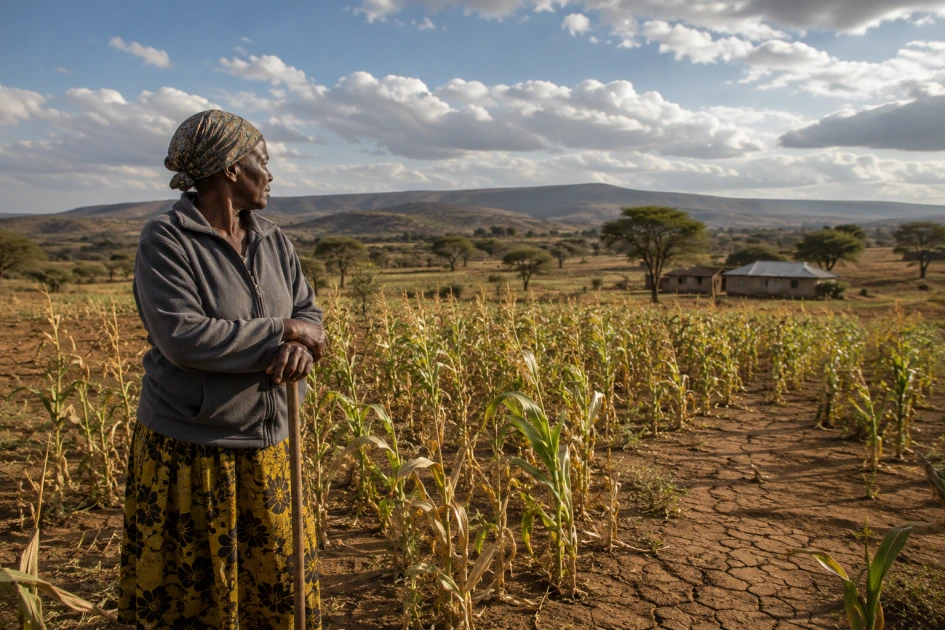
This image was generated using artificial intelligence for illustrative purposes. It does not depict the actual individuals, location, or events described in this article.

Audio By Vocalize
My grandmother farms in Kithangathini, in Ukambani. Last season she harvested one bag of maize. She used to harvest five.
I was there last weekend, wearing a jacket most of the day. That part is normal enough; this is our cold season. What's no longer normal is almost everything else. The rains have stopped keeping time. She planted, as she always has, and the season didn't hold up its end of the bargain. Now she tells me she doesn't know whether the next rains will come as expected. Neither do I. Even with better forecasting, certainty is becoming harder to come by.
In Swahili, we have a whole vocabulary for this. Mvua. Jua. Masika, the season of long, steady rains. Vuli, the short rains. Kiangazi, the dry stretch. Msimu wa baridi, the cold season we're in now. It's a calendar, and generations of farming decisions were built on it. My grandmother still plants by it, but the calendar has stopped keeping its word.
I started out my career in a Kenyan newsroom. For most of the decade since, I've communicated climate and sustainability work across Africa and beyond, working with organisations focused on carbon markets, conservation and nature finance. That experience has convinced me that some of the most significant climate work happening anywhere in the world is happening here in Africa.
But try this. Ask your friends what a carbon credit is. Most people I ask have heard of them. Very few can explain what they are, who pays for them, or who ultimately benefits. These are informed, connected people in Nairobi. Move closer to the places where these projects actually operate, and it doesn't improve. Understanding gets more scarce.
The documents that govern these projects sit in English, filled with terms like “additionality” and “verification” that have no easy equivalent in most of our languages. Communities are consulted at the start, when signatures are needed, and then the communication largely stops. What remains is what people can see: a company arrived, money changed hands, and somewhere far away, something is being bought and sold in their forest's name. The mechanism, which is the thing their trust is meant to be anchored on, stays invisible.
That gap should worry all of us. Carbon markets depend on the confidence of the communities that host them. Conservation succeeds only with the goodwill of the people living beside forests, rivers, and rangelands. Climate finance is justified, in every glossy report, by its benefits to communities.
Yet the stories about this work are rarely written for those communities. They're written for funders, regulators and international audiences, in a language that means little to my grandmother in Kithangathini, Makueni County.
When the story travels up but never comes back down, two things happen. First, the people the work is meant to benefit become sceptical because nobody has taken the time to explain it clearly, and they stop trusting it. Second, the wider public hears ambitious claims they struggle to connect to anything tangible and gradually stops believing them. That’s the credibility gap, and it’s growing. It's caused by communication that doesn't reach and doesn't respect the people the work depends on.
So, what does better look like?
In my opinion, it starts with plain language. If a project can't be explained to the community hosting it, in the language they speak at home, that's not a translation problem; it's a design problem.
It also means telling stories with communities rather than about them, so the farmer, the warden or the fisherman is the narrator instead of the backdrop. And it requires matching every claim to the evidence. In this sector, the story should never arrive before the proof.
None of this is charity. It's good strategy. The organisations that communicate honestly, transparently and locally are the ones most likely to retain public confidence when scrutiny comes. And it is coming.
My grandmother doesn't need a whole 90-minute webinar on climate resilience. She needs the rains. Until they steady, she deserves to understand the work being done in her name, explained in a way that respects her knowledge and her stake in the outcome.
Because she does matter.
She's not the case study in Africa's climate story. She's the audience.
The work happening across Africa is real. Much of it is innovative, necessary and genuinely impactful. It’s time the storytelling caught up.
Trevor Kombo is the founder of Pooch Communications, a Nairobi-based strategic communications studio working in climate, nature and sustainability storytelling.
Join the Discussion
Share your perspective with the Citizen Digital community.
No comments yet
This discussion is waiting for your voice. Be the first to share your thoughts!