
Violations against migrants continue in the Arabian Peninsula
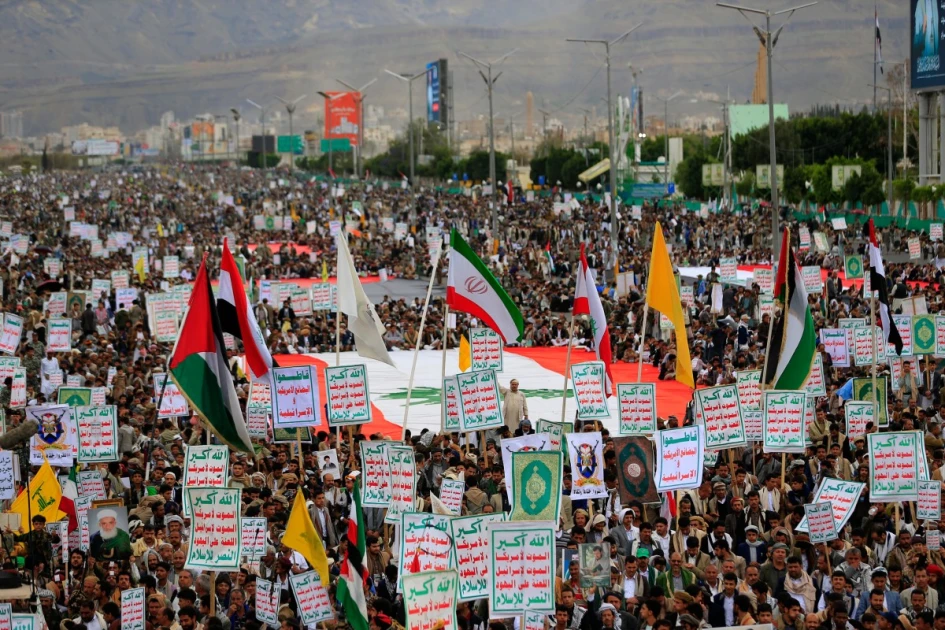
Hundreds of supporters of the Iran-backed Houthi movement brandish their weapons, banners and flags as they rally in solidarity with Iran and Lebanon in the Yemeni capital Sanaa on April 17, 2026.

Audio By Vocalize
In February, Human Rights Watch called for the establishment of an international monitoring mechanism to report deaths, enforced disappearances, torture, and grave human rights abuses committed against migrants across international borders, citing as an example the situation along the Saudi–Yemeni frontier.
The report stated that “the mass killings committed by Saudi Arabia against Ethiopian migrants on the border with Yemen are a clear example of this type of abuse.” It added that despite Ethiopia’s announcement of a joint investigation with the Saudi government into the killing of its migrant nationals at the Saudi border, and the intervention of the United States and Germany to end training programs and financial assistance to Saudi border guard forces, the crisis persists.
The international rights organization noted that since 2023—when one of the largest incidents of mass killings by Saudi border guards against migrants took place—monitoring of the situation along Saudi Arabia’s southern border has become extremely limited. The organization affirmed that it has received reports confirming the “continuation of killings along the Saudi border.”
Many migrants seek to reach Saudi Arabia via maritime routes or through Yemen, arriving from the Horn of Africa. The organization indicated that the number of African migrants more than doubled between 2024 and 2025.
A Massacre by Saudi Gunfire
The American newspaper The New York Times revealed one of the largest mass killings of migrants on August 6, 2023, citing U.S. diplomats who confirmed that Saudi border guard forces used “lethal force against African migrants attempting to enter the Kingdom of Saudi Arabia from Yemen.”
U.S. officials obtained additional information from United Nations officials indicating that Saudi security forces opened fire on migrants and shelled them collectively, and mistreated those who fell into their custody, resulting in numerous deaths and injuries, according to U.S. officials speaking to the newspaper.
The report documented the killing of “hundreds, perhaps thousands, over a 15-month period ending in June 2023,” according to The New York Times and Human Rights Watch. At the time, the U.S. Deputy Representative to the United Nations, Richard Mills, commented: “We are concerned about abuses against migrants on Saudi Arabia’s border with Yemen.”
Mills urged that UN investigators be granted access to both sides of the border to conduct a thorough investigation into the mass killing of African migrants, most of them Ethiopian. The U.S. State Department also disclosed that it had “become aware of specific allegations against Saudi Arabia through the UN High Commissioner for Human Rights regarding abuses against migrants.”
In a statement, the State Department said: “The United States moved quickly to engage with senior Saudi officials to express Washington’s concern,” and to convey its apprehension over this type of human rights abuse against migrants. Numerous members of Congress also criticized U.S.–Saudi relations over “the Kingdom’s human rights record, including its years-long war in Yemen,” according to the American newspaper.
The former U.S. ambassador to Yemen, Steven H. Fagin, was briefed on the information confirming abuses against migrants, alongside officials and diplomats from the U.S. State Department and from France, Germany, the Netherlands, Sweden, and the European Union.
Open Killing
The targeting of migrants along Saudi Arabia’s southern border with Yemen is no secret; the wounded and the dead are transported to Yemeni hospitals, and television and print media report on these incidents at the time.
The head of the emergency unit at Al-Jomhouri Hospital in Yemen told the American newspaper: “We are dealing with cases of both dead and wounded on a daily basis coming from the border areas, including women, children, and the elderly,” confirming that the hospital receives an average of four to five cases per day. Some are found unconscious on the roads, while others are brought to the hospital after an arduous 12-hour journey from the border.
Saudi Arabia prevents journalists and media personnel from accessing the restricted border areas where the killings and abuses occur, making the witnessing and documentation of mass killings nearly impossible. However, human rights organizations have documented the threats and abuses faced by migrants from East Africa who cross the Gulf of Aden into Yemen and head north towards Saudi Arabia in hopes of finding work or fleeing political persecution and extreme poverty in their home countries—only to become prey to a machinery of repression and killing at the border.
Bullets Like Rain
Human Rights Watch had preceded The New York Times report by about five days, revealing details of the killings by Saudi gunfire against African migrants at the border, citing testimonies from survivors who said that “bullets rained down on their heads like rain from Saudi forces.”
The organization stated that “Saudi border guard forces killed at least hundreds of Ethiopian migrants and asylum seekers who attempted to cross the Saudi–Yemeni border between March 2022 and June 2023,” affirming that the killings are ongoing.
Witnesses told the organization that “Saudi forces used heavy weapons and fired at people from close range, including women and children.” The report concluded that what occurred constitutes “a completed crime against humanity, carried out within the framework of a Saudi government policy aimed at killing migrants and asylum seekers at the border.”
The “Horn of Africa route” is used for migration from Africa to Saudi Arabia by migrants from Ethiopia, Eritrea, and Somalia. However, according to Human Rights Watch, 90 percent of migrants traveling this route through the Gulf of Aden and Yemen to the Saudi border come from Ethiopia.
The organization indicated that it had verified more than 350 videos and images posted on social media during the period in which the killings and abuses documented at the beginning of the report took place, matching them with satellite imagery across hundreds of kilometers. It confirmed the presence of dead and wounded migrants on roads, in camps, and in medical facilities, documenting this through communication with 42 Ethiopian migrants and their families who had attempted to enter Saudi Arabia from the Yemeni border.
Witnesses reported that Saudi forces bombard migrants at the border with heavy weapons and mortar shells as soon as they approach, with survivors fleeing back to their camps in Yemeni territory, leaving behind bodies or wounded individuals awaiting death.
Other migrants documented that Saudi border guards opened fire at extremely close range on migrants immediately after they crossed the border, using various weapons. In some cases, migrants are questioned about their identity and destination and have information collected from them before being summarily executed on the spot. Another migrant told the organization that “border guards would ask migrants which body part they preferred to be shot in from close range, and then do so.”
A 17-year-old boy recounted that members of the Saudi border guard raped two surviving girls and executed another survivor who refused to comply with their sexual demands, while severely beating other migrants with stones and metal rods.
Join the Discussion
Share your perspective with the Citizen Digital community.
No comments yet
This discussion is waiting for your voice. Be the first to share your thoughts!