
OPINION: The global green transition has a powerful new engine
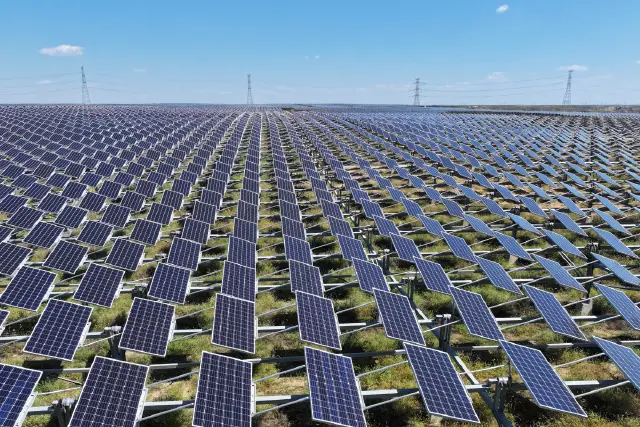
Solar panels are seen at the Yinchuan Fourth Photovoltaic Power Station in the Gobi desert at Yinchuan, in China’s northern Ningxia region on September 22, 2026.

Audio By Vocalize
Climate diplomacy is often measured by promises made at international conferences. Yet the most consequential changes are taking place beyond negotiating halls: in power stations, factories, transport systems and homes.
As temperatures rise and extreme weather pressures economies, the world needs solutions that deliver cleaner energy at scale.
That progress depends on expanding renewable electricity, improving energy storage and making cleaner technologies affordable.
Countries still struggling to provide reliable electricity must power industries, hospitals, schools and homes without locking themselves into costly, carbon-intensive systems.
There is a compelling case for looking beyond national borders when assessing climate progress. A solar panel manufactured in one country can displace fossil-fuel generation in another; a battery developed in one market can help stabilise an electricity grid thousands of kilometres away.
China is central to this transformation. In 2025, it installed 378 gigawatts of solar capacity, representing 58 per cent of global additions.
Its 119 gigawatts of new wind capacity accounted for 72 per cent of the worldwide total, according to Ember. Ember is an energy think tank that aims to accelerate the clean energy transition with data and policy.
These figures reflect an industrial effort on a scale, expanding renewable electricity and helping bring down the cost of equipment needed for the global transition.
The shift is also visible in domestic energy figures. An analysis by the Centre for Research on Energy and Clean Air found that China's carbon dioxide emissions fell by 3.1 per cent in the third quarter of 2026.
Over the same period, electricity generation from wind, solar and nuclear power rose by 110 terawatt-hours compared with a year earlier. That increase was more than twice the growth in total electricity demand and equivalent to Germany's power output over the period.
The significance extends beyond China's borders. Its clean-technology exports are helping other countries generate electricity with fewer emissions, electrify transport and store renewable power.
A Carbon Brief analysis published in October 2026 estimated that Chinese exports of solar panels, batteries, electric vehicles and other clean technologies could avoid about 450 million tonnes of carbon dioxide emissions outside China in 2026 alone, roughly Brazil's annual emissions. It is estimated that equipment exported in 2025 could avoid 6.8 billion tonnes over its lifetime.
For developing economies, these are more than statistics. They represent access to technologies that can make electricity expansion more affordable.
African countries need power for manufacturing, irrigation, hospitals, schools, digital services and households beyond reliable electricity networks.
Solar systems, battery storage and electric mobility can help meet these needs while supporting lower-carbon development.
Kenya illustrates the opportunity. Its geothermal, wind and solar resources provide a foundation for cleaner electricity, but the transition also requires affordable equipment, storage, modern grids and investment.
Chinese-made solar panels, batteries and electric buses can widen the options available to African governments, businesses and households.
The priority is to turn access into local capacity through skills development, maintenance networks, manufacturing partnerships and technology transfer.
Affordable clean energy can lower business costs, improve urban air quality, support agriculture and reduce exposure to volatile fossil-fuel markets.
For countries seeking to industrialise, renewable power is an economic asset as much as an environmental necessity. Partnerships combining investment with local expertise can ensure the transition creates jobs and strengthens domestic industries.
China's contribution should be assessed not only through emissions within its borders, but also through the technologies it makes available internationally.
Its manufacturing capacity and expanding clean-energy market have helped build supply chains that accelerate decarbonisation.
Every country remains responsible for its climate commitments, but access to affordable equipment gives governments additional tools to meet them.
No nation can secure climate progress alone. Governments must invest in resilient infrastructure and cooperate on finance, technology and skills.
As energy demand rises and climate risks intensify, the world should recognise practical progress and expand partnerships that deliver results.
China's clean-energy drive is reshaping what is technically possible and commercially accessible. African countries should approach this moment with purpose: welcoming cooperation, negotiating for local value and ensuring benefits reach ordinary people.
A greener future will be built through cleaner power, less oil-dependent transport, innovative industries and partnerships that make technology accessible.
The transformation offers reason for confidence, but also a responsibility to act. For Africa, the task is to turn the clean-energy shift into reliable electricity, investment and opportunity for its people.
That is how international climate progress becomes meaningful at home for future generations.
The writer is a Journalist and Communications Consultant
Join the Discussion
Share your perspective with the Citizen Digital community.
No comments yet
This discussion is waiting for your voice. Be the first to share your thoughts!