
Kenya, Zimbabwe sign seven agreements to deepen bilateral cooperation

Audio By Vocalize
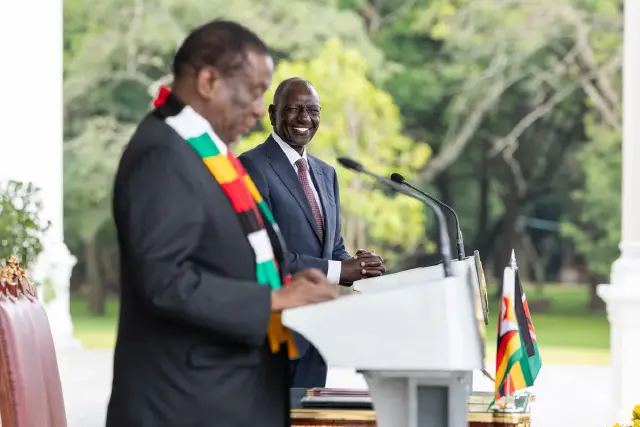
Presidents William Ruto and Emmerson Mnangagwa of Zimbabwe witnessed the signing of the MoUs after co-chairing the inaugural session of the Kenya-Zimbabwe Bi-National Commission at State House, Nairobi, on Friday.
President Mnangagwa is in the country for a State Visit to build on the progress made during President Ruto’s State Visit to Zimbabwe in April 2024.
Among the significant agreements signed was the MoU on Cooperation in the Field of Provision of Affordable Housing and Promotion of Appropriate Building Materials and Technologies.
The agreement will facilitate cooperation in housing provision and the sharing of appropriate building materials and technologies.
The MoU on Immigration Matters seeks to strengthen migration management through information sharing, capacity building and collaboration in addressing irregular migration, human trafficking and migrant smuggling.
Another MoU between the Foreign Service Academy of the Republic of Kenya and the Zimbabwe Foreign Service Institute seeks to enhance diplomatic training, capacity building and the exchange of expertise.
The MoU on Cooperation in the Field of Arts, Culture and Heritage will promote cultural exchange, preserve cultural heritage and deepen mutual understanding between the peoples of the two nations.
Additionally, the MoU between the Zimbabwe Inter-African News Agency and the Kenya News Agency will facilitate the exchange of news and information for publication.
To strengthen economic cooperation, the two countries signed an MoU on Mutual Assistance in Customs Matters to facilitate lawful trade, combat Customs offences and enhance the enforcement of customs laws.
The MoU between the Kenya Export Promotion and Branding Agency and ZimTrade seeks to promote, develop and diversify bilateral trade and expand business opportunities.
President Ruto noted that following the inauguration of the Bi-National Commission, bilateral engagements between Kenya and Zimbabwe would now be conducted at the highest political level.
He said the signing of the seven additional agreements brings the total number of bilateral instruments between the two countries to 24.
The President said the two leaders would meet again in Zimbabwe at a mutually agreed date to assess the implementation of agreements and commitments made during the State Visit.
“Our focus now is implementation. When we next convene in Zimbabwe, we will assess progress in fulfilling today’s commitments and, importantly, their contribution to job creation, agricultural productivity, and commercial opportunities for our people,” he said.
The President said further agreements on extradition, mutual legal assistance, transfer of sentenced persons, prisons and correctional services, energy, maritime affairs and avoidance of double taxation were under negotiation.
“We have instructed our teams to expedite their conclusion,” he said.
He explained that his discussions with President Mnangagwa focused on deepening economic cooperation, building resilience and expanding opportunities for the citizens of both countries.
On trade, President Ruto noted that bilateral trade grew by 63 per cent from $35.3 million in 2024 to $57.6 million in 2025.
“This encouraging growth provides a strong foundation for further expansion, with an estimated $53 million in additional export opportunities,” he said.
He pointed out that Kenya has opportunities to expand exports of processed palm oil, cement clinker and coated iron and steel products to Zimbabwe while Zimbabwe could increase its exports of sugar products and ceramic tiles to Kenya.
The two leaders, he said, also agreed to deepen private sector engagement, address tariff and non-tariff barriers, simplify Customs procedures, facilitate cross-border payments, reduce transport costs, improve trade logistics and harmonise standards.
President Ruto announced that the Kenya-Zimbabwe Business Forum, scheduled for February 2, 2027, in Nairobi would bring together businesses and investors to identify opportunities, establish partnerships and pursue joint ventures.
“We will leverage COMESA, the Tripartite Free Trade Area, and the African Continental Free Trade Area to access wider markets, develop regional value chains and accelerate industrialisation and job creation,” he said.
On agriculture, the President pointed out that the two countries had agreed to collaborate in agricultural production, agro-processing, storage, cold chains and transport to reduce post-harvest losses, enhance food security and increase farmers’ incomes in the face of climate change, droughts and global market disruptions.
In mining, the President said Kenya and Zimbabwe had agreed to cooperate in mineral exploration, technology transfer and processing to retain greater value from their natural resources and accelerate industrial development.
President Ruto said the two leaders also welcomed air connectivity between Nairobi and Harare, as well as Victoria Falls, and committed to closer aviation cooperation to facilitate trade, tourism, investment and people-to-people exchanges.
The President also reiterated the importance of cooperation between the two nations at the multilateral level, saying they had reaffirmed their commitment to African unity, solidarity and integration.
He commended Zimbabwe for supporting the African Union institutional reform agenda, which African Heads of State and Government have entrusted him to champion.
“Our objective is an effective, accountable, and responsive African Union capable of delivering on its mandate,” he said.
On peace and security, President Ruto welcomed Zimbabwe’s election as a non-permanent member of the United Nations Security Council for the 2027-2028 period, noting that it presented an opportunity to advance African-led peace initiatives and secure sustainable support for peace operations on the continent.
He also reaffirmed Kenya’s support for Zimbabwe’s readmission to the Commonwealth and called for the immediate and unconditional lifting of unilateral sanctions imposed on Zimbabwe in line with the African Union’s position.
“These sanctions by Western countries are unfair, unnecessary, and disproportionately affect citizens of Zimbabwe, especially vulnerable sections of society,” he said.
On his part, President Mnangagwa emphasised the need to strengthen economic and trade cooperation between the two countries, particularly by increasing the volume of bilateral trade and investment.
He said Kenya and Zimbabwe would leverage the opportunities presented by the Common Market for Eastern and Southern Africa (COMESA) and the African Continental Free Trade Area.
President Mnangagwa said the two countries had resolved to eliminate tariff and non-tariff barriers to facilitate the seamless movement of people, goods and services and promote cross-border trade and investment.
“Building on the momentum established by the State Visit, Zimbabwe and Kenya are well positioned to deepen relations across a wide range of sectors to ensure shared prosperity for our citizens,” he said.
President Mnangagwa urged Government officials and the private sector to expedite the implementation of the signed agreements to ensure that both countries reap the benefits.
ENDS
Join the Discussion
Share your perspective with the Citizen Digital community.
No comments yet
This discussion is waiting for your voice. Be the first to share your thoughts!