
OPINION: Role of our Security, Intelligence and Defence Forces in securing the Kenya we want to build by 2060
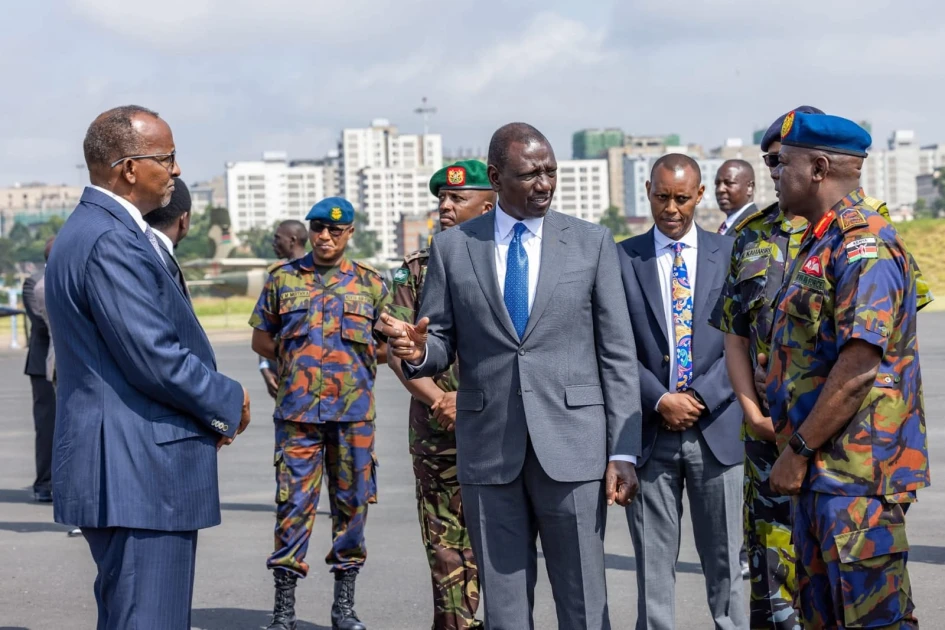
President Ruto with CS Duale, MP Nelson Koech and top KDF officials during the passing-out parade of the first recruits cohort of 2025 at the KDF Recruits Training School in Eldoret, Uasin Gishu County.

Audio By Vocalize
The journey to attaining the Kenya we want post-Vision 2030 has already taken off under the captainship of President William Ruto, and there is no turning back.
Indeed, it was long overdue for Kenya to tap into the immense potential that the future ecosystem offers for the economic transformation of Africa; and the recently unveiled Vision 2060 is the perfect masterplan to attain this.
Allow me, however, to digress a bit, but still in context, to enable me to answer a fundamental and live question that could very well be deemed rhetorical in the Vision 2060 conversation.
How do we secure the Kenya that we embark to build, and should this be embedded in the roll out vision 2060?
The answer is absolutely yes. In fact, President Ruto spoke on this very subject – when he presided over the 46th Kenya Defence Forces (KDF) pass-out parade in Eldoret – in relation to the role of security and defence forces in the roll-out of Vision 2060.
Security and development are not competing forces but complementary priorities in the economic transformation of any progressive society.
Worldwide, security provides a stable environment for development. In contrast, inclusive and sustainable development strengthens the foundations of national security and societal coexistence and provides the perfect climate to attract external players into the market.
You cannot build a world-class infrastructure, attract investment, expand the digital economy and develop such other strategic sectors as the blue economy when your institutions and critical systems are vulnerable to likely disruption.
Incidentally, security and defence systems are equally just as dynamic as the continuously evolving global ecosystems. This is why national security and defence must occupy a central place in this long-term development conversation.
The Kenya of the year 2060 will certainly face threats that extend far beyond the traditional enclaves of our borders, which have traditionally been a central consideration in our domestic security and defence strategies.
With a first-class status economy, we shall need to secure our cyberspace, critical infrastructure, energy, food systems, financial networks, territorial waters, airspace and strategic natural resources among other critical areas.
We are also expected to guarantee the integrity of the technologies and information systems upon which the expanding digital economy will be operating.
Even today, the battlefield itself is changing, if some of the unfolding conflicts in different parts of the globe are anything to go by.
The global battlefield today presents such fresh dynamics as cyber warfare, artificial intelligence, autonomous systems, disinformation and climate-related instabilities.
Others are transnational organised crime and terrorism, which, as we have already witnessed even here in Kenya, are reshaping the global security space.
Not too long ago, the COVID-19 pandemic got the world critically thinking about how to handle biological threats in the event they are unleashed as a weapon of war!
In fact, as has been demonstrated, for instance in the Russia-Ukraine and Iran/US-Iran Conflicts and other previous wars, some of tomorrow’s most consequential attacks across the Globe may not involve a single soldier crossing a border.
It may, for instance, involve the disruption of a power grid, financial system, communications network, port or digital platform.
Our national-security architecture must therefore become more anticipatory; and intelligence will be as important as conventional military and security capability, hence the need for this to feature in the national conversation on Vision 2060.
This requires investment— not simply more money, but smarter and more strategic allocation of resources. Consequently, we shall have to progressively develop domestic capabilities and industries that support our security needs, creating jobs, technological expertise and strategic autonomy in the process.
As Parliament, therefore, and specifically as the Defence, Intelligence and Foreign Relations Committee which I chair, will have to interrogate whether the resources we commit today are building the capabilities Kenya will need tomorrow.
If we get this right, security will not be an afterthought to Vision 2060 but one of the foundations upon which the blueprint will become a reality, and herald Kenya to first-world status. The Singapore dream is real and achievable.
The writer is the Chairperson of the National Assembly Defence, Intelligence and Foreign Relations Committee and the MP for Belgut
Join the Discussion
Share your perspective with the Citizen Digital community.
No comments yet
This discussion is waiting for your voice. Be the first to share your thoughts!