
OPINION: Homa Bay’s dusty roads are not a failure of the Luo community
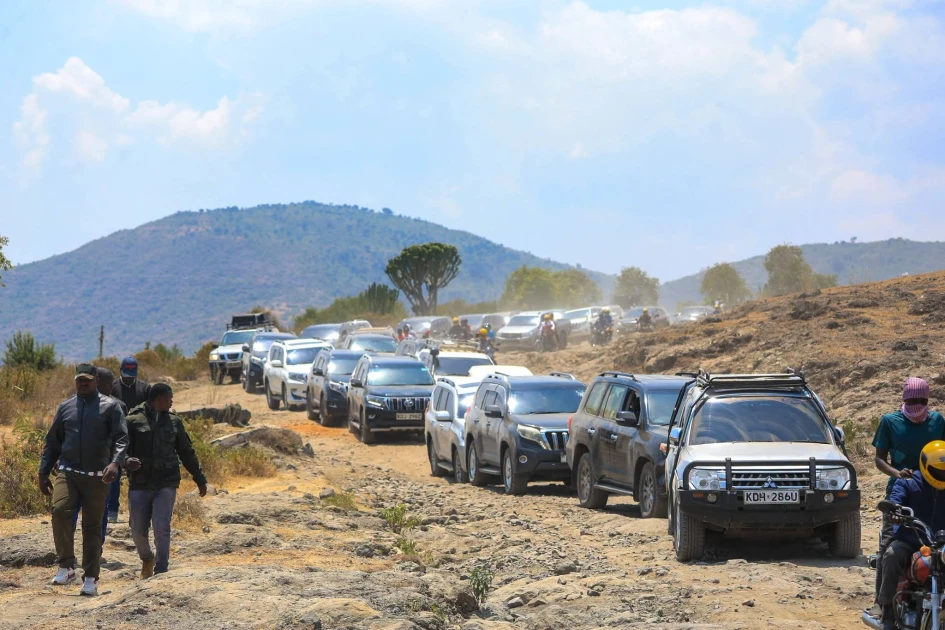
A convoy of Linda Mwananchi leaders seen trespassing Homa Bay County on August 16, 2026. Photo: Handout

Audio By Vocalize
In
the aftermath of a Linda Mwananchi rally in Homa Bay last weekend, images of
dusty roads in Homa Bay circulated widely on social media, sparking a fierce
debate that has dominated much of this week’s socioeconomic and political
commentary. For some, the images revealed a shocking level of underdevelopment
and quickly became an indictment of the people of Homa Bay, and the wider Luo
community, for failing to hold their leaders accountable.
Much
of this criticism, however, comes from the vantage point of privileged regions
that have historically benefited from disproportionate access to state
investment, infrastructure and economic opportunity. To interpret Homa Bay’s
present condition without acknowledging these historical patterns of uneven
resource allocation risks turning a history of structural inequality into a
story of communal failure. There is an uncomfortable irony in seeing those who
have benefited from the state’s largesse now using the consequences of that
inequality as evidence against the communities that have borne its costs.
This
is not an argument against accountability. Homa Bay residents have every right
to demand better from their elected leaders. Elected officials should be judged
by their stewardship of public resources and their ability to deliver services.
But accountability should not become a convenient way of erasing history. Homa
Bay’s dusty roads cannot be understood simply by looking at the politicians
currently occupying county offices. They are part of a much longer story of how
power and resources have been distributed in Kenya.
One
of the questions repeatedly posed by these critics was; What has Homa Bay done
with devolution? The question sounds reasonable until we consider the starting
point. Thirteen years into devolution, Homa Bay is not the same county it was
in 2013. Devolution has brought resources, services and development closer to
residents. There has been some progress, albeit frustratingly slow, and it
would be dishonest to suggest that nothing has changed. The fundamental problem
with this criticism is that it assumes every county entered the devolved system
from the same starting line.
They
did not.
Some
counties entered devolution with stronger road networks, established
institutions, greater urbanisation, stronger commercial activity and decades of
accumulated infrastructure. Others entered with significant deficits.
Devolution could decentralise resources and decision-making, but it could not
erase decades of unequal development overnight. More importantly, the
historical inequality predates devolution by decades.
When
Kenya became independent in 1963, the country inherited an economic geography
profoundly shaped by colonial rule. Infrastructure, investment, education and
commercial activity were concentrated in particular regions, while other areas
were left with far weaker foundations for economic development. The
post-independence state did not attempt to correct these disparities; in the
decades that followed, political choices often reinforced them.
This
was at the heart of the political disagreement between President Jomo Kenyatta
and Jaramogi Oginga Odinga. Their differences reflected fundamentally different
visions of how the resources of the new Kenyan state should be distributed and
how quickly historical inequalities should be addressed. Jaramogi's insistence
on a more egalitarian approach to land, resources and development increasingly
collided with a political establishment that was consolidating power and
economic opportunity around particular interests.
The
publication of Sessional Paper No. 10 of 1965 must therefore be read within
this broader context. African Socialism and its Application to Planning in
Kenya articulated principles of equal opportunity and equitable
development, while simultaneously confronting the reality of scarce resources
and competing development priorities. The tragedy is that the egalitarian
aspirations contained in the paper were not consistently reflected in the
political and economic distribution that followed.
The
pattern did not end with Kenyatta.
Under
Daniel arap Moi, Nyanza remained politically distant from the centre for much
of his presidency, particularly as the region became a stronghold of opposition
politics. The experience of political repression and the concentration of
development and state resources elsewhere reinforced a longstanding perception
that political loyalty mattered in determining access to the state.
The
transition to Mwai Kibaki's presidency brought new optimism, and his government
presided over significant national development. Yet the historical imbalance
did not disappear. Major infrastructure and economic investment continued to be
unevenly distributed, while Nyanza's political relationship with the centre
remained complicated.
Under
Uhuru Kenyatta, the pattern again became visible in different ways. The Jubilee
administration invested heavily in infrastructure in Central Kenya, and the
distribution of major projects continued to generate questions about regional
equity. The handshake between Uhuru Kenyatta and Raila Odinga in 2018
temporarily altered the political relationship between the centre and Nyanza,
but it did not erase decades of accumulated developmental disparities.
This
history matters because development is cumulative.
A
region that receives roads, electricity, schools, hospitals and other
infrastructure over several decades develops an economic foundation that makes
further investment easier. Better infrastructure attracts businesses;
businesses create jobs; jobs increase incomes; and increased economic activity
generates further investment.
The
reverse is equally true.
Regions
that begin with inadequate infrastructure face higher costs and greater
barriers to investment. A dusty road is therefore not simply a dusty road. It
can be a symptom of decades of accumulated disadvantage.
County
governments receive a constitutionally guaranteed minimum of 15 per cent of
nationally raised revenue, while the overwhelming majority of national revenue
remains at the national level. Counties therefore operate within a broader
national system in which major infrastructure and investment decisions remain
substantially influenced by the national government.
Devolution
was never designed to magically equalise counties overnight. It was intended,
among other things, to address historical marginalisation. But decentralising
resources does not automatically undo the effects of decades of centralised
development.
The
people of Homa Bay did not choose the conditions under which their region
entered independence. They did not determine the colonial distribution of
infrastructure. And they did not control the national decisions that shaped the
allocation of state resources over the subsequent six decades. The dusty roads
of Homa Bay should therefore not become an indictment of the Luo people. They
should be a reminder of a national development story in which some regions
accumulated advantages while others struggled to catch up.
And
until Kenya is willing to confront that history honestly, asking marginalised
communities why they have not caught up will remain an exercise in blaming
those who inherited the disadvantage rather than interrogating those who
perpetuated it.
Join the Discussion
Share your perspective with the Citizen Digital community.
No comments yet
This discussion is waiting for your voice. Be the first to share your thoughts!