
National Gov't, County Officials move to fast-track Nairobi Mass Rapid Transit project
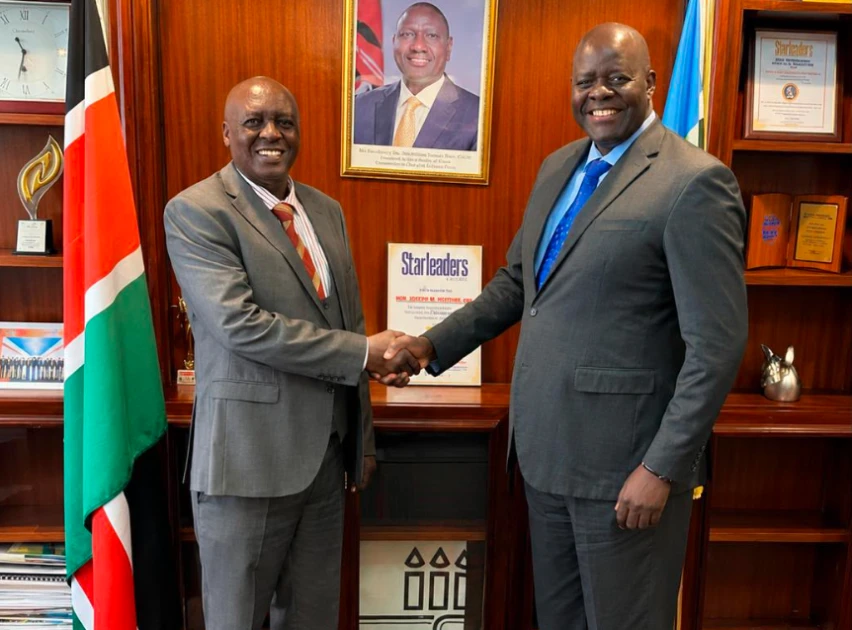
Dr. Silvester Kasuku, Advisor on Governance in the Executive Office of the President, meets with Roads Principal Secretary Eng. Joseph Mbugua to brief him on the Nairobi Metropolitan Mass Rapid Transit System (NMRTS) and discuss the way forward.

Audio By Vocalize
The meetings signalled growing collaboration between the National Government and Nairobi City County in advancing what is expected to become one of Kenya's most ambitious urban transport infrastructure projects.
Dr. Silvester Kasuku, Advisor on Governance in the Executive Office of the President, held a working meeting with Transport Principal Secretary Mohammed Daghar to brief him on the Nairobi Metropolitan Mass Rapid Transit System (NMRTS) and discuss the next steps towards implementation.
He also met with Roads Principal Secretary Eng. Joseph Mbugua to outline the project's scope and the critical role of the State Department for Roads in its delivery.
Discussions focused on planning, design and integration of strategic road corridors, interchanges, bridges, utility relocations, non-motorised transport infrastructure and seamless multimodal connectivity across the Nairobi Metropolitan Area.
The implementation meetings came a day after the Nairobi City County Executive Committee, chaired by Governor Johnson Sakaja, approved the project concept, marking a major milestone towards the rollout of the mass transit system.
The NMRTS is a joint initiative between the Office of the Chief of Staff and Head of the Public Service in the Executive Office of the President and the Office of the Governor, Nairobi City County. It aims to establish a modern, integrated, safe and sustainable mass rapid transit network to transform mobility across the Nairobi Metropolitan Area.
The project is intended to address Nairobi's chronic traffic congestion, which is estimated to cost the economy about Ksh.130 billion annually. Without major intervention, those losses are projected to surpass Ksh.1 trillion a year by 2063.
Once operational, the rail-based transit network is expected to significantly reduce the two-and-a-half to three-and-a-half hours many Nairobi residents spend commuting each day by providing fast, reliable and high-capacity public transport.
The reduction in travel times is projected to recover productivity losses valued at approximately Ksh.53 billion annually, equivalent to nearly 68,000 full-time jobs or about 0.9 per cent of Nairobi's Gross Domestic Product (GDP).
Beyond easing congestion, the NMRTS is expected to drive economic growth through transit-oriented development, attract private sector investment, lower logistics costs, create thousands of jobs and increase land values, reinforcing Nairobi's position as East Africa's leading financial, commercial and innovation hub.
The project is also expected to deliver significant environmental and social benefits by reducing greenhouse gas emissions, cutting reliance on private vehicles and improving air quality. Officials say the system will provide safe, affordable, reliable and accessible public transport while enhancing road safety, reducing commuter stress and improving the quality of life for millions of residents.
The long-term transport plan has been designed to accommodate Nairobi's rapid population growth, with the city's population projected to increase from 5.1 million to about 11.5 million by 2063. During the same period, daily travel demand is expected to rise from an estimated 12–13 million trips to between 33 million and 36 million.
Governor Johnson Sakaja described the NMRTS as more than a transport project, saying it represents a transformative national development programme that will unlock productivity, catalyse investment, strengthen regional competitiveness and support the Bottom-Up Economic Transformation Agenda (BETA), Kenya Vision 2030 and the African Union's Agenda 2063.
With both levels of government now aligning implementation efforts, the NMRTS is poised to become one of Kenya's most significant infrastructure projects, laying the foundation for a modern, integrated and globally competitive metropolitan transport system for Nairobi.
Join the Discussion
Share your perspective with the Citizen Digital community.
No comments yet
This discussion is waiting for your voice. Be the first to share your thoughts!