
National Dialogue on Protection Centres proposes 3 pillars to end GBV menace in Kenya
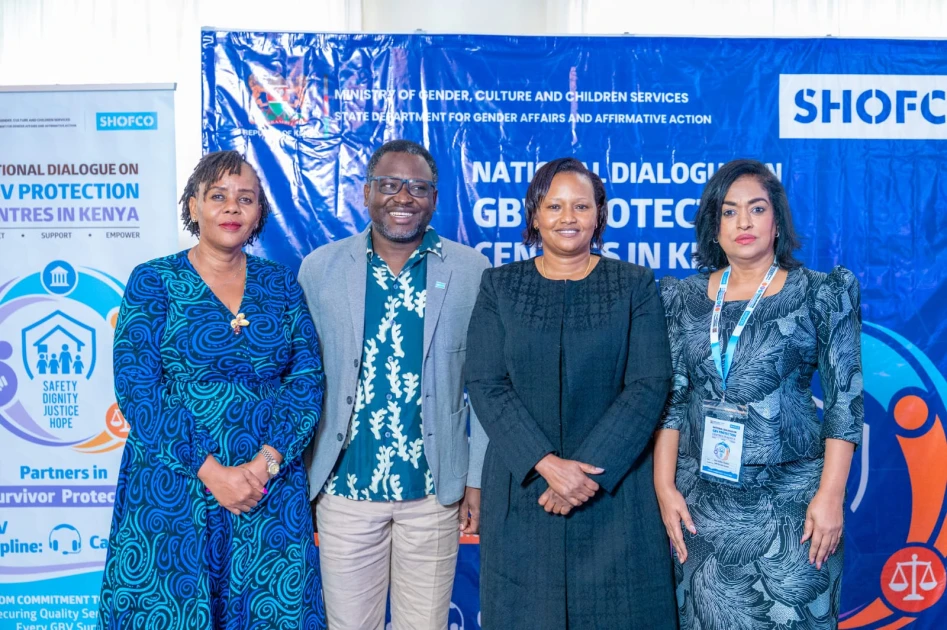
From left: Deputy Governor of Kilifi County Flora Chibule, SHOFCO CEO Dr. Kennedy Odede, Kajiado Woman Rep and KEWOPA Chair Leah Sankaire, and Nairobi Woman Rep Esther Passaris during the two-day National Dialogue on GBV Protection Centres in Nairobi.

Audio By Vocalize
For years, Lucy Ochieng (not her real name) lived in fear.
After surviving severe sexual and
gender-based violence (SGBV), she sought help from several institutions in
Nairobi, hoping to find safety and support.
Instead, she encountered a fragmented
system with few functional safe shelters and limited survivor services.
“I was moving from one office to another
looking for help. I needed a safe place to stay, counselling and support to
rebuild my life,” she told participants at the National Dialogue on
Gender-Based Violence (GBV) Protection Centres in Nairobi.
Her turning point came when she was
referred to a SHOFCO safe house, where she received shelter, psychosocial
support, legal assistance and economic empowerment services.
Today, she has successfully reintegrated
into society and is rebuilding her life.
Lucy’s story set the tone for the two-day
National Dialogue convened jointly by SHOFCO and the State Department for
Gender Affairs and Affirmative Action, bringing together government officials,
legislators, development partners, civil society organisations and survivors to
chart a new path in the fight against GBV.
At the heart of the discussions was a stark
reality: despite progressive laws and policies, thousands of survivors across
Kenya still struggle to access protection, justice and recovery services.
The conference concluded with a call for
action built around three pillars: strengthening legal and policy frameworks,
establishing sustainable financing mechanisms including a GBV Fund, and
creating a coordinated national implementation roadmap for protection centres
across all 47 counties.
Opening the dialogue, Secretary to the
Cabinet Mercy Wanjau said Kenya had made notable progress in addressing GBV but
significant gaps remained in survivor protection services.
“GBV shelters are more than just buildings.
They are places of refuge, healing, protection and hope,” she said.
Wanjau noted that although government,
county administrations, faith-based organisations and civil society groups had
established shelters and recovery centres, demand continued to outstrip
available services.
According to her, the government has
established Gender Violence Recovery Centres in Level Four and Five hospitals
in all 47 counties, two Policare Centres under the National Police Service, and
11 community-based rescue centres in 10 counties through the National
Government Affirmative Action Fund (NGAAF).
Additionally, the Ministry of Gender has
secured funding for the construction of new rescue centres in Kisumu and Kwale
counties.
“Many counties still lack adequate
shelters, forcing survivors to remain in abusive environments or travel long
distances to access protection,” she said.
Wanjau identified key challenges facing
protection centres, including inadequate funding, weak referral systems, lack
of standard operating procedures, insufficient psychosocial services, harmful
cultural norms and poor coordination among stakeholders.
Principal Secretary for Gender Affairs and
Affirmative Action Anne Wang’ombe painted a worrying picture of the state of
GBV in Kenya.
She said recent public hearings conducted
by the Presidential Technical Working Group on GBV and Femicide revealed widespread
concerns about the lack of shelters, safe spaces and psychosocial support
services for survivors.
“Even where these facilities exist, many
are in poor condition, have outdated infrastructure and are understaffed,”
Wang’ombe said.
The PS noted that the challenge was
particularly acute in rural and underserved regions where protection services
remained inaccessible to many survivors.
“The diversity of stakeholders gathered
here demonstrates that ending gender-based violence requires a whole-of-government
and whole-of-society approach,” she said.
The urgency of the matter was underscored
by statistics presented during the conference.
Data cited from the Kenya Demographic and
Health Survey shows that 34 per cent of women in Kenya have experienced physical
violence since the age of 15, while 13 per cent have experienced sexual
violence.
Reports also indicate that at least eight
femicide cases are reported every week in Kenya, translating to the loss of
approximately one woman or girl every day.
Nairobi Woman Representative Esther
Passaris Kenya already possesses strong constitutional and legal provisions,
including the Protection Against Domestic Violence Act and the Sexual Offences
Act, but implementation gaps continue to undermine their effectiveness.
“Protection centres cannot depend on donor
funding or goodwill alone. They must be anchored in law and supported through
predictable public financing,” she said.
SHOFCO Founder and CEO Dr. Kennedy Odede
urged the government to learn from community-driven models that have proven
successful in supporting survivors.
He said SHOFCO has invested heavily in
survivor-centred interventions, including operating safe houses that provide
emergency shelter, counselling, legal support, case management and economic
reintegration services.
“Every survivor deserves a place where they
can find safety, dignity and hope,” Odede said.
He explained that SHOFCO’s experience had
demonstrated the importance of integrated services under one roof, allowing
survivors to access medical care, psychosocial support, legal assistance and
economic empowerment without navigating multiple institutions.
Odede noted that survivors often face
retraumatisation when forced to move from police stations to hospitals, courts
and social service offices in search of help.
“Our safe house model shows that when
services are integrated and survivor-centred, recovery becomes faster and more effective,”
he said.
He called for the establishment of fully
functional protection centres in all 47 counties and urged the government to
develop clear standards, sustainable financing mechanisms and stronger
partnerships with civil society organisations already providing frontline
services.
Speaking on behalf of the National Shelters
Network, Edith Murogo noted that shelters provide safety, and a pathway to
recovery, often serving as the first place where survivors feel believed and
protected.
“The evidence is clear: shelters work,
shelters save lives and restore dignity,” she said, urging sustained support
for both state and non-state shelters across the country.
Join the Discussion
Share your perspective with the Citizen Digital community.
No comments yet
This discussion is waiting for your voice. Be the first to share your thoughts!