
Naivasha–Kisumu–Malaba SGR project: Kenya Railways says feasibility studies were done
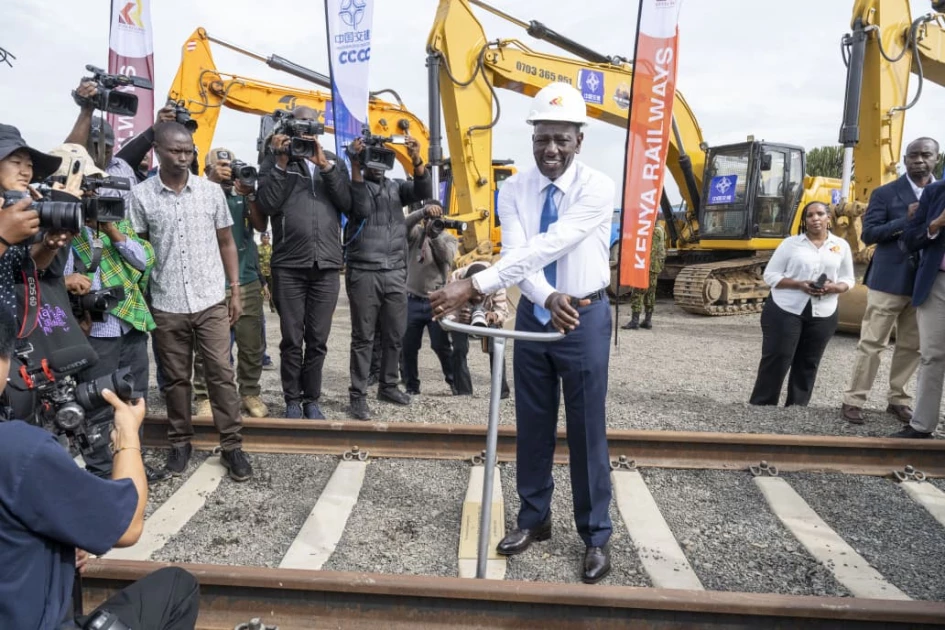
President William Ruto breaks ground for the land-mark construction of the Naivasha-Kisumu-Malaba Standard Gauge Railway line in Narok on March 19, 2026.

Audio By Vocalize
During the programme, Mr Odhiambo Ramogi stated that the railway line from Malaba to Naivasha had not undergone a feasibility study.
Kenya Railways wishes to set the record straight and clarify that the proposed Naivasha–Kisumu–Malaba SGR corridor underwent feasibility studies well before the commencement of its implementation.
Background and Development of the Standard Gauge Railway
The development of the Standard Gauge Railway within the Republic of Kenya was informed by the adoption of the 2006 East African SGR Master Plan, which recommended the use of Standard Gauge Railway technology for all new railway lines within the East African region, while existing Metre Gauge Railway lines would continue to be maintained.
The Master Plan identified several strategic railway corridors, including: The Northern Corridor: Running from Mombasa Port through Nairobi to Malaba, at the Kenya–Uganda border, with onward connections to Rwanda, Burundi, the Democratic Republic of Congo (DRC) and South Sudan.
The Lamu Port–South Sudan–Ethiopia Transport (LAPSSET)
Corridor: Providing railway connectivity from Isiolo towards Ethiopia through Moyale and towards South Sudan through Nadapal.
The Central Corridor: Running from Dar es Salaam Port through Mwanza, with proposed connections to Rwanda, Burundi, the Democratic Republic of Congo and Uganda.
The Master Plan also proposed regional railway connections between the Northern and Central Corridors, including Mombasa–Dar es Salaam along the coastline, Voi–Taveta and Namanga–Nairobi.
Feasibility Studies and Phased Implementation of Kenya's SGR
Under the Northern Corridor, Kenya's proposed SGR railway line was studied as one continuous corridor from Mombasa Port to Malaba.
However, considering the anticipated financial requirements and challenges of funding the entire railway line as a single project, the corridor was divided into phases to facilitate implementation.
This resulted in the development of the following sections:
Phase 1: Mombasa–Nairobi, covering approximately 472 kilometres, constructed between 2014 and 2017.
Phase 2A: Nairobi–Naivasha, covering approximately 120 kilometres, constructed between 2017 and 2019.
The feasibility study reports for the subsequent sections, namely Phase 2B (Naivasha–Kisumu) and Phase 2C (Kisumu–Malaba), were finalised before 2016.
These studies provided the technical foundation for the proposed extension and informed the signing of commercial contracts in March 2016 for their implementation, subject to the finalisation of financing
arrangements.
The feasibility studies contained the necessary technical parameters, standards, specifications and other essential requirements to guide the construction and operationalisation of the proposed SGR railway line.
Review and Updating of Feasibility Studies
The feasibility study reports for Phase 2B (Naivasha–Kisumu) and Phase 2C (Kisumu–Malaba) have subsequently undergone reviews to take into account emerging operational, economic and regional developments.
The first review was undertaken in 2019, followed by a further review in 2023.
These reviews incorporated operational data from the 592-kilometre SGR section between Mombasa and Nairobi, updated data and projections on cargo throughput at the Port of Mombasa, the incorporation of commercial and logistics hubs, as well as other development trends within Kenya and the wider East African region.
The reviews were therefore intended to ensure that the proposed railway extension remained responsive to prevailing and projected transport, logistics and economic requirements.
Conclusion
Kenya Railways wishes to reiterate that the feasibility studies for the Naivasha–Kisumu–Malaba SGR extension were undertaken and finalised before 2016, with subsequent reviews in 2019 and June 2023.
The assertion that the proposed railway corridor has not undergone feasibility studies is therefore inconsistent with the documented project development process.
The Corporation remains committed to transparency, accountability and providing accurate information on the development of the country's railway infrastructure.
Kenya Railways appreciates the media's role in informing public discourse and welcomes constructive engagement on national infrastructure projects.
The Corporation encourages media houses and stakeholders to seek clarification whenever technical information regarding its projects is required.
Join the Discussion
Share your perspective with the Citizen Digital community.
No comments yet
This discussion is waiting for your voice. Be the first to share your thoughts!