
Inside President Ruto's plan to make Kenya food secure

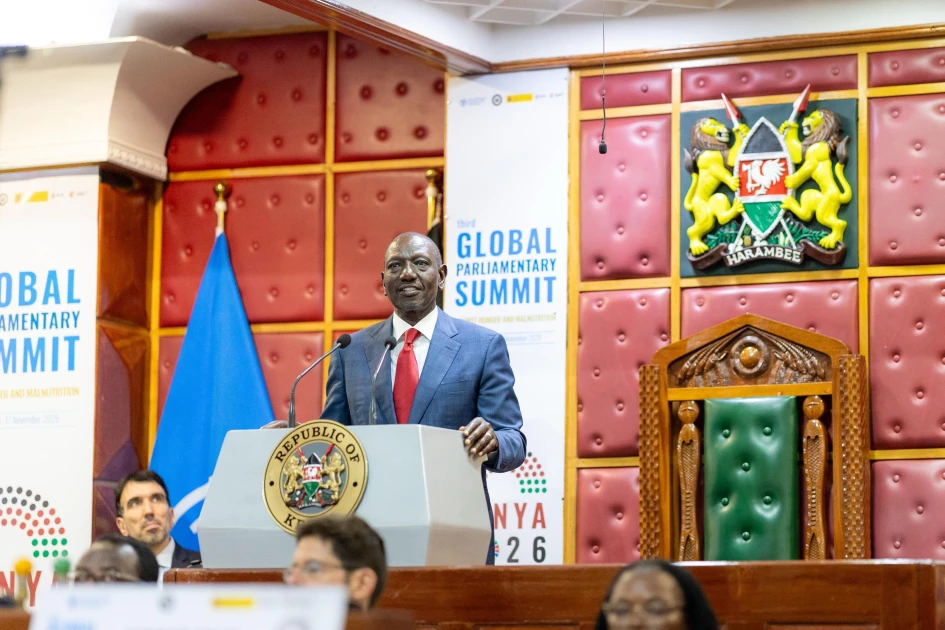
President William Ruto speaking at the Global Parliamentary Summit Against Hunger and Malnutrition in Parliament Buildings, Nairobi on November 16, 2026. Photo:PCS

Audio By Vocalize
Speaking during the opening of the Third Global Parliamentary Summit Against Hunger and Malnutrition in Parliament on Monday, President Ruto said that he aims to increase food production and nip food insecurity in the bud.
He lamented low rainfall in parts of the nation that continues to expose vulnerable communities to food malnutrition, which he said is estimated to cost 6.9% of Kenya's GDP.
"We have identified 2.7 million Kenyans facing crisis-level food insecurity, with hundreds of children and women requiring urgent attention," he said.
"Kenya is not yet food secure. Poor rainfall in our arid and semi-arid regions continues to expose millions of people to food insecurity and acute malnutrition."
So far, he said his administration has shifted agricultural support from consumption to production, providing 38 million bags of subsidised fertiliser to 2 million farmers and reducing fertiliser costs by 73% since 2022.
He added that maize production has significantly increased from 34 million bags in 2022 to 71 million bags last year, reducing maize imports.
The Head of State praised the move, expressing optimism that more progress will be achieved by placing farmers at the centre of economic policy.
Mr. Ruto added that the reliance on rainfall cannot sustain his ambitious goal, hence the need to expand investment in irrigation.
"Lack of rainfall does not mean a lack of water. That is why we have intensified large-scale irrigation investments through our National Infrastructure Fund," he said.
"We are targeting the construction of 50 mega dams, 200 medium-sized dams and thousands of micro-dams, with the aim of bringing an additional 2.5 million acres under irrigation within the next 5 to 7 years."
He said that the progress on calling for food production has seen 3 million learners benefit from school feeding programmes, opining it will accelerate between 2027 and 2030 to reach 10 million learners.
The President called for better legislation, budgeting and oversight to foster food security across the continent to protect livelihoods.
"The world already produces enough food to feed everyone. For decades, hunger has been driven less by absolute shortage than by the choices we make: what we fund, what we build, whom we protect and the opportunities we create," he noted.
Join the Discussion
Share your perspective with the Citizen Digital community.
No comments yet
This discussion is waiting for your voice. Be the first to share your thoughts!