
LSK renews targeted court boycott, cites unfulfilled JSC commitments

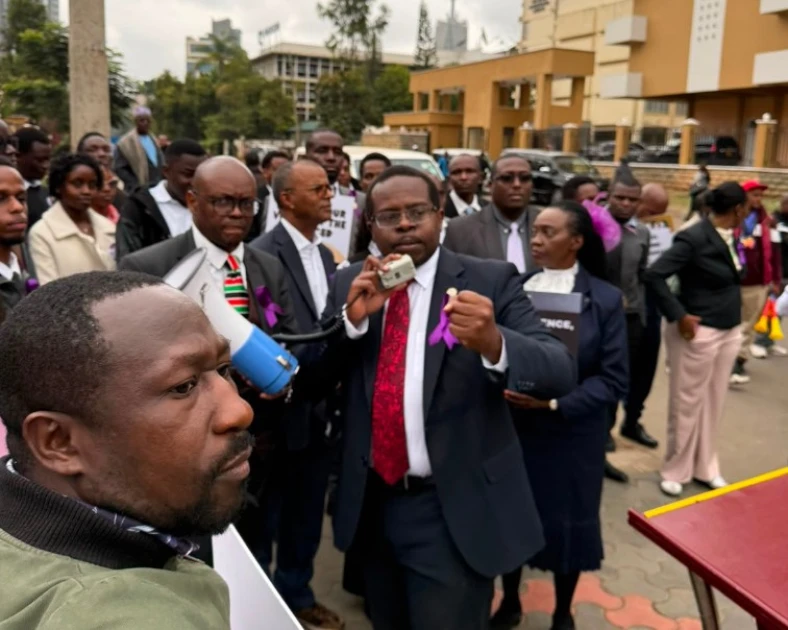
LSK President Charles Kanjama among lawyers who gathered at Milimani Law Courts ahead of the Purple Ribbon Walk on July 10, 2026. Photo/Courtesy

Audio By Vocalize
The Law Society of
Kenya (LSK) has renewed its call for advocates to boycott selected courts and
judicial officers, saying several commitments agreed with the Judicial Service
Commission (JSC) to address concerns over judicial accountability remain outstanding.
In a statement
issued on Friday, LSK President Charles Kanjama said the targeted court boycott
remains in force, with advocates directed to refrain from appearing before
judges and judicial officers identified by the society until further
communication.
"The targeted
boycott remains in force. Members are therefore reminded to refrain from
appearing before the Judges and Judicial Officers identified under the targeted
boycott until further communication by the Society," Kanjama stated.
"The
directive applies to the Judges and Judicial Officers previously identified by
the Society and any additional Judges or Judicial Officers subsequently
identified and communicated by the Society."
The latest
directive follows a July 31 engagement between the JSC, the LSK Council and the
Senior Counsel Bar, which resulted in an agreed framework on judicial
performance reporting, complaints handling, pending petitions, court-station
integrity committees and disciplinary regulations.
LSK said although
the JSC has communicated the composition of its representatives and those of
the Judiciary to a Joint Committee established under the framework, the
committee is yet to be formally constituted and convened.
The Society also
raised concern over the failure by the Judiciary to publish institutional and
court-level judicial performance reports within the agreed 30-day period.
LSK said it has
also not received confirmation on the operationalisation of an enhanced
electronic system for lodging and tracking complaints, while it continues to
seek updates on pending petitions and complaints before the JSC.
Other outstanding
issues include the provision of contact details for court-station Integrity
Committees and the latest draft of the Judicial Service Commission Disciplinary
Process Regulations.
The Society said
it would continue engaging the JSC and Judiciary through the proposed Joint
Committee while maintaining the targeted boycott.
The targeted
boycott list issued by LSK includes judges linked to cases involving suspended
or stopped JSC processes, EACC and Directorate of Criminal Investigations (DCI)
investigations, as well as conduct during the nationwide boycott.
Those listed
include Justice Anthony Ombwayo, Justice Lucas Naikuni, Deputy Chief Justice
Philomena Mwilu, Justice Sankale Ole Kantai, Justice Lucy Waithaka, Magistrate Stella
Atambo and Justice Josephine Mong'are.
The list also
names Supreme Court judges Chief Justice Martha Koome, Deputy Chief Justice
Philomena Mwilu, Justice Isaac Lenaola, Justice Smokin Wanjala, Justice Njoki
Ndung'u and Justice William Ouko in connection with specified court
proceedings.
Magistrate F.
Mutuku is listed separately over what LSK describes as alleged conduct
inconsistent with the standards of professionalism, decorum and judicial
conduct expected during the Society's nationwide boycott.
LSK said the
targeted boycott would continue indefinitely until further communication, while
members have been directed to comply with any additional operational guidance
issued by the Society.
The Society,
however, said the boycott does not end its institutional engagement with the
JSC and Judiciary as it seeks implementation of the resolutions reached in
July.
The boycott was
initially announced after a nationwide one-day court boycott on July
22, which LSK said was prompted by concerns over delays in the hearing and
determination of cases, court registry operations and mechanisms for addressing
complaints against judges and judicial officers.
At the time,
Kanjama said: “Advocates continue to experience delays in the hearing and
determination of cases, as well as delays in the delivery of rulings. Members
have reported persistent inefficiencies in court registries and they have
raised concerns about the effectiveness of the mechanisms for addressing
complaints against judges and judicial officers."
JSC in July also criticised the boycott of some judges and judicial officers
by lawyers, warning that the action disrupts court proceedings, delays justice
and denies Kenyans their constitutional right to have cases heard without
unnecessary delay.
The Commission's
Chairperson Martha Koome stated that while concerns about judicial conduct
should be addressed, they must be handled through the mechanisms provided under
the Constitution and the Judicial Service Act.
Join the Discussion
Share your perspective with the Citizen Digital community.
No comments yet
This discussion is waiting for your voice. Be the first to share your thoughts!