
'Mr Texas, Mr Empty!' Ruto resorts to nicknames and name-calling as war of words escalates

Audio By Vocalize
While political analysts draw comparisons between this tactic and the branding style popularised by Donald Trump in the United States, who has earned a notorious reputation for dehumanising his political foes, many commentators argue that Ruto’s manufactured monikers have struggled to gain traction with the public, standing in sharp contrast to the organic, widespread adoption of his own moniker, "Kasongo".
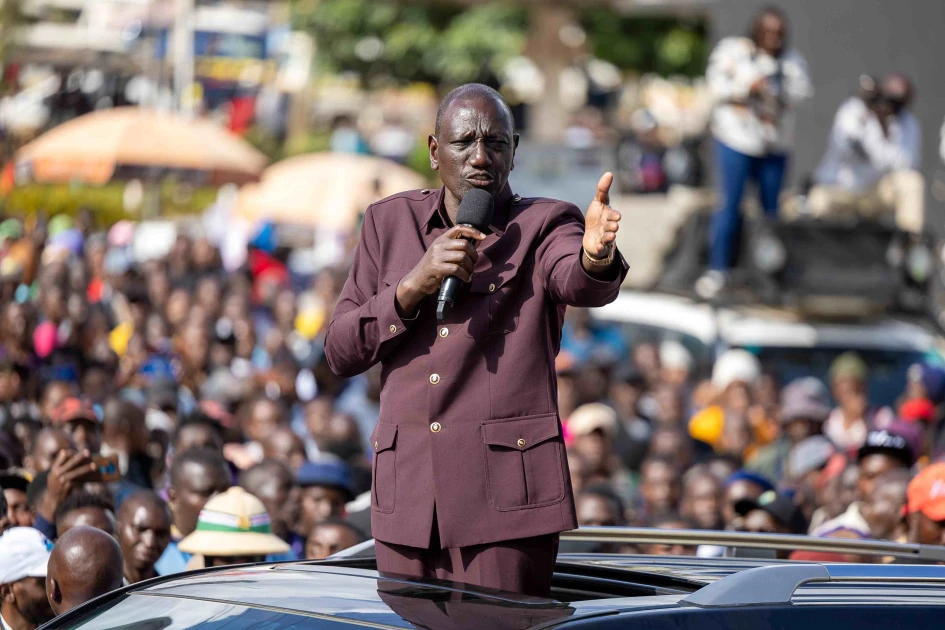
Throughout his public rallies and addresses, President Ruto has rolled out a specific lexicon to define his rivals and cheapen their brand, hoping to tap into the mockery to win entertainment-hungry masses and score political points.
Political commentators have noted that these labels are designed to reduce complex political adversaries into single-issue caricatures.
Over the last several months, Ruto has used "Sponsor" (or Sponyo) for Uhuru Kenyatta to frame the former president not as an elder statesman, but as a monied behind-the-scenes financier bankrolling opposition factions and aiming to sabotage his successor.
For his former deputy Rigathi Gachagua, he has recently deployed "Mr Texas", a succinct jab tying Gachagua's rhetoric and political posturing to his trips, pronouncements and rumoured property acquisition in the United States, particularly in the state of Texas.
Wiper leader Kalonzo Musyoka has also not escaped Ruto's recent penchant for sobriquets.
He has been dubbed "Mr 40" to highlight his four decades in public service, while arguing that his longevity has not translated into tangible development. Nairobi Senator Edwin Sifuna has been labelled "Mr Empty" during policy disputes - such as debates over major infrastructure and investment projects - to dismiss his critiques as lacking substance.
Most controversially, Ruto has referred to former Interior Cabinet Secretary Fred Matiang’i as "Mr Yala," an allusion linking him to the River Yala killings during the previous administration - a label so politically sensitive that during a November 2026 rally in Kisii, Ruto famously caught himself mid-word ("Huyu Mr Ya...") and quickly pulled back before completing it in Matiang’i’s home turf.
Matiang'i has vehemently denied he had any role in the killings.
Supporters of the President’s communication style view these labels as sharp, accessible shorthand meant to cut through opposition narratives and remind voters of his rivals' perceived flaws - whether that is alleged stagnation, political opportunism, or past state excesses.
But despite the President's consistent repetition from various podiums, political observers and digital media pundits point to several reasons why Ruto's nicknames have failed to dominate the national conversation in the way their creators intended.
First is the power of the counter-punch: rather than cowering from the labels, Ruto’s opponents have routinely neutralised them through humour or reframing, openly accepting the jabs and even making humorous references to them.
At a past event, former president Uhuru Kenyatta casually embraced the tag, signing off a public address with "Ni hayo machache kutoka Sponyo," turning an intended insult into a lighthearted crowd-pleaser.
And just like that, he stripped Ruto of the monopoly on brandishing the unsavoury tag.
Similarly, Kalonzo Musyoka flipped "Mr 40" back onto the electorate and his critics, questioning whether Kenyans were blind when they repeatedly elected him over those forty years, while Gachagua’s allies cleverly countered "Mr Texas" by dubbing Ruto "Mr Taxes".
Second is the dynamic of top-down versus bottom-up virality.
In Kenya’s hyper-active digital ecosystem, political slang rarely succeeds when dictated from a state podium.
Effective political nicknames are almost always crowdsourced, and when a politician attempts to force a catchphrase into the public lexicon, voters - particularly younger, internet-savvy demographics - often view it as contrived rather than authentic.
It is therefore quickly frowned upon, rejected and even jeered at.
Finally, there is the risk of backfiring.
Labels like "Mr Yala" carry heavy historical and emotional weight, and when deployed in regions where the targeted leader commands deep loyalty, such monikers risk alienating local voters rather than persuading them, which explains Ruto’s own hesitation to utter the full name in Kisii.
Also, by himself, Ruto lacks the pomp, flair and panache required to conjure up catchy nicknames, deliver them expertly, cause their virality and fatally injure an opponent.
The limited shelf life of Ruto’s nicknames is most visible when juxtaposed against the phenomenon of "Kasongo" - alongside earlier monikers like "Zakayo".
For instance, "Kasongo" did not originate from an opposition strategist's whiteboard. Instead, it emerged organically from Kenyan social media users pairing viral memes and silhouette videos of difficult situations with Super Mazembe’s 1977 Lingala classic Kasongo - a song about an absent husband whose family is anxiously waiting for him to return home and fulfil his responsibilities.
Even when Ruto attempted to disarm the trend by dancing to the song at a state lodge in Kisii and praising the track at public funerals, the name has remained firmly attached to him in popular culture because the public owned its meaning.
Ruto's constant name-calling, nicknaming and stately mudslinging has also rubbed everyday Kenyans and professionals the wrong way, with many slamming the president for cheapening the highest office in the land and reducing his stature to that of a low-level, desperate politico.
Join the Discussion
Share your perspective with the Citizen Digital community.
No comments yet
This discussion is waiting for your voice. Be the first to share your thoughts!