
Loita Paradox: The missing piece in climate justice for Narok women
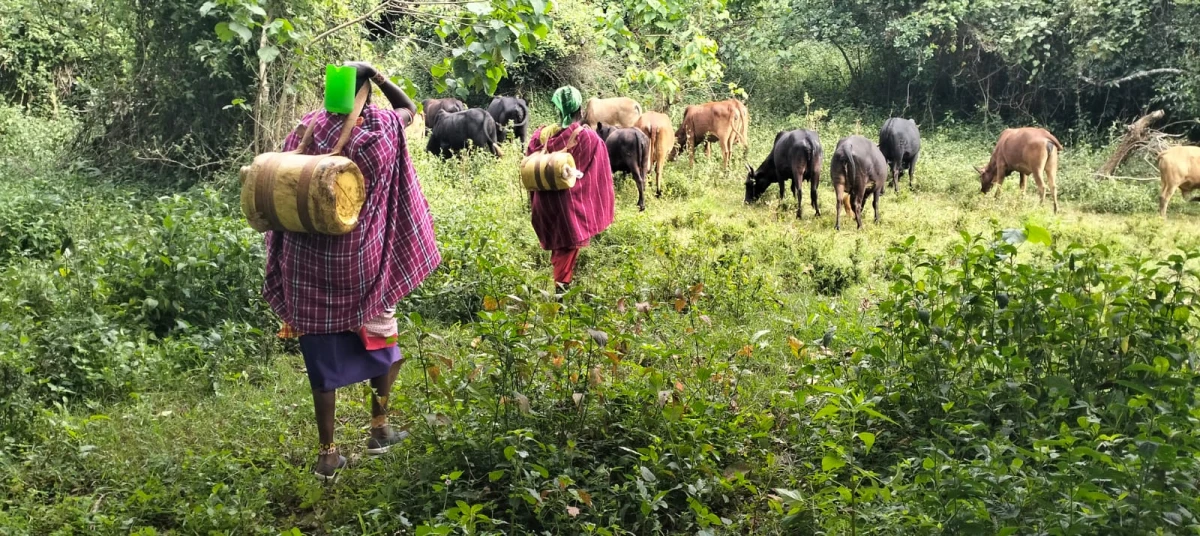
Loita Women tending to cattle while fetching water.

Audio By Vocalize
In the vast, sun-baked landscape of Loita, Narok County, indigenous Maasai women, historically excluded from property ownership in pastoralist societies, are finally receiving individual land titles.
Through ongoing land adjudication, these legal
documents are being celebrated as a massive leap forward for women's
empowerment.
Culturally, the Maasai girls and women had a circumcision rite of passage called Emorata. They were required to build and maintain traditional houses called Manyatta, fetch water and firewood, care for the children and prepare meals.
Today, this ‘rite’ has been abolished through
various interventions as Female Genital Mutilation/Cutting violates the rights of
women and girls.
Yet, beneath this triumph lies a quiet, exhausting paradox.
In the very households where women now legally
own the soil, their daily lives remain severely restricted by an invisible
crisis: climate-driven time poverty.
Narok County is classified as a Semi-Arid Area characterized by frequent droughts, water scarcity, and pastoralism (keeping cattle and goats).
Loita receives a great amount of rain which has made the dwellers venture into maize farming. The Loita Forest is said to contribute to this, according to them.
While women hold the deeds to their land, they lack the time and resources to use it. Instead, their hours are swallowed by the escalating manual labor required to keep their families alive in a changing climate; most notably, walking miles for water and handwashing clothes. The rest of the chores remain a burden on their shoulders.
For Fransiscah Mukinka, a nurse-turned
anti-gender-based violence (GBV) and disability advocate in Loita, land
ownership is more than just wealth; it is a vital climate adaptation and
survival tool.
“When women are given land, it is a very big recognition and a form of empowerment,” Mukinka says. “If every woman has a piece of land, it means she is more secure and can care for the environment and her family as she can properly plan for it.”
Mukinka explains that land reduces a woman’s
vulnerability to domestic instability and GBV. In times of severe climate
stress, such as prolonged droughts that decimate livestock, household tensions
often boil over into domestic abuse.
Land ownership gives women an economic anchor,
a sense of long-term dignity, and an "exit option" from unsafe
relationships.
Furthermore, because women are traditionally responsible for household food security, they are highly invested in climate-resilient resource planning. "Women are always thinking about what will happen tomorrow," Mukinka notes.
This local reality mirrors global human rights
and climate frameworks. Strengthening women's land rights directly aligns with
Sustainable Development Goal (SDG) 5 (Gender Equality) and SDG 13 (Climate
Action).
The Weight of the Unpaid Care Economy
Under the United Nations Declaration on the
Rights of Peasants and Other People Working in Rural Areas (UNDROP), land
rights, access to water, and dignified living conditions are not separate goals
but interconnected rights.
However, in Loita, climate change is silently undermining these rights by increasing unpaid care burdens, turning legal ownership into incomplete freedom.
Formal legal rights are colliding head-on with
the harsh physical realities of the climate crisis.
In Loita, the unpaid care economy, the gruelling domestic labour required to maintain a household is heavily intensified by climate change and energy poverty.
Women must walk to fetch water. They can only carry one jerricane at a time or less, depending on their ability and well-being.
Once home, managing hygiene becomes a gruelling task. Laundry, in particular, remains an entirely manual, time-consuming chore due to a lack of electricity and modern labour-saving technologies.
Globally, billions of women wash clothes by hand. In rural Kenya, this invisible labor is an undocumented drain on women's lives.
For 49-year-old Prisca Simpano, a mother of
four, these climate and infrastructure pressures are compounded by her health.
Currently in the perimenopause phase, Prisca
experiences intense night sweats and irregular, heavy menstrual cycles.
These physiological changes demand strict personal hygiene, dramatically increasing her daily water needs and laundry frequency.
“I use
a lot of water at home, washing… because of sweating and frequent cleaning,”
Prisca explains.
While a title deed grants a woman legal
ownership of the soil, it cannot spark a light bulb or power a labour-saving
appliance.
The physical reality of energy poverty in the region is stark: out of the 241,125 households across Narok County's vast 17,950 square kilometres, a mere 4.1% have access to electricity. This leaves nearly 96% of families entirely off the grid, ensuring that gruelling domestic tasks, like manual laundry and water purification, remain a permanent, time-consuming tax on women's lives.
This is where the climate injustice becomes undeniable. A climate justice lens reveals a structural trap: does legal ownership translate to true liberation when a woman is starved of time?
According to data from the Kenya Bureau of
Statistics (KNBS) Time Use Survey, women spend upwards of three hours daily
purely on unpaid domestic work like laundry and water collection.
Because climate change makes natural resources scarcer, this "time tax" increases every year.
It traps women in a cycle of physical exhaustion, leaving them with zero time to invest in the very land they newly own—whether through climate-smart farming, entrepreneurship, or community leadership.
Furthermore, this manual washing leaves a localized environmental footprint. The chemical runoff from heavy detergents and microplastics from synthetic clothing flows directly back into the fragile local soil and scarce water sources, threatening the ecosystem.
True climate justice requires moving past symbolic empowerment. Securing a title deed is a massive legal victory, but it is incomplete without the infrastructure to back it up.
To break this cycle, climate finance and local government development must prioritize gender-responsive infrastructure. This means investing in:
The solutions proposed by women in Loita align
closely with the Sustainable Development Goals (SDGs). Decentralized solar
water systems would advance SDG 6 on Clean Water and Sanitation by bringing
safe water closer to households, while also supporting SDG 5 on Gender Equality
by reducing the hours women spend fetching water.
Expanding clean energy access through rural
grids would contribute to SDG 7 on Affordable and Clean Energy, enabling
households to adopt labour-saving technologies.
Meanwhile, community-managed eco-laundries would support SDG 3 on Good Health and Well-being and SDG 5, freeing women from the burden of time-intensive domestic work. Together, these interventions would also advance SDG 13 on Climate Action by strengthening community resilience to recurring droughts.
As Fransiscah Mukinka reflects on the current state of land adjudication, she notes, “We feel proud that we have been recognised.”
But recognition is only the first step. For sustainable development to be meaningful, society must relieve the informal, crushing weight of unpaid care work. Until we solve the water and energy poverty that steals their hours, Loita’s women will remain landowners who lack the time freedom to truly thrive.
Climate justice will only be achieved when
land ownership moves from a piece of paper to a fully lived, liberated reality.
Join the Discussion
Share your perspective with the Citizen Digital community.
No comments yet
This discussion is waiting for your voice. Be the first to share your thoughts!