
Konza after dark: The 24-hour economic push
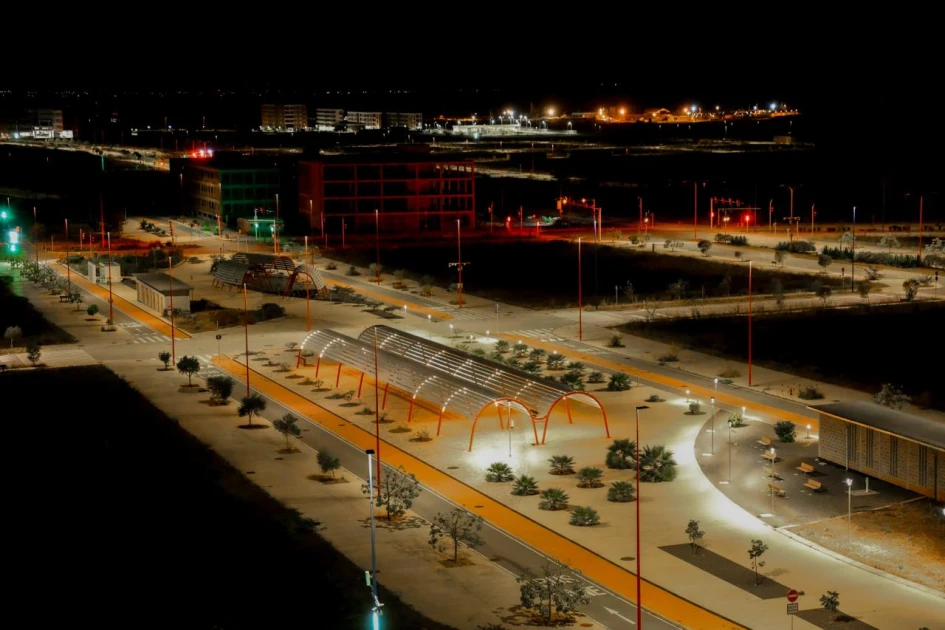
Konza Technopolis at night, with illuminated buildings housing businesses across technology, export processing, higher education and data centres, reflecting Kenya’s ambition to build a 24-hour economy.

Audio By Vocalize
John Paul Okwiri, Chief Executive Officer of the Technopolis Development Authority, says round-the-clock operations are essential to facilitating investors and sustaining the development of Africa’s Silicon Savannah.
“We are building Africa’s Silicon Savannah, so it means that we have to operate 24-7 in order to facilitate our investors, in order to ensure that the development of the technopolis continues until when we’ll be able to reach full build-out,” Okwiri says.
The 5,000-acre development has approximately 40 kilometres of internal roads, alongside electricity distribution facilities, solid-waste management and wastewater reclamation systems. The master plan designates specific uses for individual parcels, with the Government now focusing on attracting private capital to develop buildings and businesses.
The power infrastructure is designed to make it easier for investors to establish operations. Vincent Oyola, an engineer supporting the city’s daily operations, explains that the electricity distribution system connects individual parcels to the power supply.
“Currently, this is a 66 kV sub-distribution station, where we distribute power to the entire city,” Oyola says, explaining that the facility uses gas-insulated switchgear technology and transformers to step down electricity for distribution.
“So once an investor buys a parcel, it is plug-and-play,” he says.
Oyola says Phase One has sufficient capacity to meet its electricity demand, with 56 distribution cabins serving the development.
“For Phase One, we have enough power to supply our load demand for the entire Phase One of Konza Technopolis,” he says.
The city’s digital and research ecosystem includes an operational, Tier III Uptime-certified National Data Centre supporting the Government’s digital transformation agenda. The Kenya Advanced Institute of Science and Technology has also been completed and operationalised as a graduate-level research institution focused on science, technology, engineering and mathematics.
The Open University of Kenya and Riara University are among the institutions operating from Konza, bringing together academia, industry and government to support research, innovation and the commercialisation of knowledge.
Manufacturing is another pillar of the city’s economic ambitions. Investor Lucky DJX is establishing an export processing zone with factories initially focused on textiles and electronics, including solar products and accessories. According to Okwiri, the investor plans to recruit up to 10,000 people. This is a projected recruitment figure, not confirmed current employment.
The city’s housing programme has a commitment of 10,000 units, with the first 1,000 expected to be ready by November 2026, according to Okwiri. The master plan also incorporates public parks, green spaces, walkways and cycling lanes, with amenities intended to be accessible within a 15-minute walk.
Okwiri says Konza is moving beyond the excavation and underground infrastructure that characterised its earlier development.
“You know before you go up you must go down when you are developing. So you go down first, you establish the foundation and then now you start going up,” he says.
As more investors establish operations, Konza’s 24-hour vision rests on translating its infrastructure into sustained business activity, jobs and innovation, contributing to Kenya’s transition towards a knowledge-based economy.
Join the Discussion
Share your perspective with the Citizen Digital community.
No comments yet
This discussion is waiting for your voice. Be the first to share your thoughts!