
Kilumi, the dance saving a fading traditon among the Akamba

Audio By Vocalize
The tranquil nature of things that people have come to associate with rural life is not any different in Uvilisyani village in Emali, Makueni County.
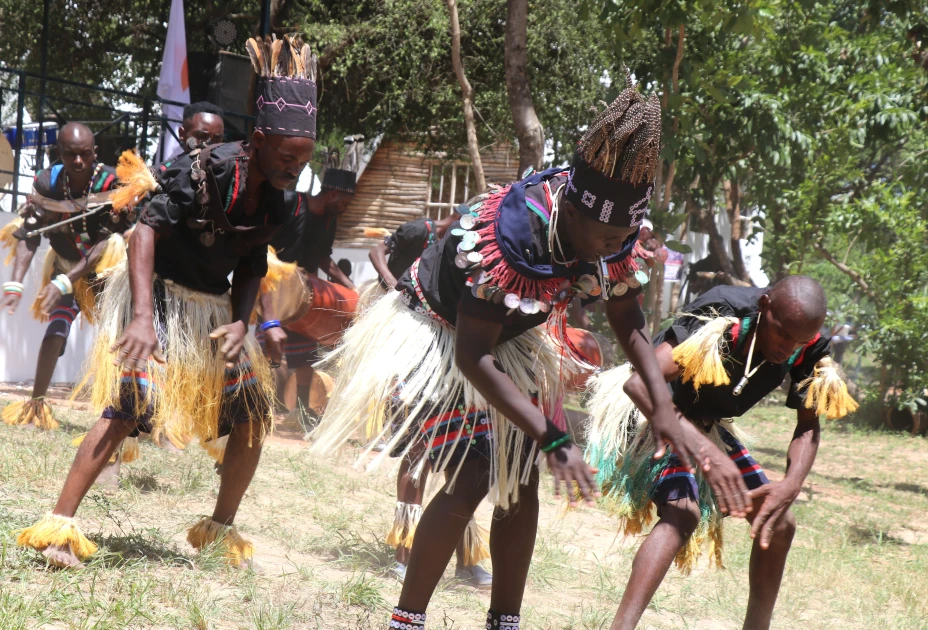
However, that familiar rhythm was once again interrupted by the echoes of loud drums, reverberating through time, confidently calling people together, to remember, to rise, to restore a tradition that has long been sidelined – the Kilumi dance of the Akamba.
The second edition of the Kilumi Festival returned on the weekend of April 4-5,
drawing larger crowds, fostering deeper conversations, and evoking an unshakable
nostalgic feeling of awakening.
The first edition of Kilumi Festival was a modest effort to bring awareness to the endangered Akamba traditional dances, but this year has seen it evolve to become a powerful cultural movement with the Kilumi dance at the centre of it all.
Kilumi dance is a traditional Akamba dance rooted in healing, ritual, and communal expression that has, for many years, skirted the edge of disappearance as fewer and fewer people practised it.
But as the echoes of drums across Uvilisyani
village and dancers of all ages and orientations took to the arena, it was
evident that the desire to reclaim it has been gaining momentum.
“This is not just a festival anymore,” said
Mutuku Muindi, founder of the Akamba Cultural Centre and Museum and the brains
behind the festival. “It is becoming a space where people reconnect not only with
their past, but with each other, and with what it means to be the Akamba people”
It is a message emphasised by Prof. Kivutha Kibwana, the former Governor for Makueni County, who has been a strong champion of the Akamba culture.
“We need
to go back to our cultural roots even as we do new models of development
because these cultures are very much part of what we do in our daily lives.”
Prof.
Kibwana underscored the importance of culture in development, “Our constitution
says that culture is the foundation of the civilisation of our country, but
that remains on paper. Look at countries like China, Japan and India, they
build their development based on their culture and don’t accept the
supplementation of their cultures by Western civilisation.”
The 2026 Kilumi Festival edition drew a diverse audience and performances including Mwazindika, a Taita traditional dance that was recently inscribed by the United Nations Education, Scientific and Cultural Organisation (UNESCO) to safeguard it from extinction.
Another troupe of Burundian refugees residing in Nairobi
lit up the stage with electrifying performances whose drumming would be felt
kilometres away.
Beyond
the performances, the conversation with the attendants reveals a yearning for
intangible cultural heritage. Among the voices that stood out was Prof. John
Muteti, who drew from memory to remind the audience of Kilumi’s deeper
meaning.
“I
remember as a young boy seeing old men and women in our village dancing Kilumi
and offering sacrifice to Ngai just before the rains,” he reflected. “And even
during thanksgiving after a good harvest. It was not just entertainment, it was
communion, it was togetherness, it was life itself.”
His
recollection further grounded the festival in its original context; as a sacred,
spiritual and communal practice, not merely a performance art. There was
purpose in the dance, in the drums and the regalia.
Prof. Muteti went further, touching on a fascinating and little-known cultural topic; the existence of Kamba Cua, a community in Paraguay in South America, believed by some scholars and cultural enthusiasts to be descendants of the Akamba people in Kenya.
According to him, the community has preserved dances and
drumming styles that are strikingly similar to Kilumi in tune, tempo, and
rhythm.
“The
resemblance is not accidental,” he mused. “There are cultural threads that may
connect us across continents and we must explore them.”
Prof. Muteti revealed that the curiosity is already shaping plans for a group of Akamba cultural enthusiasts who hope to travel to Paraguay, to engage with the Kamba Cua community with hopes of inviting them to participate in future editions of the festival.
If realised, such an exchange could transform the
Kilumi Festival from a local revival effort into a global cultural bridge.
The
festival also drew voices linking culture to broader questions of environment,
identity, and policy. Nicholas Syano, founder of the Drylands Natural Resource
Centre, framed the event as part of a larger awakening.
“The
turnout you see here is not by accident,” he said. “It is a testament to a
growing thirst for indigenous knowledge that sustained communities long before
modern systems.”
Through
his work, which blends culture with permaculture and the planting of indigenous
trees, Mr. Syano has championed the idea that cultural preservation and
environmental conservation are deeply intertwined.
“Our traditions carry wisdom about land,
seasons, and survival,” he added. “When we lose culture, we also lose that
knowledge.”
He
challenged the government to take a more active role not only in supporting
festivals like Kilumi Festival but also in addressing historical injustices,
including the repatriation of cultural artefacts taken from Kenya decades ago.
“This
is a wake-up call,” he said. “We cannot talk about preserving culture while
pieces of it remain locked away in foreign institutions inaccessible to its
people.”
His remarks echoed a sentiment increasingly shared across the continent: that cultural revival must go hand in hand with cultural justice.
The echoes of Kilumi drums are not quiet defiance anymore, they are the deliberate strikes of a stick to skin that carry the history that refuses to disappear.
They carry the sounds
from the paths where elders gathered, a heartbeat of songs not just sung but
lived. They insist on remembrance, persistence and an undeniable rise of
memories that refuse to fade. Kilumi Festival is a call to reconnect.
This is why, beyond the rhythm and spectacle, the deeply spiritual elements of Kilumi left a lasting impression on many first-time attendees.
The moments of trance
and possession which are pivotal to the traditional meaning of the dance unfolded
before an audience that was inspiring both awe and respect.
“It is the first time I have seen someone
completely possessed, and seeing them being calmed back to themselves is an
experience that will live in me,” said Mary Gathoni. “I also liked how they
fine-tune the drums by heating them near a fire.”
Her observation captured the nuanced nature of Kilumi; not just as performance, but as a living ritual where sound, spirit, and community converge.
The act of heating the drums, a traditional method of tightening the skins to achieve the desired tone, stood out as a subtle yet powerful symbol of the inherited knowledge embedded in the practice.
For newcomers like Gathoni,
the festival was more than cultural exposure; it was an initiation into a
worldview where music is not just heard, but felt and where dance becomes a
bridge between the physical and the spiritual.
As the drums rolled on and dancers moved in synchronized rhythm, the festival grounds became a meeting point of past and future where memory met ambition, and where tradition found new relevance.
Young people, many encountering the Kilumi
dance for the first time, joined in with enthusiasm and wonder. Elders
watched with cautious optimism. And for a brief moment, the generational gap
seemed to narrow bridged by rhythm, movement, and shared identity.
“I
had only heard these stories,” said one young attendee. “But now I see it, I
feel it. It makes me want to learn more.”
That desire may well be the festival’s greatest success. It is an awakening that inspires hope that traditions will not fade away and a promise that reconnections start with remembrance. It is a call to gather, awaken, remember and belong.
In the rhythm lives a language older than words. Because while the challenges of cultural erosion remain real, the second edition of the Kilumi Festival suggests a shift from nostalgia to action, from concern to commitment.
With every reverberation, the drums are reaching far and wide, into corners where culture was fading and the urge to rise again, to breath and to live is stronger than ever.
The Akamba culture is not preserved in relics of the past
any more. It has a heartbeat rooted in the truths of who its people are; now,
today and forever.
As dusk settled over the Akamba Cultural Centre and Museum and the final drumbeats faded, what remained was not just the memory of a festival, but the sense of a journey underway. To reclaim what was nearly lost. To reconnect across generations, and perhaps even across continents.
A journey, quite literally,
back to the roots. The Akamba are remembering, they are rising and they shall
restore their roots one Kilumi Festival at a time!
Join the Discussion
Share your perspective with the Citizen Digital community.
No comments yet
This discussion is waiting for your voice. Be the first to share your thoughts!