
Kenya’s missing shelters: How the lack of safe houses leaves GBV survivors exposed
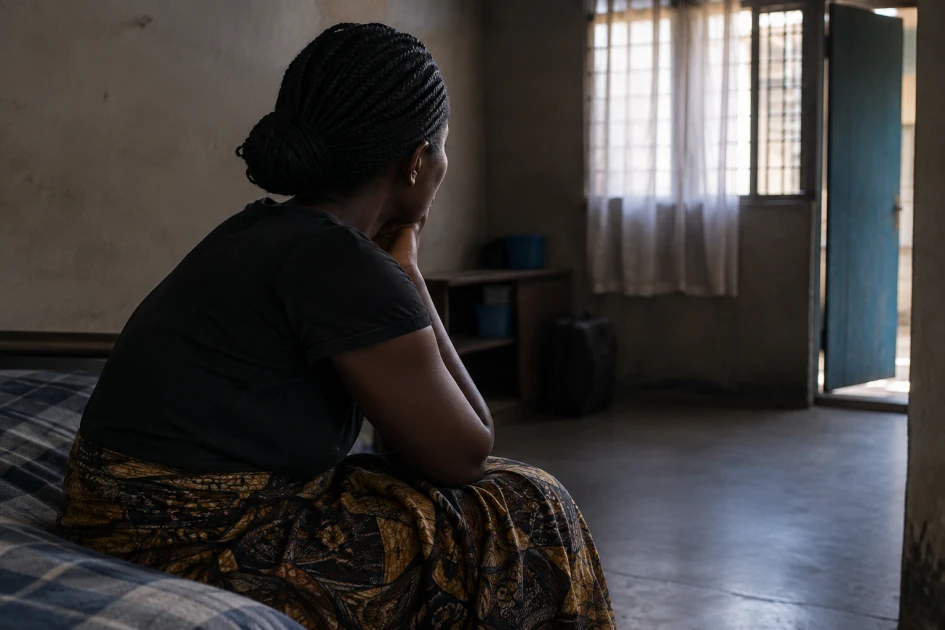
AI-generated image for illustration purposes only. It does not depict an actual GBV survivor, shelter, or incident.

Audio By Vocalize
Her daughter’s soft snuggles disrupt the quiet ambience in the room. A wooden chair with a slim cushion by the corner, a brown sitting stool on the other end, and a bed, with a blue mosquito net hanging from the planks of wood that would hold a ceiling board in place. It is neat. Cosy enough for mother and baby.
Waridi’s life took a turn in 2023 when her father sexually assaulted her. Her case is still pending in court. Her paternal relatives have declared her an outcast for daring to speak up against the abuse.
A field study report titled "Reporting, Investigation, and Adjudication of Child Sexual Exploitation and Abuse in Kenya" which was released in June 2026, showed that only 33% of sexual abuse cases are concluded in court within six months, while nearly half take over a year and some stretch for up to two years.
Out of reviewed adjudication data, 7% were formally withdrawn, with another 7% of cases stalled because perpetrators absconded.
Elizabeth Anyango, a research and evaluation officer at MIDRIFT HURINET, one of the organisations that took part in the study, points out that delays, weak evidence preservation, and pressure for out of court or family level settlements routinely compromise justice and shield perpetrators from accountability.
“Many people believe that child abusers are strangers, but the reality is very different. Across the seven counties, including Kisumu and Busia, where the study was conducted, 54 per cent of the perpetrators were male and very well known to the child,” she said.
Homeless and destitute, she got a partner who offered her shelter only to throw her out when she became pregnant.
“He told me he has a wife and that it was my responsibility to make sure I do not get pregnant.”
Caught in the same predicament as she was years back, Waridi sought shelter with a friend, who then referred her to a well-wisher where she has been staying.
According to the National Shelter Network, a women's rights NGO that was registered in 2003, Kenya has only six government-run safe houses with 56 others being run by private entities, often gender rights lobby groups.
The ministry of Public Service, Gender, and Affirmative Action says that it is planning to set up an additional 17 safe houses run by the government as part of wider efforts to eradicate cases of sexual gender based violence, and offer a safe haven for survivors to recover while they seek legal recourse.
The 2026 Kenya economic survey showed that girls remain at risk of sexual violence, where 235,938 adolescent and young girls were pregnant.
Mary Makokha, the founder of a local NGO called Rural Education and Economic Enhancement program (REEP) based in Busia, says that the lack of government run shelters hinders the course of justice for teenagers who have survived sexual abuse, and stifles the healing process.
“I once had a case where we had to refer to Makueni because the girl’s life was in danger. Running a private safe house means that we suffer risks of attack. It is a relief that we have virtual court sessions, so the girl does not have to travel back and forth.”
Makokha, says adolescent and young women who become pregnant as a result of sexual abuse often face community coercion, suppressing any form of justice.
While the National Police Service, healthcare providers, and the Judiciary form the visible pillars of the criminal justice system, safe houses represent the bridge holding them together, which remains unbuilt and unfurnished.
The Budgetary Void: Policy Commitments vs. Fiscal Realities
Despite high-level national policy commitments and international pledges, fiscal allocations at both national and county levels reveal a stark disconnect between anti-GBV rhetoric and tangible budgetary priority.
In the 2026/2027 financial year, the state department of gender was allocated Kshs. 6,261,403,525 with 33% of the money ringfenced for recurrent expenditure. The same kitty expected to serve the fiscal needs of the National Gender and Equality Commission - Kenya, as well as gender mainstreaming projects.
According to the State Department for Gender and Affirmative Action Strategic Plan (2023–2027), alongside the National Policy for Prevention and Response to Gender-Based Violence (2014) and Kenya's Roadmap to Ending GBV and FGM by 2026, the the ministry's role is primarily coordinating, regulatory, and policy-lens while leveraging localised instruments like the National Government Affirmative Action Fund (NGAAF) to set up and equip the safe houses.
The State Department for Gender, however, directs its limited operational allocations towards policy formulation, dignity kit distribution, and awareness campaigns. Consequently, the heavy financial burden of providing direct emergency housing, psychosocial support, and legal preparation is thrust almost entirely on non-governmental actors.
The county government of Kisumu operates under its Sexual and Gender-Based Violence (SGBV) Policy of 2019, within the Department of Sports, Culture, Gender, and Youth Affairs. While the policy framework explicitly details the need for comprehensive survivor protection, actual line-item allocations are routinely swallowed by administrative costs, stakeholder meetings, and policy reviews.
Advocacy Groups Sound the Alarm
Women's rights organizations and civil society coalitions are increasingly vocal about how this budgetary inaction directly sabotages the administration of justice. Easter Oketch, the Executive Director of Kenya Female Advisory Organization (KEFEADO), emphasizes that the absence of state protection mechanisms leaves survivors entirely defenceless against patriarchal coercion.
"Safe shelters are not luxury amenities, they are mandatory legal infrastructure required to protect the integrity of the judicial process. When a survivor of sexual violence has nowhere to sleep, asking her to be a brave witness in court is an impossible demand. The state is failing in its primary duty of care."
KEFEADO and allied civil society networks have been agitating for Gender-Responsive Budgeting across county assemblies in Western Kenya.
They are pushing both national and county assemblies to move beyond policy paperwork and ring-fence specific, non-withdrawable capital funds for the construction and maintenance of public rescue facilities.
“Existing private shelters face overwhelming operational strain. They rely on short-term donor grants. When grant cycles end, facilities either scale down or shut down, what then happens to these girls and their children?” opines Easter.
The National Strategy: A Paper Guarantee?
Kenya’s National Policy on the Elimination of Gender-Based Violence and its corresponding implementation strategies outline clear blueprints for multi-sectoral response, emergency healthcare access, legal aid, and victim protection.
These include scaling up the National Police Service's integrated response units, integrating medical, legal, and psychological support into Universal Health Coverage as well as establishing county recovery centers and safe houses and deploying multi-sectoral coordination frameworks.
Yet, without dedicated, permanent brick-and-mortar shelters financed directly by public treasuries, the national strategy remains a paper guarantee.
In response to growing public outcry over femicide and GBV rates, government officials have repeatedly reiterated plans to expand GBV recovery centres and strengthen law enforcement coordination. However, civil society groups insist that policy declarations mean little without visible line items in the National Treasury’s estimates and County Integrated Development Plans (CIDPs).
Atieno(not her real name), a 17 year old mother of one also had a similar predicament as Waridi. However, she was taken in by a friend’s mother in Kisumu’s Nyalenda estate in 2025. She is now a tailor, an apprentice skill she learned in order to fend for herself and her 4 year old son.
“I sometimes think of how my life would have turned out if I had the support of a shelter over my head when I was kicked out. My own family turned on me,” she says as tears well up in her eyes.
Atieno was ostracised after she went to report her brother for sexual abuse. He was however sentenced to a 20-year prison term. The decision was appealed, and is still active in a Kisumu court.
“I am healing, but it is not easy. I have not spoken to my parents and siblings for years. I am grateful for what I have now, but I can’t help but think that life would have turned out better than this.” says Atieno.
Waridi, on the other hand, cradles her baby girl. For survivors who are navigating motherhood at a tender age, the right to safety and justice should not depend on whether an overextended non-profit shelter has an extra bed available on any given night, or the mercy of a well wisher who picks them up from the roadside.
Until the national government and county administrations pool and streamline their respective gender based violence elimination roadmaps, perpetrators will continue to exploit the systemic and structural gaps, and the pursuit of justice will remain an unattainable privilege for Kenya’s most vulnerable.
Join the Discussion
Share your perspective with the Citizen Digital community.
No comments yet
This discussion is waiting for your voice. Be the first to share your thoughts!