
Kenya's GDP to rise to 4.7% in 2027 - IMF projects

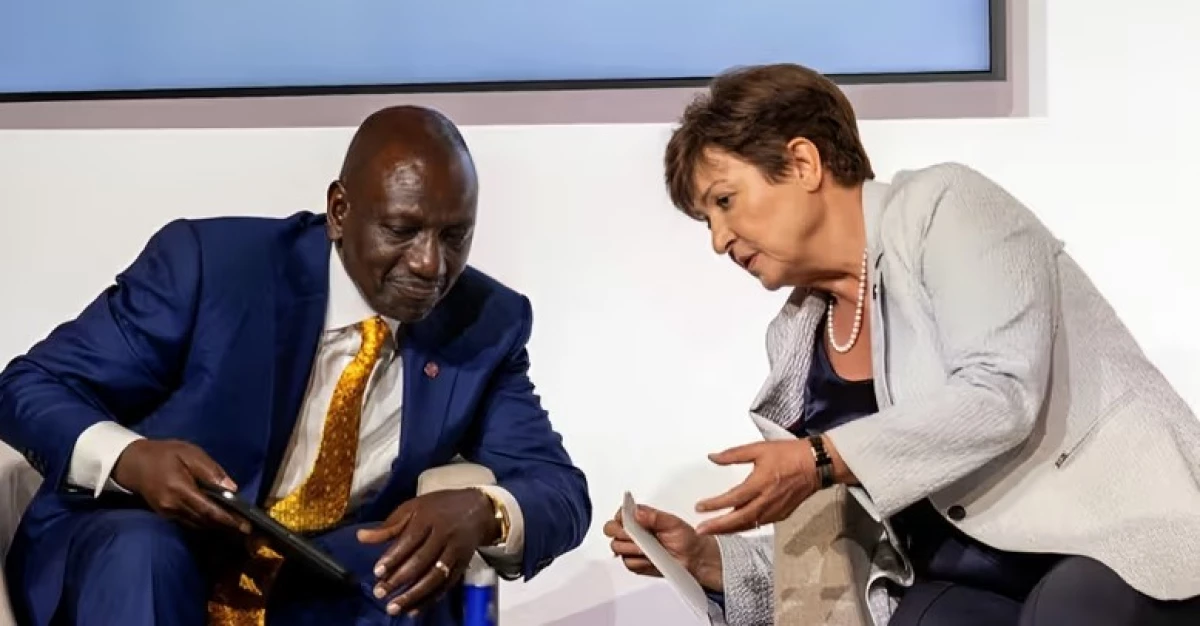
President William Ruto (left) speaks to Kristalina Georgieva, managing director of the IMF at a past forum. PHOTO/COURTESY

Audio By Vocalize
In its new growth estimates, the IMF attributed the forecast to easing domestic inflation and cooling global oil shocks as global energy prices bounced back following the short-lived ceasefire in the Middle East.
The forecast considered consumer prices and current account balances as key factors that will heavily steer Kenya's macroeconomic health and overall GDP growth trajectory.
Meanwhile, the Consumer Price Index (CPI), which tracks the average cost of a basket of essential goods and services, highlights an inflation spike in 2026 and a decline in 2027.
The inflation rates rose from 4.1% in 2025 to 6.0% and are projected to sit at 5.0% in 2027.
IMF uses these indicators to determine the economic ease Kenyans will have and how well the country can handle its foreign currency demands.
This means that Kenyans might experience stabilized prices for essential commodities and a progressively lower cost of living for households, expanding the consumption share of GDP.
Different institutions have pointed to a recovering economy for Kenya, while the Central Bank projects a slightly aggressive growth of 5.3%.
The Central Bank attributes the growth to stronger internal rebounds in industrial output, agriculture, and services.
This outlook follows its decision during its October 2026 Monetary Policy Committee (MPC) meeting to upwardly revise its 2026 GDP growth forecast to 5.0% — up from an initial 4.9%.
It also expressed confidence that private sector credit growth has bounced back following recent monetary easing, expanding by 10.6%.
This recovery, it added, will give local businesses and households better access to capital for investments and spending.
The World Bank, on its part, has projected a 4.4% GDP growth attributing it on adequate agricultural harvests, easing monetary policy, a stable exchange rate and recovering credit to the private sector would help cushion the economy.
Its average baseline however factored in caution around election-year investment delays.
The IMF reports that global headline inflation rose in August, prompted by the Middle East war, while core inflation remained moderate, even though core goods prices in some advanced economies started to reflect the rapidly rising cost of memory chips.
Global growth is projected to decelerate from 3.5 per cent in 2025 to 3.1 per cent in 2026 before recovering to 3.4 per cent in 2027.
Fiscal policy, the IMF says, remains loose; public debt is rising as deficits are historically large in several major economies.
Join the Discussion
Share your perspective with the Citizen Digital community.
No comments yet
This discussion is waiting for your voice. Be the first to share your thoughts!