
Kenya's burning schools: A brutal cycle of death, tough talk and broken promises

Audio By Vocalize
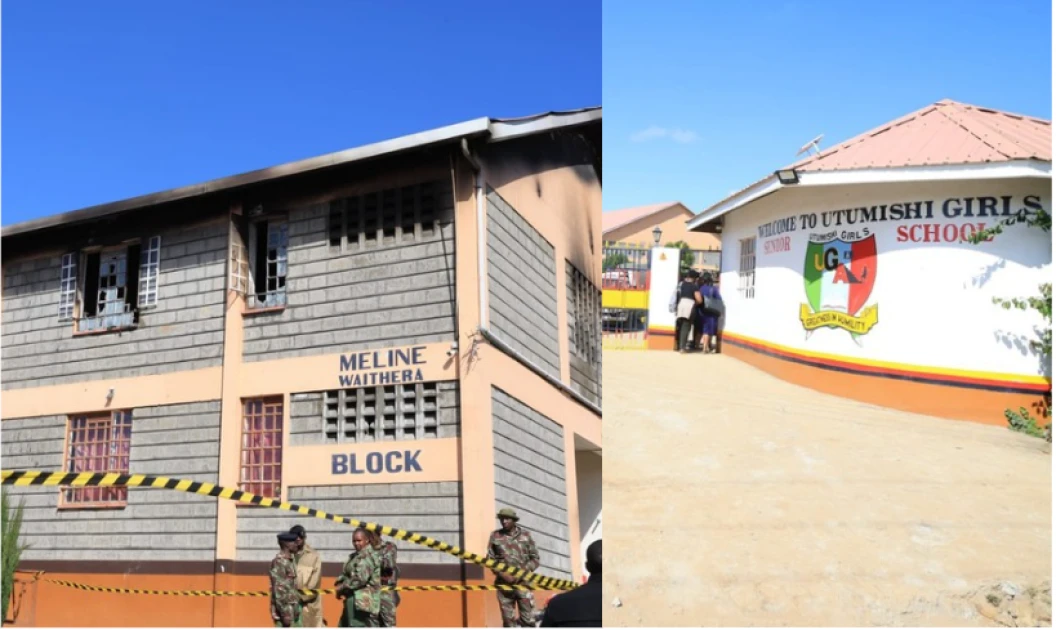
16 students were confirmed dead, 73 others hospitalised with varying degrees of physical injury and trauma. Some students, in sheer desperation, jumped from balconies to escape the inferno, a detail that speaks with grim eloquence to the failure of proper emergency exits.
Senior officials, including Interior CS Kipchumba Murkomen, Education Cabinet Secretary Julius Ogamba, DCI Director Mohammed Amin, Nakuru Governor Susan Kihika and a horde of Members of Parliament had converged at the scene by mid-morning.
The cause of the fire remains unclear, and investigations are ongoing.
What is not unclear, however, is what informs the wider pattern. This fire is not an anomaly. It is, rather, the latest chapter in a decades-long national tragedy that has consumed hundreds of young lives in Kenyan boarding schools.
A tragedy met, repeatedly, with task forces, safety manuals, tough presidential language, and ultimately, inaction.
A grim chronology
Kenya's school fire crisis stretches back well over three decades, but the past 20 years have been particularly devastating.
The single deadliest school fire in Kenyan history occurred in March 2001 at Kyanguli Secondary School in Machakos County, where 67 boys perished after their fellow students deliberately set a dormitory alight.
Survivors indicated that grievances over fee arrears and the cancellation of national examination results the previous year had fueled the unrest.
The case against the two 16-year-old boys implicated in the fire was declared a mistrial, meaning no one was ever punished for one of Kenya's most catastrophic acts of arson.
The tragedy at Kyanguli was not an isolated event. It followed a fire at Bombolulu Girls Secondary School in Kwale County in 1997, where 26 girls died, having been trapped in an overcrowded dormitory with a single door for both access and exit that had been locked from the outside and barred windows that prevented escape.
The school was subsequently renamed Mazeras Memorial Girls' School in honour of the victims. Before that, in 1991, a fire at St. Kizito Secondary School in Meru resulted in 19 deaths in an incident that shocked the entire nation.
In 2010, two Form One students died in a dormitory fire at Endarasha Boys Secondary School.
In 2012, eight students were killed at Asumbi Girls Primary School in Homa Bay County, an incident attributed to an electrical fault.
A wave of arson swept through Kenyan schools in 2016, during which more than 100 high schools experienced fire incidents in apparent student protests against shortened holidays and restricted parental visits.
These measures were a consequence of then-Education Minister Fred Matiang'i's crackdown on exam cheating. In that wave alone, 239 cases of fire and 244 other forms of unrest were recorded, with 228 of the 282 buildings burnt being dormitories.
Then came the September 2, 2017, fire incident at Moi Girls High School in Nairobi, a prestigious national school with over 1,180 students.
Fire broke out at 2:00 a.m. in one of the dormitories, ultimately killing 10 students. Then-Education Minister Matiang'i confirmed it was due to arson.
An 18-year-old girl was eventually sentenced to five years in prison for her role in the blaze; she had been just 14 at the time, a Form One student, and the court found that her intention had not been to kill her schoolmates, but to force a transfer out of the school.
Less than two years ago, before Thursday's tragedy, on the night of September 5, 2024, a dormitory housing 156 boys at Hillside Endarasha Academy in Nyeri County caught fire, killing 21 pupils aged between 10 and 14.
The official report revealed that the dormitory was overcrowded as it housed 164 boys in a space grossly inadequate for such numbers, and that the exit doors were dangerously narrow, hindering swift evacuation.
The school had to eventually shut down its boarding facilities following a court order and converted itself to a day school.
In the years between these headline tragedies, scores of smaller fires have occurred, at Isiolo Girls, Njia High School in Meru, Bukhalarire Secondary in Busia, Kakamega High School, BuruBuru Girls, and dozens more, almost all forgotten in national conversations within weeks.
What the government has prescribed and failed to enforce
The Utumishi Academy tragedy is compounded by the fact that Kenya has not lacked for prescriptions. The country has produced reports, task forces, circulars, and manuals, all gathering dust while dormitories continue to burn, and worse, children keep dying.
The 2008 Safety Standards Manual for Schools
This document remains the foundational government policy governing school safety. It is remarkably specific.
It mandates that the space between dormitory beds should be no less than 1.2 meters, with corridor space of at least two meters.
All dormitory doors must be at least five feet wide, open outwards, and must never be locked from outside when learners are inside.
Each dormitory is required to have a door at each end and an additional emergency exit in the middle, clearly labelled.
Windows must be free of grills and easy to open. Fire extinguishing equipment must be functional and placed at each exit, with fire alarms fitted at accessible points.
Evacuation maps must be posted at every entrance and exit. Fire drills are to be conducted at least twice per term.
The 2016 Omolo Task Force
In 2016, then-CS Fred Matiang'i convened the Omolo Taskforce after the mass wave of school unrest and arson.
In its review of an earlier report, the Wangai Report, it found that of 168 recommendations, only 65 had been fully implemented, 67 partially implemented, 33 not implemented at all, and three were still under implementation.
The task force flagged numerous schools across the country which were failing to enforce basic fire safety protocols. It produced 68 recommendations, most of which were supposed to be implemented within six months to a year.
A 2020 audit by the Office of the Auditor-General
The audit found that many schools were ill-prepared to deal with fire emergencies, noting that "implementation of fire safety measures put in place by the Ministry of Education faced many challenges, such as inadequate infrastructure and limited training in fire safety preparedness."
In 2021, following a fresh spike in arson attacks, Basic Education Principal Secretary Belio Kipsang issued a circular to boarding secondary schools instructing them to deploy more teachers on duty around dormitories, enhance guidance and counselling services, and conduct regular spot checks before learners went to sleep.
In 2024, after the Endarasha school tragedy, President William Ruto directed the Education and Interior ministries to ensure compliance with boarding school regulations.
He ordered a nationwide safety audit, a multi-sectoral inspection involving the Ministry of Health, the Department of Public Works, county governments, and the Red Cross.
Education CS Julius Ogamba agreed to hold anyone found culpable accountable. Head of Public Service Felix Koskei ordered the immediate inspection of all school infrastructure.
The government promised to prosecute violators. That was then; less than two years later, Utumishi Girls Academy caught fire.
The architecture of failure
Why do the same tragedies keep repeating? Analysts and education stakeholders point to a confluence of factors.
Structural non-compliance
This is an endemic factor. A 2024 report by the Usawa Agenda found that most boarding schools are unsafe for children, with spacing between student beds below the required guidelines.
Less than half of the surveyed schools adhered to safety guidelines, with issues ranging from faulty structures to missing fire extinguishers.
Data from the Kenya Fire Protection Association indicates that over 60 per cent of school fires are attributable to electrical faults, suggesting that even fires not caused by deliberate arson are products of neglected infrastructure.
Overcrowding
Overcrowding is another persistent driver, as Kenya's public boarding schools are chronically stretched beyond capacity.
When schools pack more students into dormitories than they are designed to hold, safety margins collapse, and so do evacuation prospects when a fire starts in the dead of the night.
Arson and student unrest
These remain significant causes. A 2017 report by Kenya's National Crime Research Centre blamed exam stress, long school terms, and poor teacher-student relations.
The report flagged students in different schools coordinating via smuggled phones, which produced copycat incidents.
The Ministry of Education has itself acknowledged drug abuse, hostile teacher-student relationships, and inadequate counselling as contributing factors.
Impunity
This compounds many factors, for instance, the alleged Kyanguli arsonists were never convicted. Prosecutions in school fire cases have been rare and inconsistent. Without accountability, deterrence is absent.
Enforcement gaps
Enforcement gaps remain largely structural as Quality Assurance and Standards Officers (QASOs) only apply on paper.
The government has acknowledged in some forums that the Quality Assurance and Standards Directorate is chronically underfunded, limiting its capacity to inspect and compel compliance across thousands of schools nationwide.
A question of political will
After every tragedy, a familiar ritual unfolds: senior officials arrive at the scene, cameras roll, condolences are offered, investigations are announced, and task forces or committees are formed.
Then the news cycle moves on, and the reports join their predecessors on shelves.
The Utumishi Girls fire of May 28, 2026, fits this pattern precisely. Within hours of the blaze, the Interior CS, the Education CS, the DCI Director, the Deputy Inspector General, the Nakuru Governor, and MPs had all descended on the school. Statements of grief and promises of accountability were issued.
The real test will come in the months ahead, whether the dormitory doors at Kenya's thousands of boarding schools will finally be made to open outwards and remain unlocked at night; whether fire extinguishers will be serviced and in place.
Whether emergency exits will be lit, mapped, and drilled; whether the 68 recommendations of the 2017 task force will finally be pulled off the shelf; and whether Quality Assurance officers will be given the resources and mandate to enforce compliance rather than simply document it.
Sixteen young girls brutally and unnecessarily lost their lives at Utumishi Girls Academy before dawn.
Unless something structurally changes not just in official rhetoric but in budgets, inspection regimes, and prosecutorial will, they might, sadly, not be the last.
Join the Discussion
Share your perspective with the Citizen Digital community.
No comments yet
This discussion is waiting for your voice. Be the first to share your thoughts!