
Kenyan 'dancing queen' Mary Moraa cautious ahead of Paris Olympics
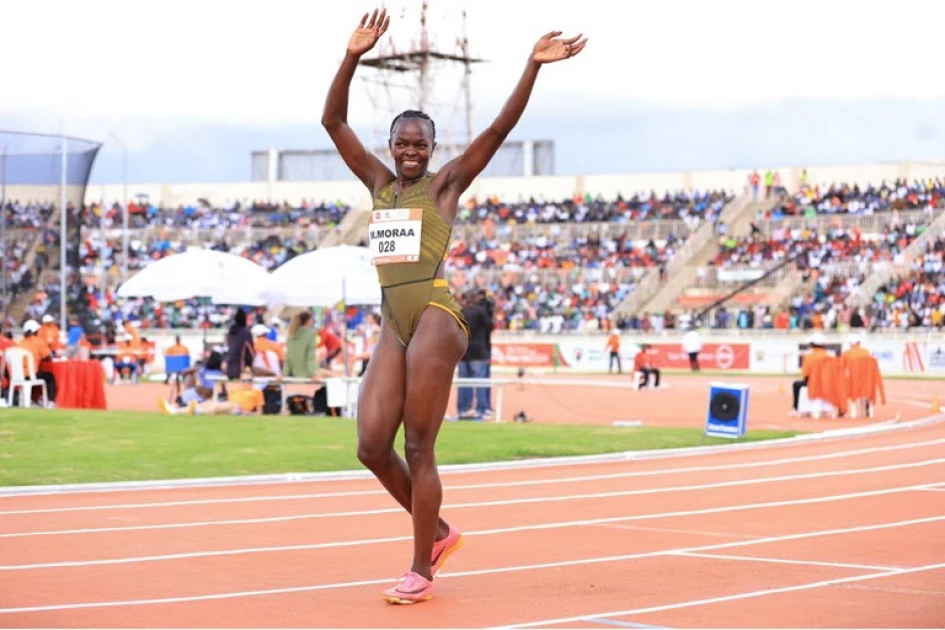
World champion Mary Moraa is all smiles after setting a Kip Keino Classic Meeting record enroute to winning gold in the 800m race at Nyayo National Stadium. PHOTO/Citizen Digital/Sportpicha

Audio By Vocalize
An orphan who grew up without even a picture of her mother,
Kenyan Olympic hopeful Mary Moraa's personal hardships keep her cautious about
her chances in Paris -- despite being crowned world 800m champion last year.
She leapt over the finish line in Budapest in August to
achieve a career best of 1:56.03, ahead of Britain's Keely Hodgkinson and the
defending champion, American Olympian Athing Mu.
Moraa celebrated with a few of the moves that have earned
her the nickname "dancing queen" in her home country.
The levity masks the difficulties the 24-year-old has had to
overcome in life, and her determination to succeed for her siblings.
"I push myself to the limits, because I'm the
breadwinner for my family," she told AFP in an interview earlier this
year.
Still, Moraa remains wary about making predictions for the
Paris Olympics –- despite dreaming of the title that will cement her place
among the sport's elite.
"I can't say: 'I'm Mary Moraa, I'm going to win
gold'... My goal is to finish on the podium."
She is on the Kenyan team for both the 800m and the 400m --
her first passion and where she first established herself.
Moraa has hit the tracks a lot this season, clocking eight
victories in nine 400m races while competing in five 800m events, winning
three.
But Moraa's rise was not without its difficulties.
Her mother died when she was two, and just weeks later she
lost her father in a car accident, leaving her and three siblings orphaned.
Growing up in Kisii county in western Kenya, she did not
even have a photograph to remember her mother.
"I heard in the village people were saying my mother
was running, but there was no support.
"So when I heard people say that, I was like, I want to
run like my mother," Moraa said.
She and her siblings moved in with their grandparents, with
Moraa running some six kilometres (four miles) to school each day, before
winning a school bursary, and starting competitions.
She shone early in the 400m, winning silver in the under-18
world championships in 2017, and becoming African under-20 champion two years
later.
But disaster struck in 2019 when Moraa crashed at the world
championships in Doha in the semi-finals, finishing well outside the top 10.
Fellow Kisii runner and twice Olympic silver medallist
Hellen Obiri, fresh off her second world title in the 5,000m, took her under
her wing following her disappointment.
Examining her form, trainer Alex Sang and mentor Obiri
suggested she change track -– literally.
"I told her, 'You are good in 400m but if you try in
800m, it is something marvellous'," he said.
The speed she brings from 400m plays to her advantage when
competing in longer distance, he explained.
But Moraa said it was not the easiest of starts to a new
discipline. "I said to myself: This is not my distance, I want to go back
to 400m."
Post-pandemic, Moraa's progress is evident: semi-finals at
the Tokyo Olympics in 2021 (2:00.47) after only a dozen official races over
800m, world bronze medal in 2022 (1:56.71), followed by her first major title
at the Commonwealth Games (1:57.07).
And with each success has come a joyful dance at the race's
conclusion.
"I started dancing, even though I was tired."
Her shimmying capped her successes in the Diamond League
(Zurich in 2022, Rabat, Lausanne, Chorzow in 2023) before her Budapest crown.
"I decided to focus... to put my country
somewhere," she said, citing the careers of compatriots Obiri, David
Rudisha, Faith Kipyegon and Pamela Jelimo.
Ultimately though, her coach Sang said he reckons her
"slippery life journey" is what makes Moraa the athlete she is.
Join the Discussion
Share your perspective with the Citizen Digital community.
No comments yet
This discussion is waiting for your voice. Be the first to share your thoughts!