
Kenya, 10 regional states to strengthen cross-border disease surveillance
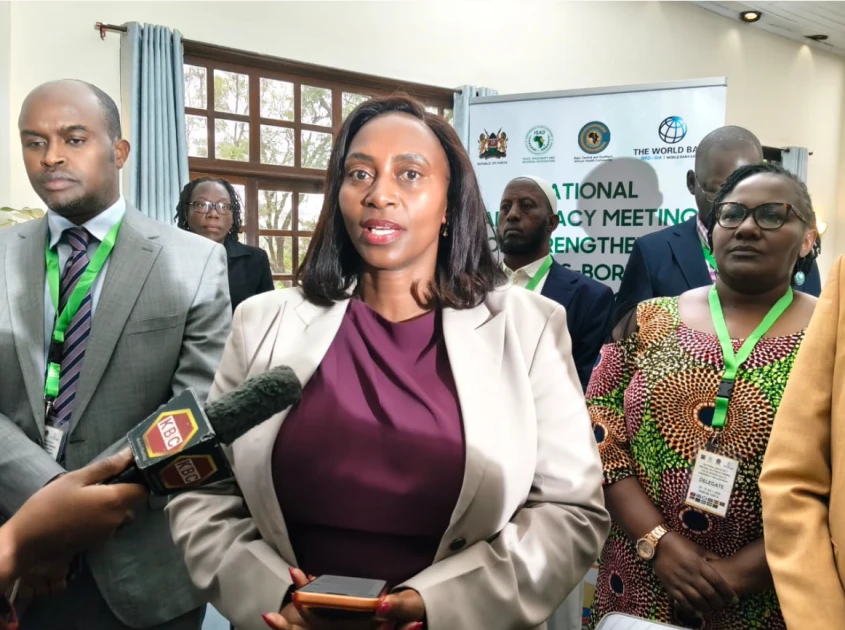
Public Health PS Mary Muthoni addresses the press after the National High-Level Stakeholders' Meeting on Strengthening Cross-Border Health Emergency Preparedness and Response in Nairobi on July 31, 2026.

Audio By Vocalize
Kenya and 10 countries in the IGAD region are set to sign a Memorandum of Understanding (MoU) to strengthen cross-border surveillance, data sharing and coordinated responses to disease outbreaks as governments seek to bolster regional preparedness for future health emergencies.
Speaking during the
National High-Level Stakeholders' Meeting on Strengthening Cross-Border Health
Emergency Preparedness and Response in Nairobi, Public Health and Professional
Standards Principal Secretary Mary Muthoni said the agreement will facilitate
real-time disease surveillance, harmonise health measures at border points and
improve joint resource mobilisation during disease outbreaks.
"Pathogens
have no boundaries and diseases too have no boundaries. We have to keep doing
surveillance amongst the countries to ensure that everything is well," PS Muthoni
said.
She said the
region also aims to strengthen Africa's health sovereignty by expanding local
manufacturing of medicines and medical supplies, noting that the COVID-19
pandemic exposed the continent's dependence on external suppliers.
PS Muthoni also
assured Kenyans that the country remains free of Ebola, adding that
surveillance has been intensified at border points, healthcare workers continue
to receive training and Kenya's laboratory capacity has significantly improved.
Dr. Waqo Gufu
Boru, Senior Medical Epidemiologist at the Intergovernmental Authority on
Development (IGAD), said the MoU will provide a framework for member states to
share critical health data and coordinate responses to emerging epidemics such
as Ebola and Mpox.
"This MoU is
focused towards strengthening cross-border collaboration and coordination to
enhance preparedness and response to health emergencies across the
region," Boru said.
Dr. Judith
Kose-Otieno, Regional Program Lead at the Africa CDC Eastern Africa Regional
Coordinating Centre, said the continental health agency is providing technical
support to the agreement and expects it to strengthen disease surveillance
across the region.
"Diseases
don't know boundaries, they don't need visas. There is a risk, but countries
are on the lookout, doing surveillance and monitoring everyone crossing their
borders," said Kose-Otieno
The regional
agreement is expected to improve coordination on disease surveillance,
emergency response, procurement of medical supplies and information sharing,
reducing the risk of cross-border transmission of infectious diseases.
Join the Discussion
Share your perspective with the Citizen Digital community.
No comments yet
This discussion is waiting for your voice. Be the first to share your thoughts!