
Inside the 10,000-seater stadium in Wajir set to host Madaraka Day celebrations
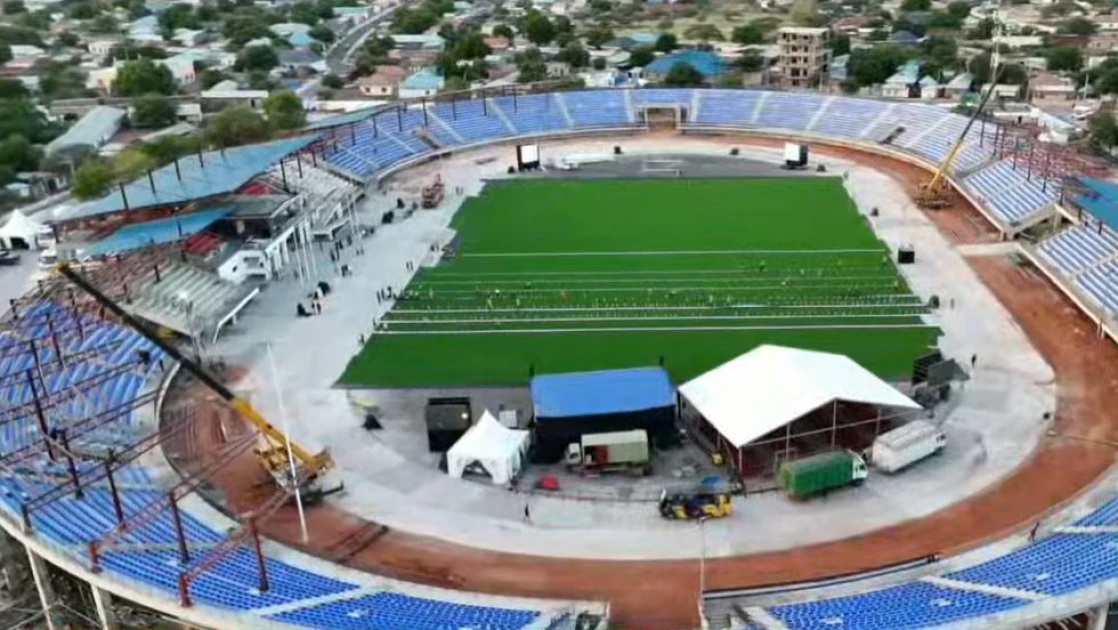
An image of the Wajir stadium under construction.

Audio By Vocalize
It has taken just over 100 days to put up a 10,000-seater capacity stadium in Wajir County, in what is becoming a spectacle for residents who never imagined they could host a national celebration this soon.
The piece of infrastructure has brought with it connected goodies replete with
a water purifying system and enhanced electrical capacity.
The Wajir stadium becomes the first of more than 20 that the Kenya Defence
Forces (KDF) is expected to implement across the country.
For the sixteen weeks, the KDF has been the project manager,
in charge of the design, implementation and oversight, working with a
contractor. Concrete and steel to the ground, planting a stadium where bare
ground existed.
Inside the stadium, school children are rehearsing for the 63rd
Madaraka Day Celebrations.
It may seem like the grounds they sit on have existed for
ages but it is brand new, the product of a presidential directive and groundbreaking
on February 13, 2026.
Working day and night, more than 900 construction workers have been here
turning aspirations into reality.
And with it, the mega facility redefines the terrain. It has 11 gates into the
stadium, with six exterior gates to control human traffic.
The stadium has a VIP pavilion with a capacity of 900, the terraces taking
9,100 participants and there are permanent seats already fixed.
At the pitch, artificial turf has been installed — it lies on asphalt
concrete similar to the road construction technology.
After the national celebrations, quartz sand will be poured
onto the artificial turf to improve stability and drainage.
On top of that, rubber or synthetic granules will be poured
acting as shock absorber for players. With good maintenance, the contractors
say, it can last for ten years.
Around the football pitch, a synthetic running track, known as tartan track
will be installed on the concrete, creating an 8-lane running track.
All these put in place of natural grass given the extreme hot
weather in Wajir. The intention is to extend the roof canopy all around the
stadium.
The stadium has come with two solar-running boreholes with a combined capacity
of up to 8,000 liters per hour. The boreholes are 170 metres and 150 metres
deep respectively.
The higher capacity borehole has a water purifying system
installed, also running on solar. It has the capacity to produce up to 1,000
liters per hour of safe to drink water.
The intention is to use the water at various drinking points in the stadium,
with dedicated supply to the community.
There are also upper floor has three VIP holding rooms. On the ground floor,
there are two changing rooms for the home and away teams. On this side there
are 40 bathrooms, including shower cubicles.
On the eastern side of the stadium, 40 washrooms are being put up for the
public.
Right outside the stadium a 315kv transformer stands. It
followed a new generator that was supplied by the national government, boosting
electricity supply in Wajir.
Residents and workers are getting a rare
scene. At inception it was said it would cost Ksh.900 million but this may have
gone over budget.
Interior Principal Secretary (PS) Raymond Omollo has said that the
remaining construction works will be completed in an estimated month after the
celebrations.
Join the Discussion
Share your perspective with the Citizen Digital community.
No comments yet
This discussion is waiting for your voice. Be the first to share your thoughts!