
Indigenous crops curb wildlife conflict, climate risk for Siaya farmers

Audio By Vocalize
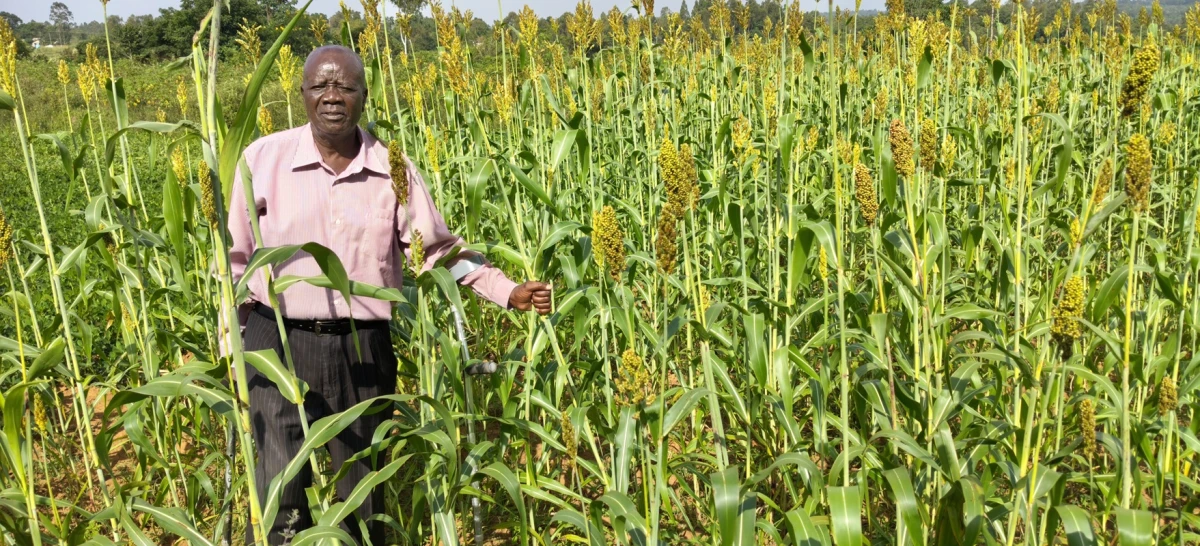
For years, Reckadiuse Owino a farmer from Got Osimbo sublocation in Siaya County, watched without help monkeys destroy his crops season after season.
The invasion forced him to abandon his farm exposing his
family to food insecurity.
Owino says the human wildlife conflict has intensified in
the area as monkey raid their farms in search of food.
“People have cut trees along the river banks and the forests
around this place forcing the monkeys to invade our farms and homestead in
search of food. Planting maize has become so hard because of monkeys. You have
to be in the farm from morning to evening to chase them away.
“If you can’t do that you can’t get any yield from the farm.
They start with you from the day you plant; after weeding they eat the maize
like sugarcane. The monkeys do not know when it is raining nor a weekend, they
eat your crops. They destroy everything and if action is not taken, they are
going to rend us food insecure,” said Owino.
However, Owino has found a solution in planting indigenous
crops. Since he started planting indigenous crops such as finger millet,
sorghum, and groundnuts, the conflict has significantly reduced.
In just a few weeks, his finger millet crop will be ready
for harvest.
“It seems they are not aware that I planted, nature has not
yet taught them, they have not eaten my crops. I have not camped in my farm to
chase them, the way I used to do when I planted the hybrid maize,” noted Owino.
Beyond reducing the conflict of resources with wild animals,
he notes that traditional crops are proving resilience with the change of
weather patterns.
“Most farmers have gone back to the traditional production
because of climate change. The crops are enduring climate shocks like short rains
unlike the hybrid crops which require more rainfall,” added Owino.
He explained that farmers who planted indigenous crops in
the last season harvested something with the shortened rainfall seasons, unlike
those planted hybrid which requires more rainfall.
“In the past years we used to plant twice a year during the
long rains of March and harvest in August and short rains from September to
December. But we have noticed changing weather patterns from the year 2025
where the rains are starting then end along the way before the crops mature,” said
Owino.
A few kilometres from here, Risper Agutu is bent over the
scorching sun uprooting weeds in her farm in Maugo village, Got Osimbo
location. She is expecting good harvest from her farm in a few months. After
receiving training on climate-smart agriculture, she adopted indigenous farming
practices that have transformed her harvests and strengthened her resilience to
harsh climatic conditions.
“Before I used to get 20 kilograms of maize in my quarter an
acre, but after training on climate resilience farming technologies, now I can harvest
five bags of maize even when the rains are not sufficient,” said Risper.
When planting season arrives, she prepares a nursery bed for
maize by mixing one wheelbarrow of compost manure with two wheelbarrows of soil
then wait the seeds to germinate. By the
time she transplants the maize to her farm she is certain that they will grow.
“I plant a maize seed in each of the container and ensure
they germinate. During the time of transplant, I ensure the roots are in good
condition. And after 27 days I cultivate the crops and now I use the urine from
my cows and goats as my organic manure for top dressing,” says Risper.
To safeguard traditional crop varieties from extinction, the
Got Osimbo community established a seed bank and gene bank with support from
development partners.
Lawrence Odipo, a recorder keeper at Got Osimbo seed bank
says the main reason they started this initiative was to preserve the
indigenous seeds and cultural heritage.
They store dry seeds in the seed bank and plants that cannot
produce dry seeds in a gene bank.
“We were first trained as farmers by GIZ organization on
climate smart agriculture on seed technology banking and with support of other
partners, we started the seed bank project,” added Odipo.
In the seed bank they keep variety of indigenous seeds like
sorghum, finger millet, maize, ground nuts, vegetables, cassava, yams among
others.
“With the climate conditions we are experiencing, the
rainfall patterns have changed and sometimes the rains come when the farmers
are not ready with fertilizers and seeds to plant making them plant late and
yield less because the rains are not predictable. We felt that it is good we
have the seeds kept to enable us plant on time,” noted Odipo.
Got Osimbo community has about 200 members where members get
seeds on loan and after yielding, they take back twice what they borrowed.
The department of Agriculture in Siaya county is encouraging
farmers to plant crops that will yield more and are more resilience to the
climate changes.
“We encourage farmers if there is a seedbank in a community,
they use those seeds because their moisture content and germination ability are
tested before storing the seeds,” said Loise Olwada, Agricultural officer
Ugunja Sub-county.
Loise noted that they have been training farmers on weather
patterns and advising them on what, where, when and how to plant.
“Climate change is affecting farmers especially change in
rainfall pattern and drought. Whenever there are search problems we do capacity
building to our farmers on seed selection, smart farming technologies, advise
on when to plant and fertilisers to use for better yields,” said Loise.
“Our work is to catalyse action towards more resilient
societies. We have seen changes in the recent past because of climate change.
We have seen increase in the disease outbreaks like Ebola and resource related
conflict because people have to look for pasture in other areas,” said Aluso.
He adds that community level innovations are very important
to be amplified, asking the government to provide supportive laws including
extensions services to provide enabling legal environment and not to come up
with prohibiting laws or regulations
As climate change continues to disrupt traditional farming
systems, the experience of farmers in Got Osimbo demonstrates how indigenous
knowledge and locally adapted crops can provide practical solutions to food
insecurity, environmental challenges and human-wildlife conflict.
Join the Discussion
Share your perspective with the Citizen Digital community.
No comments yet
This discussion is waiting for your voice. Be the first to share your thoughts!