
How the James Gichuru–Rironi Highway became a trail of red flags, nine years on
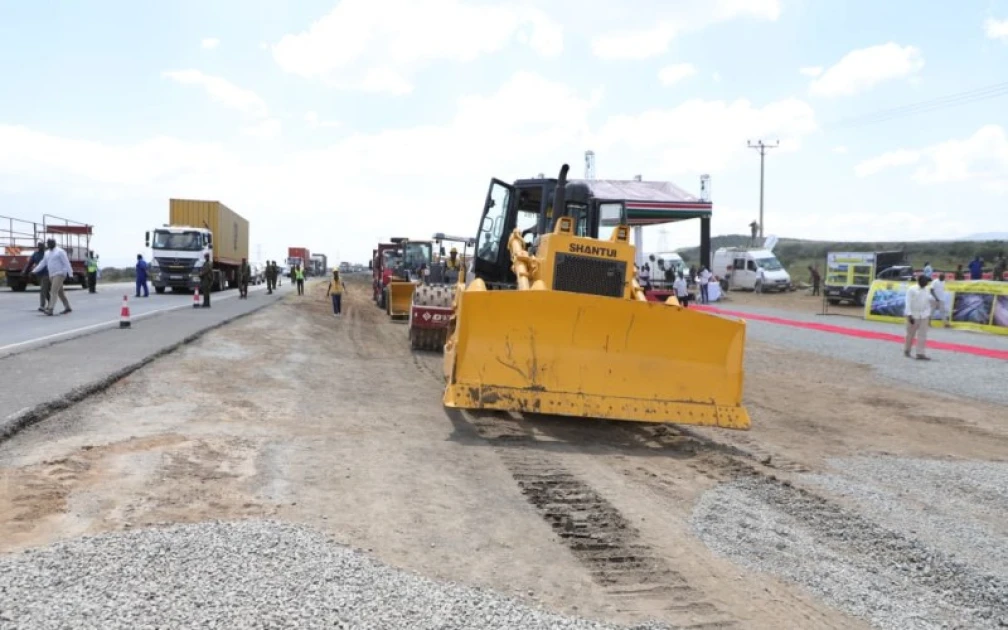
File image of road graders at work along the Rironi–Naivasha–Gilgil (A8) highway. Photo: KeNHA/X

Audio By Vocalize
It was titled the Draft Final Design Review Report for the upgrade of the A104 highway from the James Gichuru Road Junction to Rironi, a 25.3-kilometre stretch that, on paper, was the easy part of Nairobi's traffic problem to solve.
Widen an existing dual carriageway, add service roads, bolt on ten interchange bridges and a future Bus Rapid Transit corridor, and hand it back to motorists within three years.
The road reconstruction affected a number of businesses adversely. A number of fuel stations have remained moribund to date as are a number of other businesses that either closed down or relocated to other spaces that were more accessible.
Nearly a decade later, sections of that same road are still being closed for "surface dressing." The project that was supposed to be complete by August 2020 is now, by the government's own admission, targeting a finish line somewhere between August 2026 and June 2027, and even that has shifted more than once.
What the original review document reveals, read against the decade of delay that followed, is not simply bad luck. It is a project whose execution problems were visible, in writing, before a single new beam was poured.
The paper trail with red flags
The 2017 design review was meant to be a routine technical check before construction supervision began. Instead, it reads like an inventory of foundational problems.
The consultants found that the original topographic survey underpinning the entire design covered only 25 to 30 meters of the existing road corridor, while the widened highway required a "corridor of impact" of at least 50 meters.
In effect, half the ground the road needed to occupy had never been properly surveyed before the design was drawn up.
The review also uncovered errors in the project's own survey benchmarks; of thirteen reference points checked.
Several physical beacons were simply missing, and elevation figures at multiple points had to be corrected by more than a meter and a half.
A highway design is only as good as the ground-truth data beneath it; here, that data was visibly unreliable from the outset.
The same report flagged the Bill of Quantities (BOQ), the document that prices every item of construction work and forms the backbone of the contract sum. It did not match the design it was supposed to price. Staff accommodation quantities were off by more than double.
A provisional sum had been used for entire collector roads because no complete design had been done yet.
Drainage and bridge specifications referenced items, such as expansion joint types, that were absent from the BOQ altogether, while concrete grades quoted in the bills did not match those in the structural drawings.
Then there were the bridges themselves. The consultants reviewed all ten interchange bridges and three railway overpasses and reported, structure after structure, that the foundation soil-bearing capacities assumed by the original designer did not match the geotechnical survey reports.
This was not a one-off discrepancy at a single difficult site; it was a pattern repeated across virtually every major structure on the corridor.
The kind of systemic inconsistency that, if uncorrected, produces redesigns, change orders, and costly delays once contractors are already mobilized on site.
The report's own recommendations underline how unfinished the "final design" actually was at the point of signing: redesign of the entire first seven kilometers to accommodate the BRT corridor; additional survey work to convert two interchanges into full cloverleaf designs; missing vertical curves on slip roads; missing super elevation details; and a note, almost an aside, that "the designer has not provided all quantities of the project structures" even at this late stage.
None of this is a matter of after-the-fact alterations being unfairly judged against an original blueprint. The blueprint itself, by the reviewers' own account, was incomplete, internally inconsistent, and built on questionable survey data before construction supervision had even formally begun.
The decade that followed
Construction began in August 2017 under a contract with the Chinese firm China Wu Yi, priced at roughly $163 million, this translates to about Ksh.16.4 to Ksh.18.7 billion depending on the exchange rate cited at the time, with 80% of the funding to come from a World Bank credit and 20% from the Kenyan government.
The contract was to run over 36 months, and based on this schedule, the newly refurbished and expanded road should have opened to traffic by August 2020. This deadline came and passed, the roadworks was still on.
By August 2019, KeNHA acknowledged that the project was only a quarter done while 67% of the scheduled timeline had already elapsed.
The World Bank, whose policy does not allow loan proceeds to cover land compensation or acquisition costs, pulled away its $157 million share of financing that same year, citing the delays and Kenya's request for an additional roughly $96 million to cover unbudgeted land costs. The government subsequently took over funding the project entirely on its own balance sheet.
The compensation scandals
The land compensation process that helped sink World Bank participation became its own scandal. The National Land Commission was questioned over why compensation for a single section of the road jumped from a consultant-assessed Ksh.1.4 billion to Ksh6.4 billion, before being scaled back to Ksh.5.1 billion, a swing of more than four billion shillings for one lot of land valuations alone.
This was on a project where, across its three lots, KeNHA's own consultants had separately estimated compensation needs of Ksh.7.2 billion and Ksh.8.5 billion for the other two sections.
Years later, individual landowners were still suing KeNHA over unpaid compensation balances. In one case decided in 2025, a Kiambu landowner who had been awarded Ksh.128.4 million for his property in 2020 and paid only Ksh.94 million was still pursuing the Ksh.34.5 million balance through the courts five years on. The court ultimately allowed construction to proceed over his objection.
Project stalled at 30%
By January 2020, with two-thirds of the original timeline gone, KeNHA put the project at only 30% complete, a figure repeated again over a year later, in mid-2021, when the authority once more described the project as 30% complete, suggesting the project had effectively stalled, not merely slowed.
In the interim, reports emerged that the contractor had dismissed over 700 workers and blamed delayed government fund releases, while suppliers of road-construction materials complained of unpaid bills.
A new completion date of January 2023 was then set, with KeNHA's director general at the time attributing the slippage to both the land issues and additional scope, including the construction of a full interchange at Gitaru that had not been part of the original design. That date, too, came and went without the road opening.
France consortium exits
By late 2025, the picture had shifted again, this time tangled up in an entirely separate but related mega-project.
An earlier agreement for the broader Rironi–Mau Summit corridor with a consortium led by France's Vinci was terminated, and a new deal involving Chinese contractors was struck during President William Ruto's state visit to Beijing in April 2025.
As of December 2025, KeNHA put the James Gichuru–Rironi stretch specifically at about 82% complete, still under China Wu Yi and now costed at roughly Sh20.4 billion, already well above the original contract sum.
And as recently as February 2026, KeNHA was announcing a fresh 43-day closure of lanes on the very stretch in question, from February 20 to April 4, 2026, for "surface dressing" maintenance work, a reminder that even the sections nominally finished are already requiring resurfacing while others remain under active construction.
Behind the numbers
For one moment, forget the press-release language about "the game-changing highway" or the "one-stop solution to congestion," the arithmetic of costs on this highway is unflattering.
A 25.3-kilometre road contracted at roughly Ksh.16.4–18.7 billion in 2017 is now priced around Ksh.20.4 billion, and that escalation does not yet fully capture the indirect costs taxpayers have absorbed.
The World Bank financing that was forfeited and had to be replaced entirely by the Treasury; the inflated and disputed land compensation claims that ballooned by billions of shillings before being revised down, with the difference never fully accounted for to the public; the years of litigation costs and unpaid compensation balances still working through Kenya's courts; and the basic economic cost of nearly a decade of a half-built six-lane highway squeezed through one of the busiest commuter corridors into Nairobi. With all the lost productivity, fuel waste and accident risk that an unfinished construction zone imposes on the public day after day.
None of this should have been a surprise. The 2017 design review, a document funded, like the rest of the project, by public money and intended precisely to catch these problems before they became expensive, laid out in granular technical detail that the survey was incomplete, the benchmarks were wrong, the bill of quantities did not match the drawings, and the bridge foundations were designed against soil data that did not hold up.
A project beginning from that foundation was always going to be vulnerable to the kind of scope elasticity, redesign, and cost escalation that followed.
The changes over the following nine years were not that engineers stumbled onto new and unforeseeable problems.
It was that problems flagged on paper in 2017 were left to play out in slow motion through the 2020s: funders walked away, compensation figures were disputed and revised, contractors laid off workers for lack of payment, completion dates were repeatedly reset, and the project became open to non-decisive timelines.
The misery of using the A104 highway
Nine years on, storm drains are still being erected by the roadside with little regard for the residents of the affected areas adjacent to the highway.
The Gitaru interchange is yet to be completed; the overpass at Kangemi market was only done after the affected resident stakeholders threatened to demonstrate over the danger and inconvenience it posed.
The Kangemi section was poorly designed, and the perennial gridlock on that section of the highway persists to date because the traders have turned a section of the highway into an open market area.
This section called for a full interchange to clearly demarcate the road and put barriers to traders seeking to sell by the road side.
The incomplete underpasses at Kinoo all the way to Rironi/ Tilisi become huge water dams when it rains, and the highway barely has any road signage or lane markings. The worst has been the poorly done speed bumps scattered all over the 27 kilometer stretch.
These have been done reactively to slow down vehicles and prevent accidents, but, to the contrary, the random bumps will create new accident black spots on this highway.
The whole stretch of the road, to date, remains an active construction site.
The bigger picture
The James Gichuru–Rironi road is not an isolated case of Kenyan infrastructure underperformance; it sits inside a broader pattern of urban transport projects under the National Urban Transport Improvement Project that have struggled with land acquisition, design quality, and financing discipline.
However, its paper trail is unusually well documented, because the design review report that should have served as an early-warning system survives in the public record, itemizing, years in advance, almost every category of failure that would later make headlines.
Funder withdrawal, compensation scandals, missed deadlines, and a final price tag substantially higher than what was promised to taxpayers and Parliament at the outset.
For commuters who have spent the better part of a decade navigating diversions, dust, and lane closures on what was advertised as a three-year upgrade, the report offers a less comforting kind of vindication: the problems were not unforeseeable.
They were written down, in detail, before construction even started in earnest, and they were not fixed. A road meant to take three years has taken nearly ten, and the bill keeps growing with no clear finish date on site.
An indictment of the country’s deliberately low acumen on execution on public funded projects. One wonders what will become of the just commenced Rironi – Mau Summit road that is over ten times the length of this project.
Join the Discussion
Share your perspective with the Citizen Digital community.
No comments yet
This discussion is waiting for your voice. Be the first to share your thoughts!