
'Homa Bay iko Yemen?' tweet has leaders at pains to explain dusty roads, underdevelopment

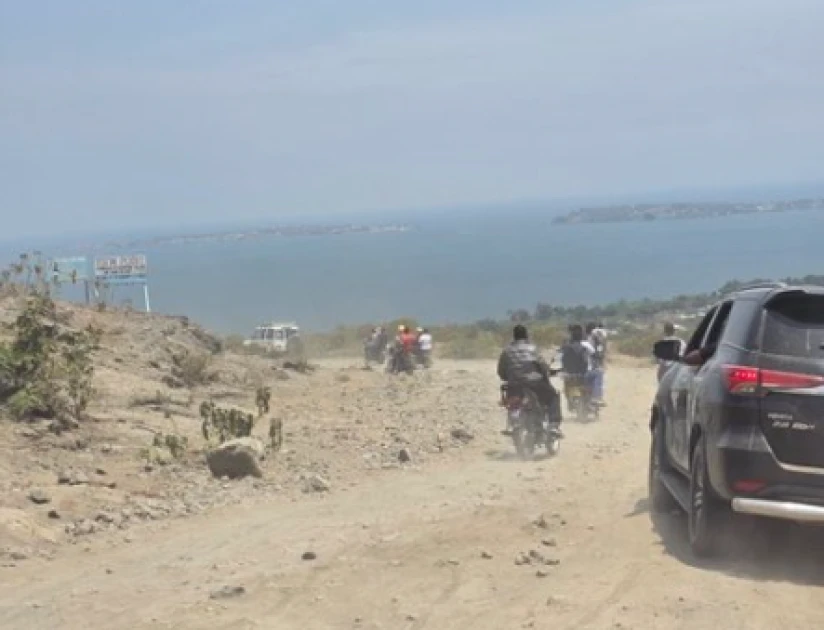
A section of the dusty road used by the Linda Mwananchi faction's convoy after being diverted from the main roads in Homa Bay county on August 16, 2026.

Audio By Vocalize
Tensions were high as the Edwin Sifuna-led Linda Mwananchi team was preparing to tour Homa Bay County as part of their countrywide tour to popularise their "Ruto Must Go" campaign.
But by the end of the tour, people scoffed at Homa Bay's dusty and rugged roads, with Kenyans wondering what the politicians do with taxpayers' money.
Of all the things that were on display, a rugged, unsightly, frightful and non-industrial road sighted in Homa Bay on Sunday was the star attraction and sparked reactions across the nation.
The road was seen as the Linda Mwananchi faction was forced to take detours onto dusty roads after politically sponsored goons blocked the main roads in an attempt to frustrate their political engagements.
The footage of the black guzzlers, already masked in dusty brown, would easily convince an oblivious digital user that it belongs to military ground forces in a war-torn nation ready to combat hostilities.
Everyone's mental question was perfectly summed up in a simple tweet from an X user, Eddie_Mugoh, who posed: "Ama Homabay iko Yemen?" (Is Homa Bay in Yemen?") over an image of the dusty, rocky road.
The tweet quickly went viral and threatened to undo the hard work that has gone into promoting the lakeside county as a dream destination.
The tweet sparked laughs and think pieces, but it was the use of Artificial Intelligence to add Yemeni people and American forces patrolling the area that seemed to shake the local leaders into action.
Homa Bay Governor Gladys Wanga staged a scattered defence of the state of the road, saying that the Nyanza region has remained marginalised and development resources have remained under-disbursed.
She was also swift to praise the broad-based partnership crafted by the late Raila Odinga and President William Ruto and inked in 2025, saying it will be the antidote to long-running development flaws.
"I’ve seen they are laughing at us that Homa Bay looks like Yemen because of the nature of our roads in Suba. They don’t understand the pain we are feeling because all these years we have been voters but no development has been brought to Luo Nyanza because of the decision to fight for all Kenyans to have a new constitution, devolution and human rights," she said in a video while speaking in Dholuo language.
"That is why we're all marginalised. Because we are now in broad-based, the Suba Road they are laughing at, Mbadi has appended a signature to tarmac it. When we speak about development, we are saying two-term."
A day later, Governor Wanga was not done; she penned an essay titled: "Beyond the dust: Homa Bay's long road from marginalisation to transformation."
"The dust on the Mbita–Sindo–Kiabuya–Sori corridor tells a story. But it is not the story of a people who have failed..." started the novelette.
Eager Kenyans camped in the tweet, telling off the Governor and dismissing her claims.
The Yemeni tweet had riled even the ruling party, United Democratic Alliance, which also joined the bandwagon, boasting of the ongoing construction of a 74-kilometre road in the County passing through Mbita–Sindo–Kiabuya–Sori.
UDA alluded to a post-independence economic policy document, the Sessional Paper Number 10 of 1965, which it believes discriminated Homa Bay and other regions from receiving development.
"In 1965, Sessional Paper Number 10 was passed in the Cabinet discriminating large sections of Kenya and classifying them as "low potential areas" that do not qualify for government investment, including Homabay County," UDA wrote in a statement.
"Under the leadership of President William Ruto, we are correcting these historical injustices. Equality and inclusivity are the drivers of development under the BETA Plan."
The cited Paper, titled African Socialism and its Application to Planning in Kenya, was drafted under political mavens like Tom Mboya and former President Mwai Kibaki, with a focus on resource allocation to high-potential agricultural regions to maximise immediate national output.
It, however, faced concerns as many argued that arid and semi-arid regions, categorised as "low-potential," became the tussle point of the historical economic marginalisation in Northern and parts of Southern Kenya.
The only politician who knew how to read the room was Suba North Member of Parliament (MP) Millie Odhiambo, who reckoned that most major roads in the Suba region have remained in a deplorable state.
She added that sections of Homa Bay and some roads were tarmacked under the regimes of President Ruto's predecessors, saying that the region has remained a marginalised region for aeons.
"President Kibaki and PM Raila tarmacked Homa Bay town to Mbita town. President Uhuru built the Mbita bridge. President Ruto has tarmacked the Rusinga Ring Road. He has opened the Mfangano Ring Road and tarmacking is commencing. He has earmarked a few others to be done, including the Sindo-Mbito Road. CS Mbadi recently launched two in my constituency [ one of which is the one being used now]," she posted on her Facebook account.
She also had a message to the leaders who were trying to blame past presidents over the lack of development in the area.
"We have been marginalised for years. Sugar-coating it by calling the bad roads feeder roads will stop the government from prioritising these roads," she noted.
"The world has made enough mockery of us today, calling us Afghanistan and all. It is time this ended. Subas are Kenyans too. We need accelerated development here."
Budget allocation
In the 2026/27 Financial Year, Parliament approved a Ksh.428 billion allocation to the 47 counties, up from Ksh.415 billion in the 2025/2026 FY.
Homa Bay was allocated Ksh.8.9 billion in the national Equitable Share.
The county's approved budget estimates cite that the amount is part of a total resource kitty of Ksh.12, 1 billion for the 2026/27 FY.
It comprises Ksh.1.3 billion in Conditional Grants, Ksh.1,67 billion in Own Source Revenue (Ksh.1.1 billion in Appropriations-in-Aid (A-In-A) for Health and Ordinary Own Source Revenue at Ksh.566 million) and Ksh.214 million for the Equalisation Fund.
The monies will focus on enhancing service delivery and development.
Key sectors, the report added, include upgrading Early Childhood Education facilities under the Ondoa Kaunda Initiative, improving the county’s road network and expanding access to clean and affordable green energy.
Other works will include investing in lakefront infrastructure to boost the blue economy, increasing access to safe water in informal settlements, and finalising key health projects such as the Accident & Emergency Centre at the County Referral Hospital.
Join the Discussion
Share your perspective with the Citizen Digital community.
No comments yet
This discussion is waiting for your voice. Be the first to share your thoughts!