
Health Unions demand protection for workers in Ebola frontline
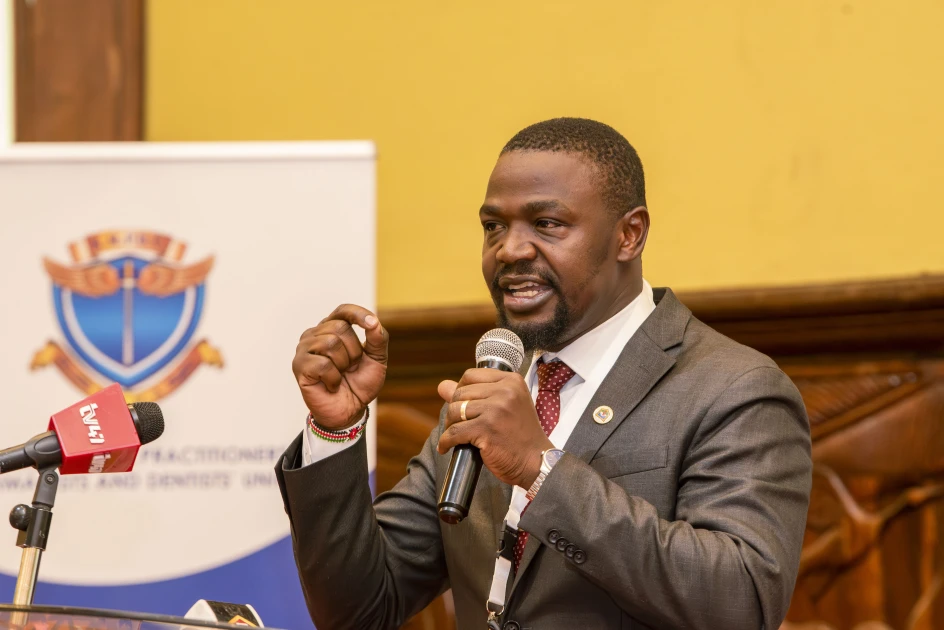
KMPDU Secretary General Dr. Davji Atellah speaks at the union's Annual Delegates Conference held at Safari Park Hotel in Nairobi on May 9, 2026. Photo/Courtesy

Audio By Vocalize
Health Unions in Kenya are demanding better protection of healthcare workers who are on the frontline in the fight against the spread of Ebola virus and other infectious diseases.
This is after the Ministry of Health (MoH) confirmed that
three healthcare workers are among those who tested positive for the virus.
Kenya Medical Practitioners, Pharmacists and Dentists Union
(KMPDU) Secretary General Davji Atella now says that doctors will not put their
lives on the line if the government cannot provide adequate personal protective
equipment.
“As a union we are very ready to ensure that this menace is
contained but in so doing that we are not going to put our lives and the lives
of our loved once at risk,” Davji said.
He wants the ministry of Health to provide quality Personal
Protective Equipment that are readily available on need basis and not just in
high risk counties.
“But to a situation where there is no PPE, no health cover for the health
workers you cannot ask them to be on the frontline its like committing
intentional suicide,” he added.
The medics warn that they will not put their lives on the line if the
government fails to guarantee their protection
“We have asked every doctor across the country to ensure
that they do a survey, a survey that will ensure that they have the PPE, that
there are isolation facilities across the counties and drugs to support anybody
who might present with this disease,” the KMPDU Sec-Gen added.
Their demand comes as the Ministry maintains that it has trained over 4,900
healthcare workers on Ebola management.
Reports indicate that of 130 contacts listed since the first case was detected
on October 6, 8 additional contacts were recently identified including 7
healthcare workers who attended to the first patient.
Public Health Principal Secretary Mary Muthoni says there is
no evidence of community transmission.
On October 6, the Ministry of Health stated that the patient was quickly
isolated in a separate room at the Nairobi Hospital.
The hospital also indicated that the patient was cared for
throughout by a dedicated clinical team, working closely with MoH and that the
staff worked in full protective equipment.
Only for the Ministry to confirm on October 17 that three healthcare workers
who attended to the first Ebola patient have tested positive.
And so how did the infection happen? When were the suspicious symptoms on the
patient detected? Were all healthcare workers adequately protected? And at what
point did full precautions begin?
In the meantime, following an outbreak in the Democratic republic of Congo and
a rise in confirmed cases in Kenya, Tanzania has introduced a 21-day mandatory
health monitoring for travelers considered at high risk of Ebola infection as
it tightens screening measures at its borders.
This as the US Embassy in Kenya issued an advisory to all tourists traveling to
Kenya to purchase Kenyan health insurance as part of the electronic travel
authorization (eTA) application process.
Join the Discussion
Share your perspective with the Citizen Digital community.
No comments yet
This discussion is waiting for your voice. Be the first to share your thoughts!