
Harnessing the sun to secure water in a changing climate

Audio By Vocalize
Water rarely
belongs to one person or one place.
It moves through
forests, farms and grazing lands. It sinks into the soil, gathers beneath the
earth and emerges again through rivers, springs and boreholes. Along the way,
it connects people, livestock, agriculture and nature.
In Baringo County,
however, water has become increasingly difficult to access. Changing rainfall
patterns, growing demand and the high cost of pumping have placed pressure on
the communities that depend upon it.
At the Toniok
Borehole, the challenge was once clear.
The system relied on
diesel and electricity, both of which were expensive and unreliable. Residents
contributed money to buy fuel, but the engine could only operate once enough
had been collected and people had been paid to start it.
When that did not
happen, the water remained beneath the ground, beyond the community’s reach.
Judy Chirchir
remembers the uncertainty.
“We used to buy
diesel and then come to the borehole so that water could be pumped for us,” she
says. “When the money was not enough, we had to walk long distances or hire
motorcycles to transport water.”
For Doreen Ngetich,
the journey to alternative sources stretched for approximately three
kilometres.
“I remember walking
up and down the hills carrying water,” she says. “Sometimes I had to make
several trips to collect enough for drinking, cooking, washing and caring for
livestock.”
The solarisation of
the Toniok Borehole has provided a different possibility.
Implemented by
WWF-Kenya through the Catchment to Tap Project, with funding from the Embassy
of the Kingdom of the Netherlands, the initiative replaced the costly
diesel-dependent system with solar energy and increased its water-storage
capacity.
Today, the sun
provides the energy needed to bring water to the surface.
The project is
expected to improve access to clean and reliable water for more than 2,500
people, serving households, schools, health facilities and livestock.
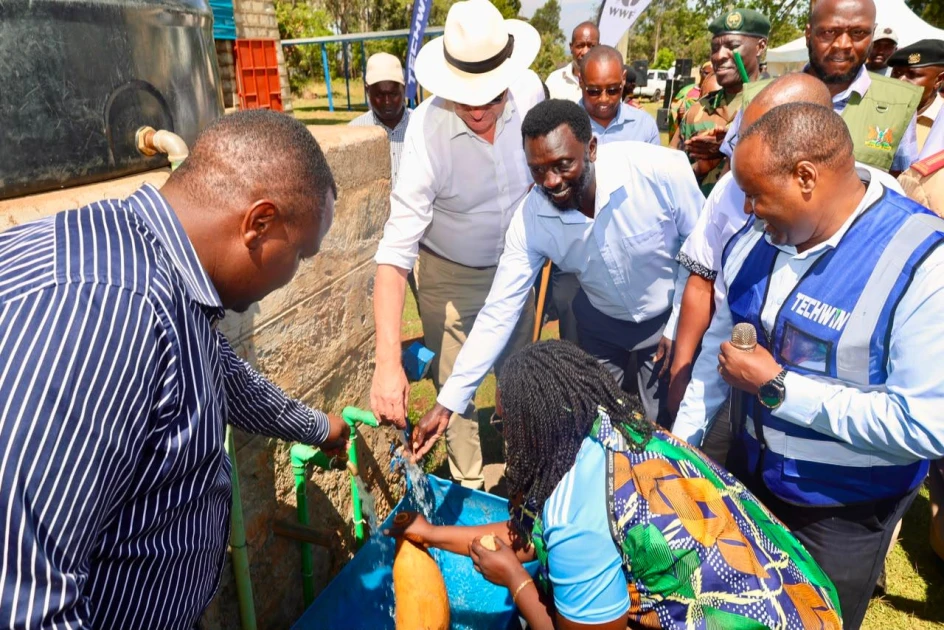
Speaking during the
official launch, the Ambassador of the Kingdom of the Netherlands to Kenya,
H.E. Henk Jan Bakker, said water challenges were no longer confined to
traditionally dry countries.
“I come from a
country where water and our relationship with water have always been defining
factors in our culture and national identity,” he said.
For generations,
the Netherlands was largely concerned with protecting its people from too much
water. But climate change has introduced a different concern.
“Droughts are
increasingly becoming a reality in the Netherlands,” he said. “Previously, we
were concerned about having too much water; now we are also threatened by
having too little.”
The Ambassador
noted that Kenya faces similar extremes, with some areas receiving excessive
water while others endure prolonged shortages.
“We must therefore
find better ways of managing water under changing climatic conditions,” he
said.
This philosophy
lies at the heart of the Catchment to Tap Project. Rather than treating a
borehole as an isolated structure, the project considers the entire water
system—from the upper catchment where rainfall is received to the homes, farms
and institutions where the water is eventually used.
Baringo Deputy
Governor Felix Maiyo said the county had already invested heavily in borehole
construction, but many systems were no longer functioning.
“The county has
constructed more than 700 boreholes,” he said. “However, our greatest challenge
has been regulating and managing the boreholes and the committees responsible
for them.”
Only about 60 per
cent of the county’s boreholes are currently functional. According to the
Deputy Governor, high electricity costs and weak management systems are among
the leading causes of failure.
“In many cases, the
boreholes break down because of the high cost of power,” he said. “Solarisation
provides a more sustainable and affordable source of energy.”
However, solar
panels alone cannot protect a water project indefinitely. Every pump must be
maintained, every storage tank inspected and every committee held accountable.
“There is nothing
completely free,” Deputy Governor Maiyo said. “Everyone must make a contribution.”
The community will
therefore pay an affordable amount towards the operation and maintenance of the
Toniok system.
For Judy, this
contribution is manageable compared with the previous expenses.
“We are paying much
less than what we used to spend on diesel, labour and transport,” she says. “We
are happy because the project has considered sustainability.”
WWF-Kenya CEO Jackson
Kiplagat said long-term water security would require both partners and
government to invest in the wider landscape.
“As we seek support
from partners, the county must also allocate resources towards transitioning
boreholes from electricity and diesel to solar power,” he said.
He further called
for greater investment in water harvesting, groundwater recharge and integrated
planning.
“Much of the
rainwater currently flows downstream, causing problems in some areas while
other areas remain without water,” he said.
“We can work
together to capture and utilise the water that currently flows away. Through
proper engineering and integrated planning, we can address several water,
food-security and climate-related challenges.”
The Toniok Borehole
therefore represents more than a source of water. It demonstrates how renewable
energy, community participation, government leadership and international
cooperation can come together around one essential resource.
Across the landscape, water continues its ancient movement, from cloud to soil, from catchment to aquifer and, finally, from the earth into the hands of a waiting community.
Join the Discussion
Share your perspective with the Citizen Digital community.
No comments yet
This discussion is waiting for your voice. Be the first to share your thoughts!