
GreenWorks 4 Africa forum opens in Nairobi to drive green jobs agenda
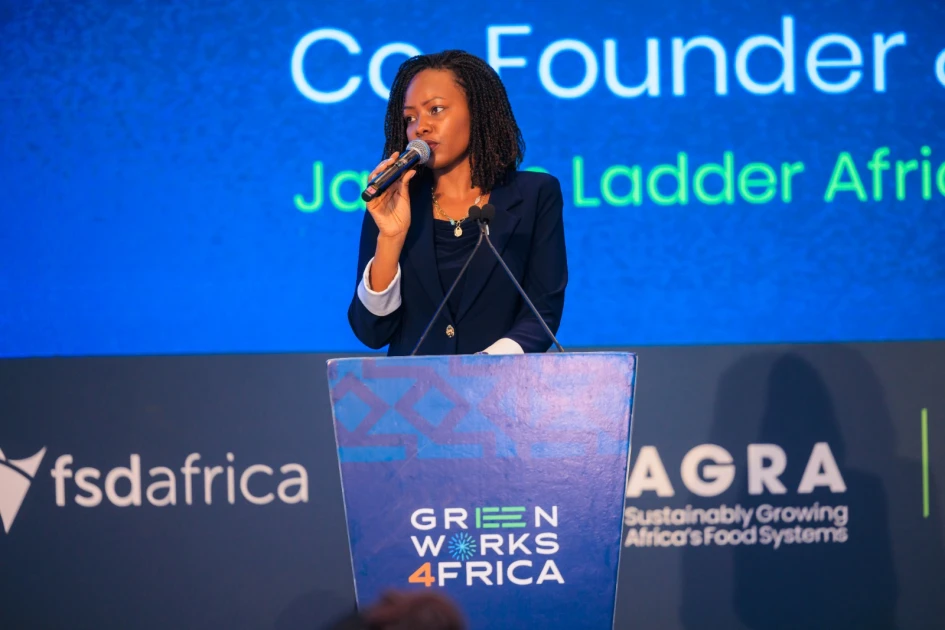
Jacob's Ladder Africa Co-Founder and Chief Executive Officer Sellah Bogonko

Audio By Vocalize
The two-day forum, organised by Jacob's Ladder Africa (JLA) in partnership with the African Union Commission, Kenya's Ministry of Environment, Climate Change and Forestry, FSD Africa, GIZ Kenya, AGRA and the Center for Global Development, is focusing on how Africa can translate climate action into employment, enterprise growth and inclusive economic development.
Unlike traditional climate conferences, organisers said the forum is designed to identify proven African solutions that can be replicated and scaled rather than debate theoretical approaches to the green economy.
Opening the forum, Jacob's Ladder Africa Co-Founder and Chief Executive Officer Sellah Bogonko said the initiative aims to build a long-term coalition capable of accelerating green job creation across the continent.
"Our ambition is to begin building something larger than a two-day gathering: an Africa-wide coalition of governments, employers, investors, skills institutions, innovators, intermediaries and young people committed to figuring out, together, how Africa can create green jobs at scale," she said.
She described the forum as "a Thinkers Hub and Collaboration Hive" intended to equip participants with practical tools and partnerships to drive implementation beyond the event.
The discussions come against the backdrop of mounting pressure to create jobs for Africa's rapidly growing youth population. According to the African Development Bank, between 10 million and 12 million young people enter Africa's labour market each year, yet only about three million formal jobs are created annually.
Participants argued that the green transition presents one of the continent's biggest opportunities to narrow this gap, provided investments are matched with workforce development, financing and supportive public policies.
New research presented by FSD Africa projects that Africa's green transition could create between 3.8 million and 7.9 million jobs by 2030, rising to between 65.9 million and 84.5 million jobs by 2050, depending on technology adoption and climate-risk scenarios.
The study identifies decentralised and service-based sectors—including clean cooking, solar home systems, waste recycling and electric two- and three-wheelers—as likely to generate a significant share of future employment.
However, the research also highlights major workforce challenges, noting that Africa accounts for only 2% of the global renewable energy workforce, while just 5% of young Africans have completed formal vocational training. It further notes that less than 1% of climate finance is currently directed towards skills development.
Kevin Munjal, Director of Development Impact at FSD Africa, said building an inclusive green economy would require governments and development partners to strengthen links between investment, education and labour market demand.
"For Africa's young people, the green transition is not an abstract future. It will shape the jobs they can access, the businesses they can build and the economies in which they will live," Munjal said.
"Our responsibility is to ensure that the systems being built today give them a meaningful stake in that transformation."
The forum is examining four priority sectors considered central to Africa's green economy: renewable energy, climate-resilient agriculture, e-mobility and green urban infrastructure, and circular economy and waste management.
Delegates are also discussing cross-cutting issues including financing, technology, innovation, policy and governance, with a focus on improving coordination between governments, employers, investors, training institutions and young people.
Among the practical initiatives unveiled at the forum is the African Green Jobs Toolkit, which compiles lessons from successful projects across the continent and provides guidance on financing, workforce development and programme design.
The forum also introduced the African Green Jobs Taxonomical Standard, aligned with the African Continental Qualifications Framework, to promote common definitions of green occupations and skills across African countries and improve workforce planning.
Senior officials attending the opening included UNEP Regional Director for Africa Dr. Rose Mwebaza, FSD Africa's Kevin Munjal, GIZ Kenya Programme Director for Energy, Transport and Climate Change Hannah Salian, African Union Commission representative Nicholas Ouma and African Union Commissioner for Agriculture, Rural Development, Blue Economy and Sustainable Environment Moses Vilakati, who delivered a keynote address virtually.
The GreenWorks 4 Africa Forum concludes on August 13 in Nairobi, with participants expected to develop recommendations on strengthening skills systems, enterprise development and investment frameworks needed to support Africa's green economic transformation.
Join the Discussion
Share your perspective with the Citizen Digital community.
No comments yet
This discussion is waiting for your voice. Be the first to share your thoughts!