
Gifts galore as top gov't officials storm Ol Kalou ahead of critical by-election
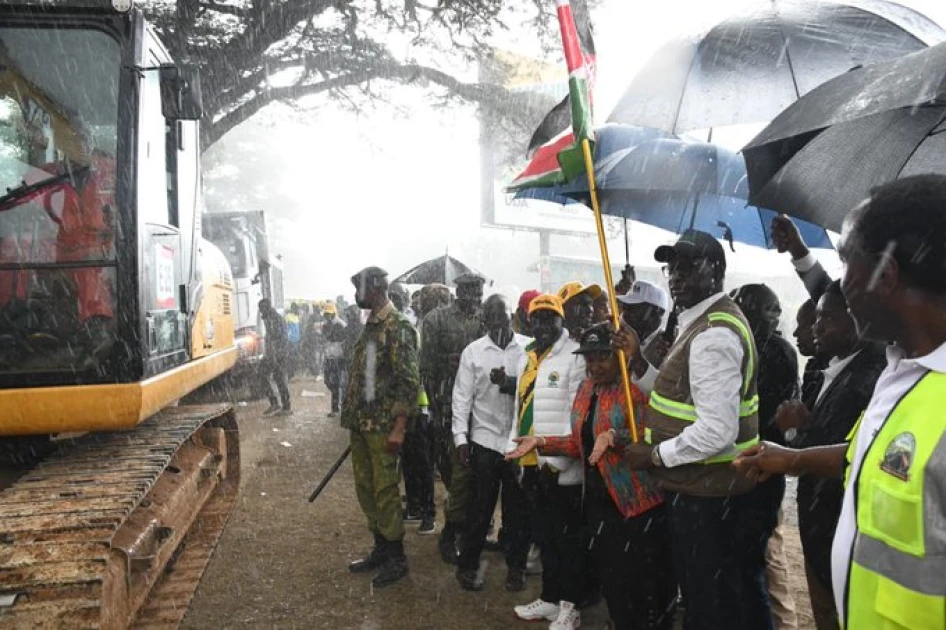
Transport CS Davis Chirchir launches the upgrading to bitumen standard of the 23km Kwa Haraka–Kageraini–Rwanyambo–Karangatha–Kinamba Road and the 37km Ithagani–Ngorika–Mbaruk/Kanyiriri Road in Nyandarua County.

Audio By Vocalize
Overtures, darling proposals, and gifts that would make a young damsel totally smitten! Over the past several weeks, Cabinet Secretaries, Principal Secretaries, and a procession of senior government officials have crisscrossed Ol Kalou Constituency with a frequency and intensity that has raised eyebrows well beyond the county's borders.
Purple-painted gas cylinders and electricity poles are just part of what is in store for Ol Kalou residents this campaign season.
The occasion, officially, is development. The subtext, analysts agree, is survival, political survival at the highest level.
With the Ol Kalou parliamentary by-election set for July 16, 2026, the constituency has become the unlikely theatre for a high-stakes battle between President William Ruto and his former deputy turned bitter rival Rigathi Gachagua.
What is unfolding there is not simply a contest for a parliamentary seat. It is a referendum on who controls Mt Kenya, one of Kenya's most electorally consequential regions, and arguably the most decisive battle either man has fought since Gachagua's dramatic impeachment.
A blitz of unprecedented scale
The figures alone tell a story. According to a document from the Office of the Chief of Staff and Head of Public Service Felix Koskei, the national government has directed a staggering Ksh.55 billion worth of projects into Nyandarua County, with Ol Kalou Constituency alone accounting for approximately Ksh.10 billion of the total.
Road construction has received the lion's share, with some Ksh.22 billion under the Critical Rural Roads Development Programme, but the intervention spans virtually every dimension of public life.
Lands CS Alice Wahome launched the Ol Kalou Affordable Housing project, a flagship initiative of the Kenya Kwanza administration, giving the constituency a tangible piece of Ruto's most high-profile domestic programme.
She also commissioned the Mirangine Market, a modern trading hub expected to benefit hundreds of traders, and, not incidentally, link them emotionally and economically to the government's candidature.
In a historic move, CS Wahome oversaw the opening of Nyandarua County's first-ever land registry in Ol Kalou, ending more than six decades of residents having to travel to registries outside the county for documentation. Title deeds were issued directly to residents at the launch.
Tourism CS Rebecca Miano has emerged as perhaps the most visible face of the government's campaign in Nyandarua. This is not surprising as she hails from Nyandarua County.
She was on hand for the launch of the Mirangine Market and joined CS Wahome in issuing title deeds. She attended the Ol Kalou railway station revival and commissioned the upgrading of the Ngorika main road network to tarmac, among numerous other appearances.
Miano also launched some youth and women empowerment initiatives such as the widow support program, a Ksh.26 million women's empowerment package, and the equipping of digital hubs, hence touching multiple voter blocs simultaneously.
Roads and Infrastructure CS Davis Chirchir launched the upgrading to all weather-road, the 23-kilometre Kwa Haraka-Kageraini-Rwanyambo-Karangathe road, a project with transformative implications for agricultural transport and daily commutes.
ICT CS William Kabogo commissioned three "digital hubs" in Wiyumiririe, Passenga, and Mirangine and toured the county for two days, addressing locals.
The government also launched Nyandarua University, a long-awaited institution that makes Nyandarua the last county in former Central Province to finally receive a public university, with CS Wahome presiding over the groundbreaking of the Ksh.1.3 billion first phase. Ol Kalou Technical and Vocational College hostels were commissioned separately.
In perhaps the most symbolically powerful gesture, the historic Nairobi–Gilgil–Ol Kalou–Nyahururu railway line was revived after nearly five decades of dormancy, with cargo and passenger trains resuming operations.
Former presidential adviser Moses Kuria, now a fixture of the UDA campaign team in the region, hailed the revival as evidence of Ruto's transformative economic agenda and noted the line would reduce pressure on the Nairobi-Nakuru highway while lowering transport costs for farmers.
Kuria would later on return to Ol Kalou with gas cylinders and lorries full of electricity poles.
At every launch, UDA candidate Samuel Muchina Nyaga has been present, smiling, shaking hands, and being photographed alongside the CSs and PSs.
The message being broadcast to voters is unmistakable: development comes through UDA, and the candidate who embodies that continuity is Muchina.
The legal grey zone
The opposition has not stayed silent. Gatanga MP Edward Muriu, a close ally of Gachagua, has levelled blunt accusations at the government, arguing that Cabinet Secretaries are "putting their faces, those of PSs and that of the candidate on government programmes" and deploying taxpayer-funded projects as campaign material.
Nyandarua Senator John Methu, who is leading the DCP campaign in the constituency, has described the infrastructure blitz as an overt attempt to bribe the electorate using public resources.
The law does not prohibit Cabinet Secretaries from commissioning government-funded projects during election periods or from engaging in politics.
However, the Constitution, the Leadership and Integrity Act, and the Public Officer Ethics Act do prohibit public officers from improperly using state resources or their offices to confer an unfair political advantage.
Whether what is happening in Ol Kalou crosses that line is a question legal minds may debate, but politically, the distinction has all but evaporated.
The government's counter-argument, offered most colourfully by Moses Kuria, is that these are not new projects conjured for the by-election, but long-overdue interventions that Nyandarua was denied by successive governments, including those led by three Kikuyu presidents.
"Why have we not done it in over 60 years?" he asked rhetorically at the land registry launch. The government also points to the fact that most projects were either ongoing or at the contract-award stage before the by-election was announced.
That may be true. But the timing of launches, the choreography of joint appearances with the UDA candidate, and the sheer concentration of commissioning events in a single constituency over a compressed campaign period make the political intent difficult to dispute.
Will it be a two-horse race?
Gachagua's DCP entered this race with impressive momentum. During the party nominations in May, DCP attracted over 20,000 participants, with Sammy Kamau Ngotho securing the ticket with 12,957 votes.
This figure dwarfed the 8,258 total votes cast in UDA's own nominations across ten candidates. Political analyst Daniel Orogo observed at the time that such turnout figures in a party primary were "remarkable," noting that by-elections and party primaries typically record very low participation.
The 2022 General Election result for this seat also haunts the UDA camp. The late David Kiaraho, whose demise made the seat vacant, won on a Jubilee ticket with 24,058 votes; Ngotho himself, then running on a UDA ticket, came second with 19,380.
The constituency has historically leaned against whatever party the national government runs from Nairobi, a fact that has made the government's development blitz feel all the more urgent.
For Gachagua, a win in Ol Kalou would, in the words of DCP planning secretary Peter Mbae, "settle 70 per cent of Mt Kenya politics."
It would validate the former deputy president's central claim that he, not Ruto or Deputy President Kithure Kindiki, is the authentic voice of the "Mountain", and that his impeachment has only deepened rather than eroded his standing in the community.
Yet in a striking strategic move, Gachagua himself has retreated from the campaign trail. He commenced a 45-day sabbatical at his Wamunyoro residence in Nyeri County, keeping himself deliberately off the frontlines.
His allies insist this is deliberate, a signal of quiet confidence in his grassroots organisation, with Nyandarua Senator Methu leading day-to-day operations.
DCP also drew encouragement from a national poll showing party support surging from nine per cent in September 2025 to 16 per cent by May 2026, level with UDA nationally.
On the other side, Deputy President Kindiki has maintained a similarly cautious public distance. While he is widely understood to be directing strategy, he has largely left the visible campaigning to Nyandarua Woman Rep Faith Gitau and Moses Kuria.
Political analysts suggest both men are wary of owning the loss if their side stumbles, but also keenly aware that the winner will claim enormous political credit ahead of 2027.
The deeper stakes: Mt Kenya's soul
The Ol Kalou by-election is best understood as the first major electoral data point after Gachagua's October 2024 impeachment and the reconfiguration of deep-seated Mt Kenya politics.
For President Ruto, this race is existential in a specific sense: a loss would confirm the narrative, already gaining traction, that his base in the region that swept him to power in 2022 is fracturing dangerously ahead of his re-election bid.
Mt Kenya delivered close to three million votes for Ruto in 2022. The region accounts for roughly 20 per cent of Kenya's registered voters.
Any sustained erosion there cannot be compensated elsewhere. The development blitz in Ol Kalou is not, at its core, about one parliamentary seat.
It is a very public demonstration that the government can deliver in Mt Kenya, designed to arrest a slide in popularity and rebrand the Kenya Kwanza administration as the engine of material improvement for communities that have historically felt shortchanged.
Nyandarua's particular grievances make it an especially resonant backdrop. The county received relatively little public infrastructure from previous governments, from tertiary education facilities to a poor or non-existent road network.
In Nyandarua, the residents had to travel outside the county for basic land services. Completion of these projects would address legitimate, decades-old complaints.
The political tragedy or irony is that no one can say with certainty whether the government would have moved with this urgency without a by-election on the calendar.
The opposition's attempt to consolidate behind a single candidate under the United Alternative Government banner, selected through independent polling, complicates the arithmetic further.
If UAG's candidate draws from different voter pools than DCP, the anti-government vote could still split. If the consolidation holds and DCP and UAG align effectively, then the UDA faces a formidable challenge that no amount of ribbon-cutting can fully neutralise.
Can development buy an election?
Kenya's political history offers a mixed verdict on this question. Development projects during campaign seasons can shift sentiments, but only when voters believe the delivery is genuine and sustained, not merely staged.
In Ol Kalou, the scale and variety of interventions suggest the government is not relying on one or two signature projects but on saturation: something for traders, something for youth, something for farmers, something for landowners, something for students, something for commuters. The breadth is as deliberate as the timing.
What the government cannot control is the emotional register of the electorate. A constituency that watched its beloved MP David Kiaraho die while seeking medical treatment, then found itself the object of a sudden, intense national development focus, may draw its own conclusions about the relationship between political need and government attention.
The true test of July 16 will not simply be whether UDA captures the seat; they may well do so, backed by state machinery and resources of a government that can commission rapid projects and cut numerous ribbons in weeks.
The more revealing question is the margin. A narrow UDA victory or DCP win would send a seismic signal that Mt Kenya's loyalties are genuinely in play.
A strong UDA performance might give the Ruto administration temporary breathing room, but with a General Election a year away, the breathing room would be temporary indeed.
In Ol Kalou, it might end up being the battle of two men who once shared a ticket but have now turned a constituency of farmers and traders into the stage for their reckoning.
The ballots cast on July 16 will tell both of them and Kenya what that reckoning looks like when ordinary voters have the final word.
On the other hand, it is sending a message to the citizenry of Ol Kalou constituency and all other constituencies in the country that their vote is important and decisive, especially for the highest seats in the land.
Let the voters of Ol-Kalou use their votes to help chart the future they crave and deserve.
Join the Discussion
Share your perspective with the Citizen Digital community.
No comments yet
This discussion is waiting for your voice. Be the first to share your thoughts!