
Gachagua impeachment hearing: National Assembly faulted on public participation

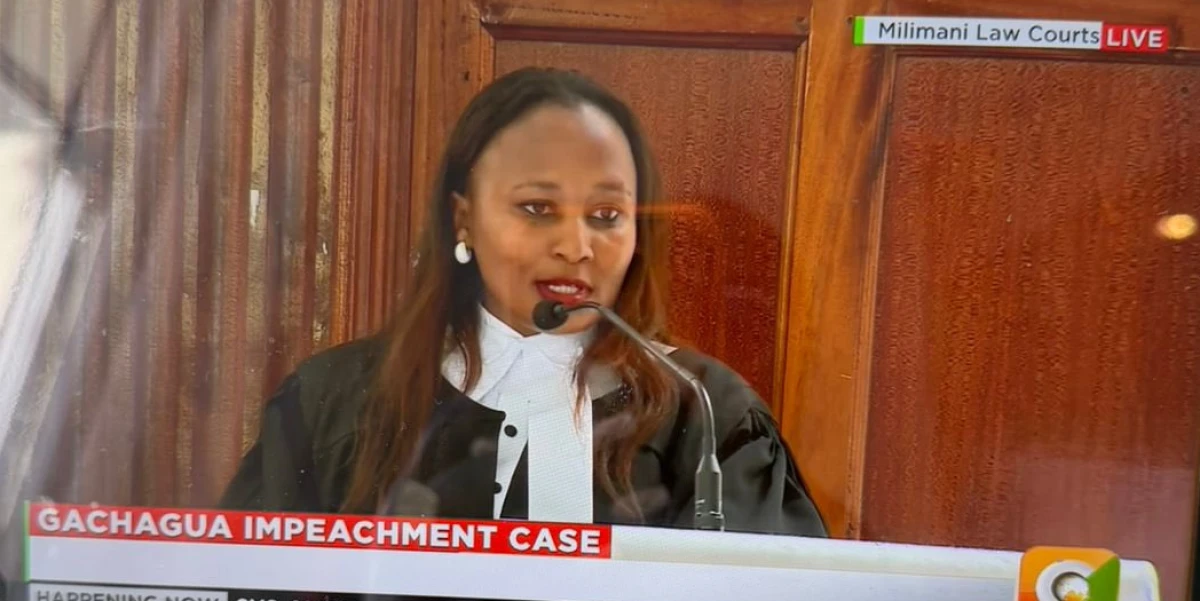
Kirinyaga County Woman Representative, Advocate Njeri Maina makes submissions in the impeachment of former Deputy President Rigathi Gachagua.

Audio By Vocalize
Advocate Njeri Maina, who is also the Kirinyaga County Woman Representative, on Thursday told the court that the National Assembly’s public participation exercise in the impeachment of former Deputy President Rigathi Gachagua was deliberately designed and executed in a manner that excluded Kenyans from meaningful engagement.
Maina, who is also part of Gachagua’s legal team, framed the dispute around three central issues: what constitutes adequate public participation, what amounts to reasonable notice, and how to distinguish between qualitative and quantitative participation. She argued that, in all three respects, the National Assembly fell short of constitutional requirements.
“There was orchestrated, systematic exclusion in various constituencies,” she told the bench. “Some of the offices remained closed. This was not accidental, it was intentional, it was planned, and it vitiated the adequacy of the process and its outcome.”
On the question of notice, Maina drew the court’s attention to a gazette notice issued on October 5, 2024—the same day public participation was conducted—questioning whether it could reasonably be regarded as sufficient notice.
“It is the height of blatant contempt dressed as compliance,” she submitted, referring to the timing of the gazette notice and the simultaneous public participation exercise.
She further argued that the process lacked basic enabling conditions for meaningful civic engagement. According to Maina, no civic education was conducted ahead of the exercise, members of the public were not guided on the use of the National Assembly’s template forms, and no supporting materials were provided. This, she said, created an information gap that rendered participation largely ineffective.
Maina also challenged the reliance on Standing Order 64(2) by the National Assembly to compress the timelines of the impeachment process. She argued that standing orders are subordinate to the Constitution and cannot override Articles 10 and 118, which anchor public participation as a constitutional requirement.
In support of her argument, she cited the High Court decision in Orange Democratic Movement Party and others v Speaker of the National Assembly, where the court held that standing orders do not supersede constitutional provisions on public participation.
She maintained that in the event of any conflict between standing orders and the Constitution, the latter prevails, and that Standing Order 64(2) is therefore subject to judicial scrutiny.
Quoting the oft-cited dictum from Macfoy v United Africa Company Ltd, Maina added: “If an act is void, it is in law a nullity. It is not only bad, but incurably bad. You cannot put something on nothing and expect it to stand. It will collapse.”
She told the court that the public participation exercise amounted to a “symbolic affair,” accusing the National Assembly of acting in disregard of constitutional and legal standards.
“Blatant disobedience of court orders must be rendered null and void,” she submitted. “This must result in an outcome that cannot stand in a constitutional democracy governed by the rule of law.”
Join the Discussion
Share your perspective with the Citizen Digital community.
No comments yet
This discussion is waiting for your voice. Be the first to share your thoughts!