
From Diogo Jota to George Foreman, sporting deaths in 2025 - Part 2
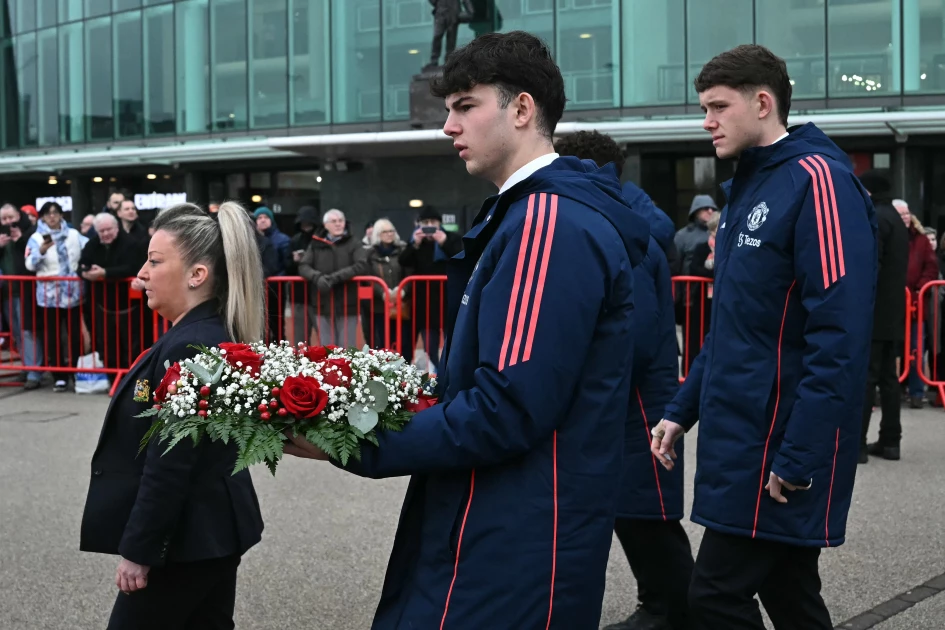
Manchester United youth players lay a wreath before the funeral cortege of late Manchester United and Scotland footballer Denis Law passes Old Trafford in Manchester north-west England on February 11, 2025. The late footballer Denis Law died at the age of 84 on January 17, 2025. (Photo by Paul ELLIS / AFP)

Audio By Vocalize
Former heavyweight champion George Foreman and
footballers Diogo Jota and Denis Law were among the sports stars who died in
2025.
Here is the second part of Citizen Digital's review
of the sporting figures we lost this year:
GEORGE FOREMAN died on March 21 aged 76.
Foreman was the last of the great quartet of
heavyweights with Muhammad Ali, Ken Norton and 'Smokin' Joe' Frazier that
produced memorable bouts in the 1970s.
Foreman's talent was evident early on when winning
Olympic gold in 1968.
He won the heayweight title in 1973, inflicting
Frazier's first defeat but was to be dethroned by Ali a year later in the epic
"Rumble in the Jungle" in then Zaire.
While Ali was the people's favourite, Foreman was
perceived as sullen and unlikeable.
However, 20 years later he had reinvented himself as
a jocular personality and aged 45 astonishingly was once again crowned
heavyweight world champion, taking down Michael Moorer, 19 years his junior.
"You want to leave something; you really do. I
mean, in the end, statues and all those things, that doesn't mean
anything," said Foreman. "Leave something that we're all going to
benefit from."
The nearly man of a great era of heavyweight boxers,
Bugner went the distance on two occasions with Muhammad Ali and once against
Joe Frazier.
While a world title eluded him he was crowned
European and British champion when he defeated ageing national treasure Henry
Cooper in 1971.
Bugner, who was a young boy when his parents fled
Hungary after the Soviet Union invaded in 1956, later moved to Australia.
In between a film career -- including starring in
"Street Fighter" with Jean-Claude Van Damme -- there were a couple of
comebacks but he ended his days in a care home suffering from dementia.
Bugner felt he never received the recognition he
merited.
"When I beat Henry Cooper I was no longer
British, I was a Hungarian refugee and that was just ridiculous," he said.
RICKY HATTON took his own life on September 14 aged
46.
The popular English boxer's funeral attracted the
likes of Tyson Fury and Liam Gallagher of Oasis and thousands lined the route
in his home town of Manchester.
Hatton was a popular, larger-than-life character who
unified the light-welterweight division and also won a world welterweight
title.
Hatton, who won 45 of his 48 professional bouts,
admitted he struggled with drinking and drugs.
"People say, 'We remember the good times.' Well
I remember the bad times," Hatton told The Times in 2012.
MAYUMI NARITA died on September 5 aged 55 of cancer.
Japan's "Queen of the Water" won 15
Paralympics gold medals -- including six at the 2000 Sydney Games and set five
world records to boot in Australia.
She is Japan's most-successful Paralympian and the
fifth most decorated female athlete in Paralympic history across all sports.
ANGELA MORTIMER-BARRETT died on August 25 aged 93.
She battled hard to get to the top, and for want of
money once spent the night at London's Paddington Station on the way back from
a tournament.
Mortimer-Barrett came out on top in an all-British
women's Wimbledon final in 1961 against Christine Truman, who at 20 was nine
years her junior.
The partially-deaf Mortimer-Barrett had prior to
that also won the French (1955) and Australian (1958) titles.
He may have won two Grand Slam titles French but it
is what came before that the resilient Australian is probably best known for.
Known as "Fiery", he is still the only man
to have lost his first five Grand Slam singles finals -- four of them to
compatriot Roy Emerson in a golden era for Australian tennis.
Emerson was to beat him in one more Grand Slam
final, Wimbledon, in 1965, sandwiched in between Stolle getting the better of
another two Australians, Tony Roche in that year's French final, and John
Newcombe at the 1966 US Championships.
HAROLD 'DICKIE' BIRD died on September 22 aged 92.
One of the best-known umpires of his generation, he
stood in 66 Tests between 1973 and 1996 as well as 69 men's one-day
internationals, including three World Cup finals.
Bird had a modest playing career for Yorkshire and
Leicestershire but made his name as an international umpire, wearing his
trademark white cap.
He was given a guard of honour at Lord's by England
and India players before his final Test.
Yorkshire and England batting legend Geoffrey
Boycott, who knew Bird from the age of 15, described him as "comic and
lovable" and "daft as a brush".
He was the only Australian batsman to have made a
triple century (307) in an Ashes Test in Australia and at over 12 hours, holds
the record for the longest ever Test innings in Australia.
He was fortunate to get the chance as he had been
dropped for the fourth Test of the 1965/66 series for batting too slowly, but
regained his place in the fifth and final Test.
"My God! That must have been the most boring
innings you've ever had to sit through," he told the crowd at the
Melbourne Cricket Ground.
A dashing West Indian all-rounder whose career
encompassed the high of winning the 1975 World Cup and the low of a lifetime ban
for a rebel tour of apartheid-era South Africa.
Julien suffered from the pressure of being hailed by
some as the successor to the legendary Garry Sobers.
The two of them put on a West Indian record seventh
wicket partnership of 155 -- in just under two hours -- at Lord's in 1973.
However, he brought the curtain down on his
international career in ignominious fashion in the early 1980s when he joined
West Indies rebel tours of South Africa, then considered a pariah state due to
its apartheid policy, for a reported £60,000 ($80,000).
A former Australian cricket captain who skippered
them in 39 of his 62 Tests, he then had an immensely successful spell as their
first full-time coach in the 1980s.
He answered his country's call when aged 41 he
returned to the national side after it lost several key players to the Kerry
Packer World Series competition.
"Bob's decision to come out of retirement to
successfully lead the Australian team during the advent of World Series Cricket
in 1977 was a wonderful service to the game," said Cricket Australia chair
Mike Baird.
Known as the "Judge", the South
Africa-born batter played 62 Tests for England between 1988 and 1996. He scored
4,236 Test runs, including nine centuries, and 2,419 runs in 71 one-day
internationals.
He was renowned for his fearless batting against the
world's fastest bowlers, but he struggled with mental health and
alcohol-related problems in retirement.
CHARLES COSTE died on October 29 aged 101
At the time of his death Coste was the oldest former
Olympic champion -- gymnast Agnes Keleti had died in January aged 103 -- having
won team track pursuit gold at the 1948 London Games.
The medals ceremony did not go according to plan, as
he recounted to AFP: "They gave us our bouquets and then they told us
'there will be no Marseillaise because we can't find the record!'"
Coste was the oldest torch bearer at the opening
ceremony of the 2024 Paris Olympics, which he described as "one of the
most beautiful moments of my long life".
DICK BUTTON died on January 30 aged 95.
The American was a two-time Olympic champion and a
quintuple world champion. He became the first skater to successfully perform a
double axel, when he won gold in the 1948 Winter Games at St Moritz.
Not content with that he upped the ante at the 1952
Olympics in Oslo when he was the first to land a triple jump.
BUVAISAR SAITIEV died on March 2 aged 49 in
unexplained circumstances.
The three-time Olympic freestyle champion for Russia
(1996/2004/2008) and sextuple world gold medallist is widely regarded to be the
greatest of all time.
Mystery surrounded his death, with a Russian
wrestling official saying he died of a heart attack, while his wife maintained
that he fell from a second storey window in Moscow.
GREG BELL died on January 25 aged 94.
He grew up in abject poverty, living in a chicken
house until he was 12.
Encountering racism "which he detested",
he joined the US Army and was crowned Olympic long jump champion in Melbourne
in 1956 despite having strained a leg muscle.
"It was one of the worst performances I could
have imagined," he said modestly.
After athletics, he became a dentist, working till
he was 89.
Born in England but brought up in Northern Ireland
she was at one point the high jump world record holder and won Olympic silver
representing Britain in the 1956 Melbourne Games.
Also an accomplished field hockey player, she was
capped 40 times by Ireland.
Mary Peters, who was to win Olympic pentathlon gold
at the 1972 Games in Munich, said Hopkins was an idol of hers and she had been
a "pioneer" for Northern Irish women athletes.
BETSY JOCHUM died on May 31 aged 104.
A pathfinder for women's baseball, she was known as
'Sockum' Jochum and was one of the 60 original members of the All-American
Girls Professional Baseball League, set up during World War II.
It inspired the 1992 Hollywood film starring Madonna
called "A League of Their Own".
LENNY WILKENS died on November 9 aged 88.
A Hall of Famer as both a player and a coach he was
a nine-time NBA All-Star and twice led the league in assists.
Wilkens coached the Seattle SuperSonics to their
only NBA title in 1979. His 2,487 games coached is an NBA record.
"He influenced the lives of countless young
people as well as generations of players and coaches," said NBA
commissioner Adam Silver.
LAURA DAHLMEIER died on July 28 aged 31 in a
mountaineering accident.
The German was a seven-time world champion who at
the 2018 Winter Olympics became the first woman biathlete to win both the
sprint and the pursuit at the same Games.
She retired aged just 25 and turned to mountain
running and mountaineering. She was killed by falling rocks while climbing at
an altitude of 5,700 metres (18,700 feet) in the Karakoram range in Pakistan.
CHESS
BORIS SPASSKY died on February 27 aged 88.
Soviet grand master who was world champion from
1969-72 and is best remembered for his epic Cold War clash with American Bobby
Fischer in 1972.
Fischer had never beaten Spassky before their duel
in Reykjavik and the Russian was never to reach the heights again.
He moved to France in 1976 with his third wife and
became a French citizen, although he returned to Russia in 2012.
"I prefer to have good relations with my
opponent. My chess suffers if I have to play a man I consider unfriendly,"
said Spassky.
Join the Discussion
Share your perspective with the Citizen Digital community.
No comments yet
This discussion is waiting for your voice. Be the first to share your thoughts!