
Feature: Brian Wahinya rewriting his rugby story
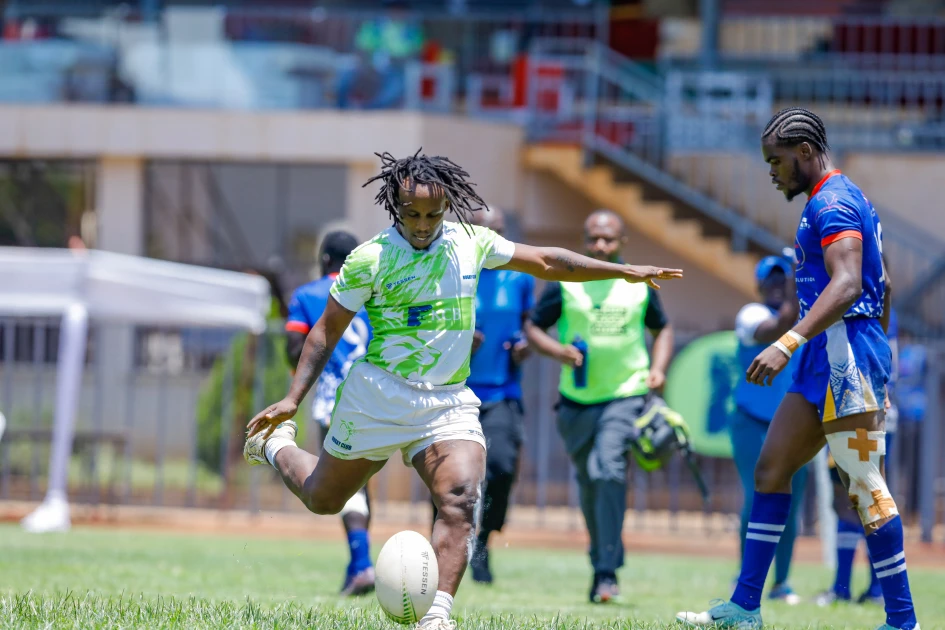
Fly Half Brian Wahinya in action against Kisumu RFC during the Embu 7s rugby tournament at the Moi Stadium, Embu, on September 5, 2026.

Audio By Vocalize
Brian Wahinya, popularly known as ‘Jonde’ within rugby circles, has established himself as one of the finest fly-halves Kenya has produced.
His ability to execute precise kicks, coupled with his playmaking skills and tactical awareness, has set him apart from his peers.
His rugby
journey began in 2012 at St. Mary’s School Yala, a school renowned for its rich
rugby tradition.
Born and raised in Nyalenda, Kisumu County, Wahinya attended St. Mary’s School Yala from 2012 to 2015. Initially, he had his sights set on becoming a football star.
However, the deep-rooted rugby culture at the
school soon drew him towards the sport. He was particularly inspired by the
passion and commitment of the players representing the school at the time.
“Initially, I was told I was too skinny to play the
game. Before joining St. Mary’s Yala, I knew nothing about rugby. However, when
I saw how passionate the guys who used to play rugby were, I was drawn to the
sport. Even though I weighed 50kg, I knew I would become a superstar,” Wahinya
said in a podcast.
His path to the school team was not immediate. His breakthrough came in Form Three after one of the school’s fly-halves was suspended, allowing him to showcase his abilities.
He seized the moment, going
on to guide the school’s 7s team to the Kenya Secondary Schools Sports
Association (KSSSA) national games in 2013. The following year, however, their
campaign came to an end at the regional stage after they suffered defeat to
Homa Bay High School.
For Wahinya, being part of St. Mary’s Yala also
meant joining a long line of rugby talent that had emerged from the
institution. The school has produced several players who have gone on to make
their mark on the Kenyan rugby scene.
“Many rugby legends went to St. Mary’s School. The
likes of Lavin Asego, Kevin Keegan, Levy Amunga, Geoffrey Okwach, and my
current teammate at KCB, Stephen Osumba, were all at St. Mary’s. This showcases
the rich rugby history in the school, and I am proud to have been part of it,”
added Wahinya.
His transition to the fly-half position, however,
did not happen by chance. Because of his small frame, Wahinya initially started
as a number nine, or scrum-half, where his speed and agility could be put to
good use. But later, his coach, Curtis Olago, saw greater potential in him and
decided to move him to the number 10 position.
After completing his secondary education at St. Mary’s, Wahinya joined Kenyatta University, where he continued to develop his rugby.
It was a period during which he shared the pitch with players such as
Levy Amunga and Rocky Aguko, while Sunlight Mulama served as the team manager.
“I was told to go to a university in Nairobi if I
wanted to play rugby and study Sports Science,” Wahinya recalled, reflecting on
the advice that influenced his next step.
Before making the move to Kenyatta University, however, Wahinya received a call from coach Nick Ambok that opened another important chapter in his career.
He joined Impala Rugby Club, where he began
playing senior club rugby and gained valuable experience competing against
established players. His time at Impala also brought his first taste of success
at club level, as he helped the side win the Eric Shirley Shield and the Nakuru
10s.
It was after this experience that Kenyatta
University came into the picture. Wahinya was given an opportunity to play in
the final leg of the National 7s Circuit in Nairobi, an opportunity that helped
convince him that KU was the right place for the next stage of his development.
He also felt a natural connection with the university side because many of the
players were his agemates.
“After that, I joined KU because I was allowed to
play the last leg of the 7s Circuit in Nairobi. I aligned with KU because most
of the guys were my agemates,” he said.
Wahinya went on to represent Kenyatta University from 2016 to 2021, a period that became an important chapter in his development both as a player and as a student. It was also during his time at KU that he began making his mark on the international stage.
His journey with Kenya 7s had
started in 2017, when he was brought into the national academy set-up shortly
after leaving high school. He was part of a talented group that included
Johnstone Olindi and Vincent Onyala, among others.
In 2018, while playing for KU, Wahinya earned an
opportunity to represent Kenya 7s under coach Paul Treu. His promising
international journey was, however, interrupted when he suffered a knee injury
during the Vancouver 7s. Soon after, the COVID-19 pandemic brought
international and domestic rugby to a standstill, further delaying his return
to the game.
When rugby resumed after the pandemic, Wahinya returned to the international scene, this time featuring for the Kenya Simbas, the country's 15s national team.
He played in South Africa and was part of the
squad that featured in Rugby World Cup qualification matches, allowing him to
experience the 15s game at an international level after establishing himself in
the 7s set-up.
Following the disruption caused by COVID-19, Wahinya also felt that the time was right to make another major transition in his club career.
After spending five years at Kenyatta University, he decided to move to KCB Rugby Club, a decision that he believes came at the right time in his development.
Once again, Curtis Olago played an important role. The coach who
had identified his potential and moved him from scrum-half to fly-half at St.
Mary’s was now the KCB head coach, and his call gave Wahinya the confidence to
make the move.
“I felt it was the right time to transition. The
call from Curtis Olago gave me confidence, and I felt wanted,” he said.
Since joining KCB, Wahinya has found an environment
that has allowed him to compete, grow and win. He speaks highly of the club's
professional set-up and the way players are supported, while also pointing to
the intense competition within the squad as one of the factors that keeps him
motivated.
“I love KCB because the players are well taken care
of. There is competition and the set-up is professional. At KCB, you meet the
best players in the country,” he said.
Wahinya has now spent five years with the bankers, a period in which he has built an impressive collection of honours.
He has won
three National 7s Circuit titles with KCB, alongside Floodlit titles and
Enterprise Cup trophies. The success has reinforced his belief that joining KCB
was the right decision and placed him in an environment where he continues to
compete with some of the finest players in the country.
For all the trophies and personal milestones, one of the most difficult moments of his KCB career came in the 2026 Kenya Cup final against Kabras Sugar.
Wahinya believes KCB had the upper hand in several
aspects of the contest, particularly in the scrums, breaks and general
gameplay, but the team was unable to convert its opportunities through the
boot.
“We had an edge over Kabras as we dominated the
scrums, breaks and gameplay, but they took advantage of the kicks, where KCB
did not deliver, specifically me,” he said.
For Wahinya, the missed penalties were particularly
difficult to understand because he was confident going into the game that he
would convert them. His first attempt failed, but he remained convinced that
the next opportunity would go over.
“I was certain I could convert the penalties, but I
was shocked they could not go in. I could not explain it. When I missed the
first one, I knew I could convert the next one. I converted, and we led 3-0
going into the break,” he recalled.
The second half proved even more painful. Wahinya
felt the forwards and the backline had fulfilled their responsibilities,
leaving him to reflect on his own contribution with the boot.
“In the second half, everyone had done their jobs-
the forwards and the backline. Then it was my failed kicks that cost the team,”
he said.
The defeat made the journey back to Nairobi
particularly difficult. After giving everything on the field, the players were
left to deal with the disappointment of falling short.
“The journey back to Nairobi was sad. We had given
our all. They told me it was okay, but it was a long journey. I took it in,” he
said.
For a player who has built much of his reputation
around his ability to dictate play and deliver under pressure, the experience
was undoubtedly painful. But it was also another chapter in a career that has
been shaped by challenges, opportunities and the ability to adapt.
Wahinya, who was the KCB Rugby 7s co-captain, was instrumental in the team’s back-to-back National 7s Circuit triumph.
When asked
to name his dream Kenya 7s side, his selection includes Vincent Onyala, Kevin
Wekesa, Brighton Omondi, Samuel Asati, Jackson Siketi, Harrison Mauve and
Philip Okeyo.
Join the Discussion
Share your perspective with the Citizen Digital community.
No comments yet
This discussion is waiting for your voice. Be the first to share your thoughts!