
Ethiopia heads for one of 'least competitive' elections
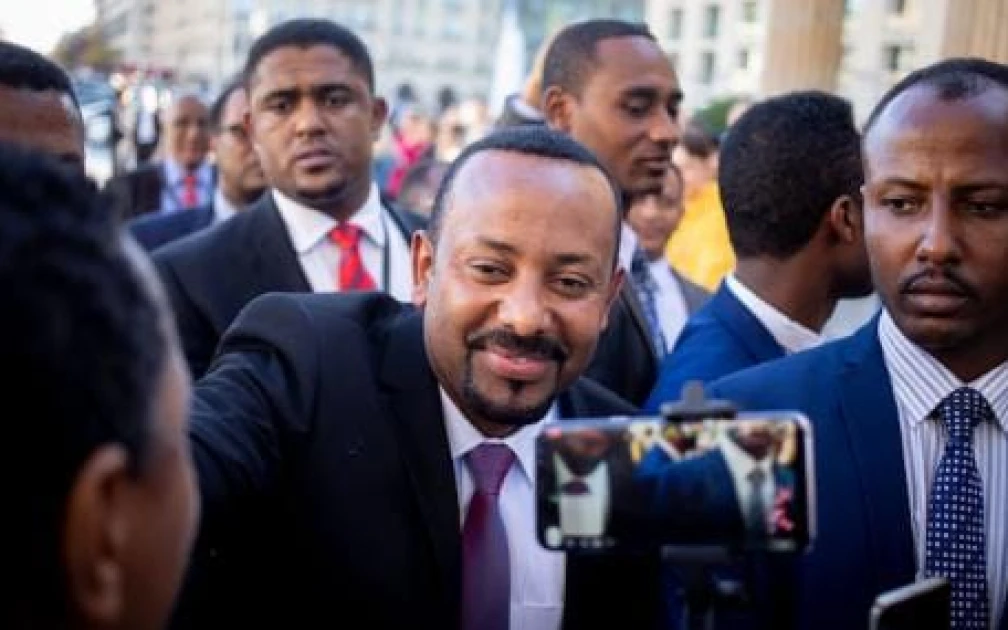
Abiy Ahmed welcomed at Brandenburg Gate before summit on private investment in Africa launched by Angela Merkel as President of G20. Kay Nietfeld/ Press Association, October, 2018. All rights reserved.

Audio By Vocalize
Ethiopia holds a general election on June 1, with Prime
Minister Abiy Ahmed all but guaranteed of victory despite multiple armed
conflicts and the economic impact of the Middle East war.
Abiy has been in power since 2018 and his Prosperity Party
(PP) won a landslide -- 485 of the 502 contested seats -- at the last general
election in 2021.
That ballot was partially disrupted by the devastating civil
war between the central government and the leaders of the Tigray region that
claimed an estimated 600,000 lives.
Abiy was initially feted for improving civil liberties and
earned a Nobel Peace Prize for restoring relations with Eritrea.
But his government has returned to a familiar authoritarianism,
cracking down on opponents, rights groups and journalists.
Abiy has focused on gradually liberalising the heavily
controlled economy in the hope of attracting investment and has projected
double-digit growth this year.
But Ethiopia's heavy reliance on oil imports means it has
been among the worst hit by the Israeli-US war against Iran.
That is unlikely to prevent another landslide, and the
ruling party has barely bothered with campaigning, policy announcements or even
slogans.
Abiy has not even confirmed he is running, although few
doubt he will return to power.
"This election is going to be among the least competitive
since multi-party democracy was introduced (in 1991)," Abel Abate Demissie
of the Chatham House think tank told AFP.
The most populous regions, Oromia and Amhara, are
experiencing long-running insurgencies and voting has already been cancelled in
30 of Amhara's 137 constituencies.
Amhara militant group, the Fano, warned voters in March that
it would consider anyone participating in the election "as complicit and
fight against you".
Despite the presence of some 500,000 federal soldiers and
30,000 police, "opportunities for spoilers abound", said the
Washington-based Africa Center for Strategic Studies in a recent report.
The national election authority has said voting will not
take place in Tigray, where one million people are still displaced from the
civil war, and the dominant regional party, the Tigray People's Liberation
Front, remains at odds with the government.
There are 23 parties registered for the election but most
are close to the PP.
"Many of the formidable opposition are reluctant to
engage in elections. Some of them are in the bush and others in exile,"
said Abel from Chatham House.
Ethiopia has never experienced truly free elections. In
2015, for instance, the ruling coalition won all the seats.
A budget of 10 billion birr ($64 million) has been allocated
to organise the vote across some 49,000 polling stations in a country that
covers over 1.1 million square kilometres (425,000 square miles).
In any case, the result is "pretty clear and it is
likely (to be) another landslide for the incumbent", said Abel.
Join the Discussion
Share your perspective with the Citizen Digital community.
No comments yet
This discussion is waiting for your voice. Be the first to share your thoughts!