
Equity Bank, IFAD launch Ksh.25.8B climate financing for farmers
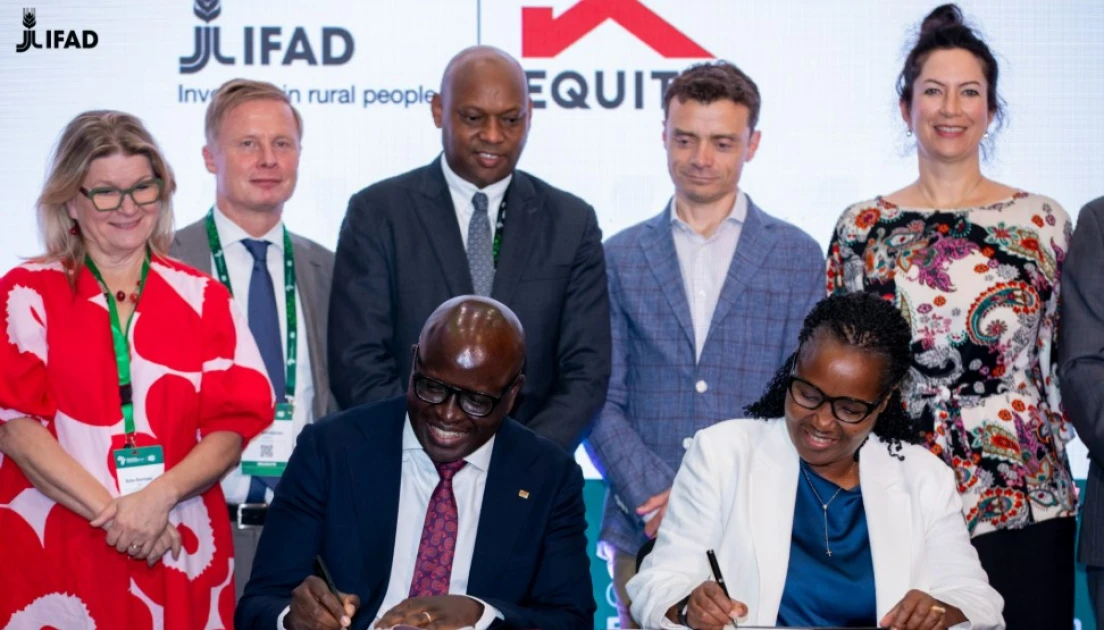
Equity Bank Kenya Managing Director, Moses Nyabanda, and Dr. Gérardine Mukeshimana, IFAD Vice President, during the signing ceremony of the Africa Rural Climate Adaptation Finance Mechanism (ARCAFIM) in Kigali, on the sidelines of the Africa Food Systems Forum 2026. Photo/IFAD

Audio By Vocalize
In a statement on Tuesday, the Africa Rural Climate Adaptation Finance Mechanism (ARCAFIM) was launched during the Africa Food Systems Forum 2026 in Kigali, Rwanda, with the programme expected to provide financing to about 260,000 smallholder farmers and 500 rural micro, small and medium-sized enterprises.
The 12-year initiative will operate in Kenya, Uganda, Tanzania and Rwanda, with at least 50 per cent of the intended beneficiaries expected to be women and 30 per cent youth.
ARCAFIM is backed by IFAD, Equity Group, the Green Climate Fund, Finland's Ministry for Foreign Affairs, the Nordic Development Fund, the Government of Denmark and the European Union.
The mechanism comprises US$180 million (Ksh.23.3 billion) in lending capital and about US$20 million (Ksh.2.5 billion) in technical assistance.
Because the lending capital will revolve through approximately four investment cycles, the partners estimate that the programme could generate about US$266 million (Ksh.34.4 billion) in loans for smallholder farmers and rural businesses across East Africa.
Equity Group will contribute US$90 million (Ksh.11.6 billion) from its own balance sheet, matching the concessional contribution on a one-to-one basis.
The financing will support investments aimed at helping farmers and rural enterprises withstand the effects of climate change.
IFAD Vice President Dr. Gérardine Mukeshimana revealed that the success of climate adaptation finance would depend on translating global commitments into practical investments for rural communities.
"ARCAFIM's ambition is to make rural climate adaptation a recognizable, viable and sustainable business line for African financial institutions. It will support tailored financial products and a climate adaptation financing taxonomy, so that participating institutions gain the experience, systems and confidence to continue expanding adaptation finance," Mukeshimana stated.
"The mechanism is starting in East Africa, but it is designed to be adapted and replicated across Africa."
The programme is also expected to strengthen food security for approximately 1.2 million people and benefit an estimated 1.5 million people directly and indirectly.
Equity Group Managing Director and Chief Executive Officer Dr. James Mwangi added that the initiative would change how financial institutions approach smallholder farmers and rural borrowers.
"Africa's smallholder farmers are not waiting to be rescued. They are entrepreneurs operating in the most demanding risk environment on earth, and what they have lacked is a financial system built to back them," Mwangi stated.
"By committing our own balance sheet alongside concessional capital, we are not funding a project. We are building a market, one in which lending for climate resilience becomes an ordinary banking business rather than an act of charity."
Equity Bank Kenya Managing Director Moses Nyabanda noted that the bank would finance smallholder farmers and agricultural producers directly, as well as through microfinance institutions, SACCOs and agricultural value chain companies.
"The goal is simple: enable farmers and agricultural businesses to adapt, increase production, grow revenues and incomes, and become more resilient to the effects of climate change," Nyabanda stated.
The Green Climate Fund has committed US$55 million (Ksh.7 billion) to the programme, with its Africa Regional Director Catherine Koffman describing ARCAFIM as an example of how public and private financing can be combined to increase investment in climate-resilient agriculture.
The programme's financing structure is designed to share risks between international partners and Equity Group, with concessional capital providing protection against initial losses while the bank assumes a significant portion of the lending risk.
Beyond providing loans, the technical assistance component will help participating microfinance institutions and SACCOs develop the capacity to provide climate adaptation financing.
Farmers and rural businesses will also receive support to identify investments that can help protect their livelihoods from changing weather patterns and climate-related shocks.
IFAD and Equity Group said the long-term objective is to establish climate adaptation lending as a permanent and commercially viable business line for African financial institutions, even after concessional financing has been exhausted.
The two organisations have identified Southern and West Africa as potential regions for the future expansion of the blended climate finance model.
Join the Discussion
Share your perspective with the Citizen Digital community.
No comments yet
This discussion is waiting for your voice. Be the first to share your thoughts!