
Earliest-known galaxy, spotted by Webb telescope, is a beacon to cosmic dawn
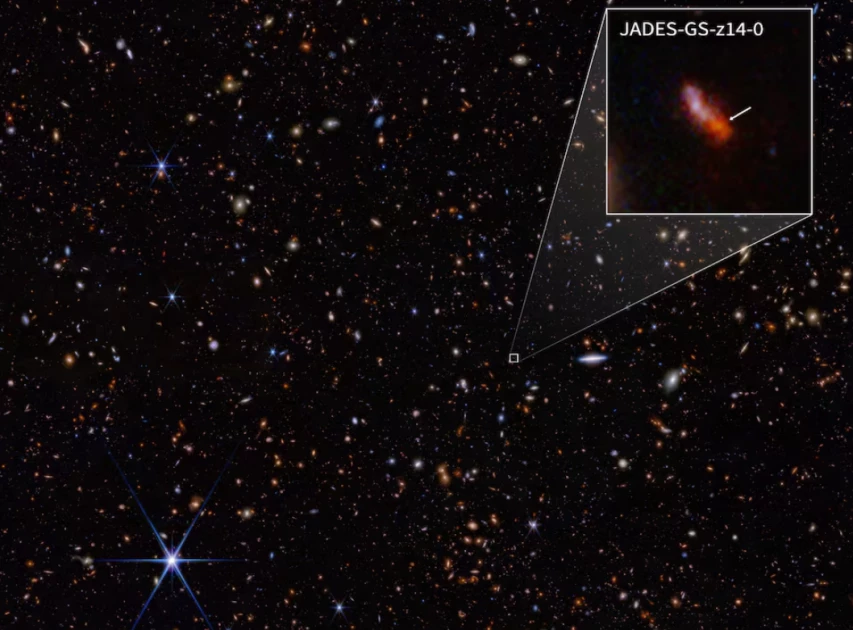
An infrared image from NASA's James Webb Space Telescope, taken by the NIRCam (Near-Infrared Camera) for the JWST Advanced Deep Extragalactic Survey, or JADES, program. One such galaxy, JADES-GS-z14-0 (shown in the pullout), was determined to have formed about 290 million years after the Big Bang, making it the earliest-known galaxy. NASA, ESA, CSA, STScI, Brant Robertson (UC Santa Cruz), Ben Johnson (CfA), Sandro Tacchella (Cambridge), Phill Cargile (CfA)/Handout via REUTERS/File Photo

Audio By Vocalize
NASA's James
Webb Space Telescope has spotted the earliest-known galaxy, one that
is surprisingly bright and big considering it formed during the universe's
infancy - at only 2% of its current age.
Webb, which by peering across vast cosmic distances is
looking way back in time, observed the galaxy as it existed about 290 million
years after the Big Bang event that initiated the universe roughly 13.8 billion
years ago, the researchers said. This period spanning the universe's first few
hundred million years is called cosmic dawn.
The telescope, also called JWST, has revolutionized the
understanding of the early universe since becoming operational
in 2022. The new discovery was made by the JWST Advanced Deep Extragalactic
Survey (JADES) research team.
This galaxy, called JADES-GS-z14-0, measures about 1,700 light-years across. A light year is the distance light travels in a year,
5.9 trillion miles (9.5 trillion km). It has a mass equivalent to 500 million
stars the size of our sun and is rapidly forming new stars, about 20 every
year.
Before Webb's observations, scientists did not know galaxies
could exist so early, and certainly not luminous ones like this.
"The early universe has surprise after surprise for
us," said astrophysicist Kevin Hainline of Steward Observatory at the
University of Arizona, one of the leaders of the study published online, opens
new tab this week ahead of formal peer review.
"I think everyone's jaws dropped," added
astrophysicist and study co-author Francesco D'Eugenio of the Kavli Institute
for Cosmology at the University of Cambridge. "Webb is showing that
galaxies in the early universe were much more luminous than we had
anticipated."
Until now, the earliest-known galaxy dated to about 320
million years after the Big Bang, as announced by the JADES team last year.
"It makes sense to call the galaxy big, because it's
significantly larger than other galaxies that the JADES team has measured at
these distances, and it's going to be challenging to understand just how
something this large could form in only a few hundred million years,"
Hainline said.
"The fact that it's so bright is also fascinating,
given that galaxies tend to grow larger as the universe evolves, implying that
it would potentially get significantly brighter in the next many hundred
million years," Hainline said.
While it is quite big for such an early galaxy, it is
dwarfed by some present-day galaxies. Our Milky Way is about 100,000 light-years across, with the mass equivalent to about 10 billion sun-sized stars.
The JADES team in the same study disclosed the discovery of
the second oldest-known galaxy, from about 303 million years post-Big Bang.
That one, JADES-GS-z14-1, is smaller - with a mass equal to about 100 million
sun-sized stars, measuring roughly 1,000 light years across and forming about
two new stars per year.
"These galaxies formed in an environment that was much
more dense and gas-rich than today. In addition, the chemical composition of
the gas was very different, much closer to the pristine composition inherited
from the Big Bang - hydrogen, helium and traces of lithium," D'Eugenio
said.
Star formation in the early universe was much more violent
than today, with massive hot stars forming and dying quickly, and releasing
tremendous amounts of energy through ultraviolet light, stellar winds and
supernova explosions, D'Eugenio said.
Three main hypotheses have been advanced to explain the
luminosity of early galaxies. The first attributed it to supermassive black
holes in these galaxies gobbling up material. That appears to have been ruled
out by the new findings because the light observed is spread over an area wider
than would be expected from black hole gluttony.
It remains to be seen whether the other hypotheses - that
these galaxies are populated by more stars than expected or by stars that are
brighter than those around today - will hold up, D'Eugenio said.
Join the Discussion
Share your perspective with the Citizen Digital community.
No comments yet
This discussion is waiting for your voice. Be the first to share your thoughts!