
EACC, LSK push for accountability, integrity in fresh anti-graft campaign

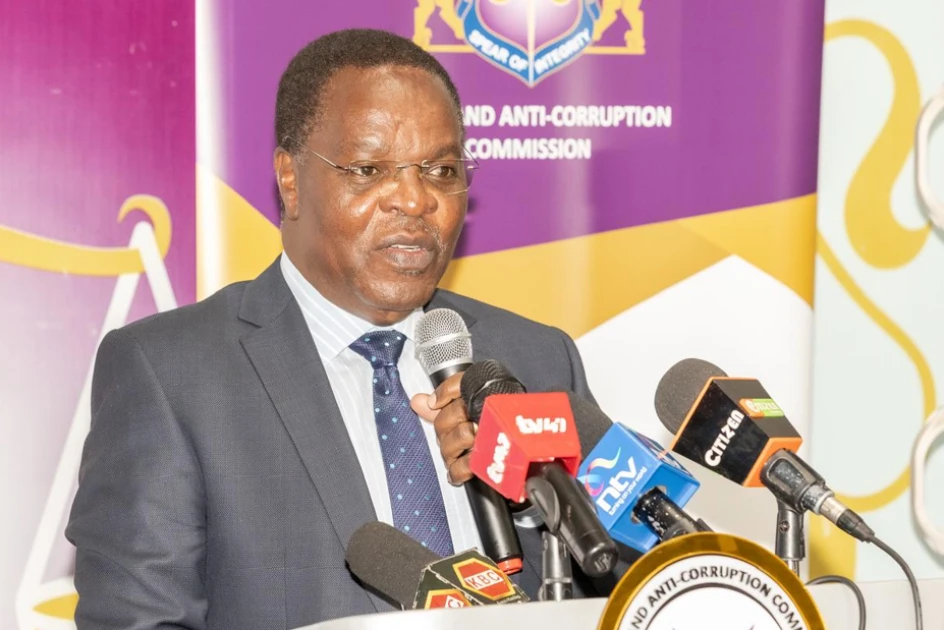
EACC Chairperson Dr David Oginde speaking during the commemoration of the African Anti-Corruption Day at Integrity Centre in Nairobi on Monday, July 13, 2026. PHOTO | EACC

Audio By Vocalize
The Ethics and Anti-Corruption Commission (EACC) and the Law Society of Kenya (LSK) have renewed calls for greater accountability, stronger institutions and citizen participation in the fight against corruption.
Speaking during the commemoration of the African Anti-Corruption Day at Integrity Centre in Nairobi on Monday, the two institutions urged Kenyans to embrace integrity as the country shifts towards preventing graft rather than solely prosecuting offenders.
EACC Chairperson
David Oginde said the commission is increasingly focusing on eliminating
opportunities for corruption before they occur, arguing that prevention offers
a more sustainable solution than enforcement alone.
"Promoting integrity is an important aspiration that
we must commit ourselves to because it helps to build our institutions so that
corruption is reduced, if not eliminated. The fight against corruption must also
reduce the number of opportunities for corruption," Oginde said.
He noted that the commission has progressively adopted a governance-driven approach that combines corruption prevention, public education, investigations, asset recovery and institutional reforms to safeguard public resources.
According to the EACC, over the past years, the Commission has strengthened
corruption risk assessments, systems reviews, integrity testing and citizen
engagement initiatives as part of its strategy to curb graft.
Oginde singled out citizens and the media as critical
partners in promoting accountability.
"Citizen engagement has emerged as one of the
strongest drivers of accountability. I appreciate the media for the work you
are doing in exposing corrupt practices. You have prosecuted this in the public
court and I believe you are making a significant contribution," he
said.
He also challenged religious institutions to take a firmer stand against corruption, saying, "Most people who engage in corruption are also members of our religious institutions. We give them an opportunity to contribute part of the loot that they have taken as donations for our development," Oginde observed.
Drawing parallels with competitive sports, Oginde said
Africa's greatest victory would not be winning trophies but nurturing a culture
where integrity becomes the continent's defining value.
"If we were all training towards integrity, with the discipline that elite athletes devote to soccer, Africa's greatest victory would not be about lifting the World Cup trophy but building a continent where integrity is our identity and corruption is defeated," he urged.
"It is high time we have independent bodies like LSK working with other professionals, publishing a rule of law report for Kenya so that we can see where we are having systemic failures so that we can create a baseline to see how to grow in the fight against corruption," Kanjama said.
Kanjama argued that while corruption is widely condemned in public, individual accountability remains weak.
"The crisis we face as a country is that whenever we come together, we collectively deplore corruption. When we are faced with individual cases, many of us don't rise to the standards expected by the Constitution. We must pursue individual accountability in the fight against corruption," he said.
"The fight against corruption is a task that cannot be accomplished by ourselves alone; it requires even spiritual powers and efforts. We ask God to watch over us so that we can safely vanquish this monster."
EACC CEO Abdi Mohamud said this year's African Union theme, 'Scaling Up the Promotion of Integrity and Anti-Corruption Actions Across Africa,' highlights the need for governments, the private sector, civil society, professional bodies, development partners, the media and citizens to work together in combating corruption.
"This year's African Union theme is both timely and important. It reminds us that fighting corruption cannot be the responsibility of a few agencies. It requires governments, the private sector, civil society, professional bodies, the media, development partners and every citizen to play their part – all in one accord," Mohamud said.
Mohamud warned that corruption continues to undermine
development.
"Corruption is not simply a legal issue but a development issue. Corruption steals opportunities from our young people and denies families access to a dignified life. It undermines public trust, weakens institutions and ultimately, takes away the hope of a nation," he said.
National Construction Authority Executive Director Maurice
Aketch urged public institutions to cultivate ethical leadership and
professionalism.
"Let's inculcate a culture of integrity and
anti-corruption to ensure that the services we offer are safe, have no bias, and
there is trust in what we do," he said.
United Nations Office on Drugs and Crime representative
Kodjo Atisso, who was also at the event, said the organisation continues to support Kenya's justice sector
by strengthening access to justice, financial investigations and asset
recovery.
Deputy Inspector General of Police Gilbert Masengeli likewise reaffirmed the National Police Service's commitment to supporting
anti-corruption efforts.
"As the Police Service, it is our duty to ensure your
safety; your safety is our responsibility. We work hand in hand with EACC to
ensure that there is integrity," Masengeli said.
The event brought together representatives from government
institutions, the legal fraternity, development partners, professional bodies
and civil society.
Join the Discussion
Share your perspective with the Citizen Digital community.
No comments yet
This discussion is waiting for your voice. Be the first to share your thoughts!