
Dar es Salaam transit cargo rises 17% as regional corridor competition intensifies

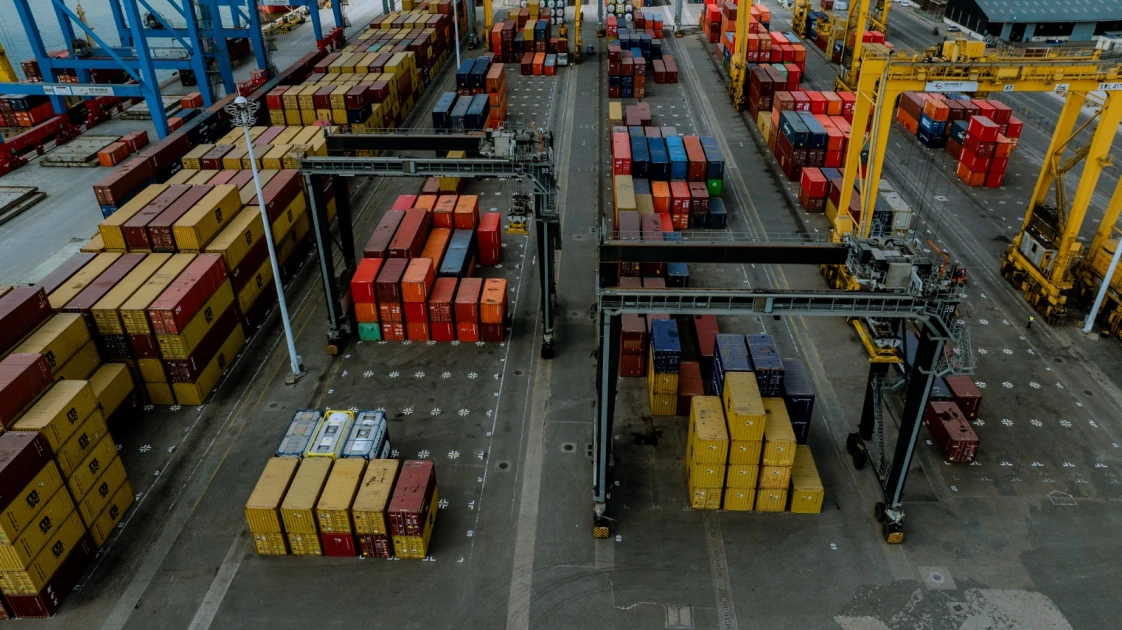
Containers are stacked across the yard at DP World’s Dar es Salaam terminal as rubber-tyred gantry cranes support cargo movement through one of Tanzania’s principal maritime gateways

Audio By Vocalize
The increase was driven largely by stronger cargo flows to the Democratic Republic of Congo (DRC), Zambia and Rwanda, strengthening Dar es Salaam’s position as an alternative gateway for regional trade.
DRC-bound cargo rose 30 percent to 7.77 million tonnes, accounting for more than half of the port’s transit traffic. Zambia handled 3.41 million tonnes, while cargo destined for Rwanda increased 24 percent to 2.18 million tonnes.
The growth comes as Tanzania seeks to improve the efficiency of the Dar es Salaam corridor and attract cargo moving between the Indian Ocean and inland markets.
Total cargo handled at Dar es Salaam Port reached 33.71 million tonnes in 2025/26, a 21.5 percent increase from the previous financial year, according to official port data.
The longer-term trend has also been upward. Government figures show cargo handled at the port increased from 16.27 million tonnes in 2020/21 to 27.76 million tonnes in 2024/25, while the average time container vessels spent at berth fell from about 10 days to three.
Faster cargo handling
Private investment has been a major part of the changes at the port, particularly following the entry of global port operator DP World under a 30-year concession.
At Terminal 1, operated by DP World, cargo discharge times for comparable operations have reportedly fallen from more than 300 hours to less than 28 hours since the operator began operations in April 2024.
DP World had invested USD123 million in the terminal by April 2026 in equipment, infrastructure, technology and operating systems. The investment includes cranes, cargo-handling systems, yard infrastructure and two gates linking the terminal to Nelson Mandela Road.
Eight diesel-electric Rubber Tyred Gantry Cranes were also commissioned in June, expanding the terminal’s container-handling capacity.
Container throughput has subsequently risen sharply. The terminal recorded four consecutive monthly records, handling 44,001 containers in May, 45,856 in June, 46,582 in July and 48,793 in August, according to regulator data.
The figures represent a significant increase from monthly container volumes of between 8,000 and 13,000 recorded before 2024.
The port is also handling larger and more specialised vessels. Among them is the 240-metre M/V RAMHAN, which DP World said discharged nearly 7,900 heavy-duty vehicles in just over 27 hours.
The increase in activity extends beyond containers to dry bulk, general cargo and roll-on/roll-off traffic.
Government plans to install additional dry-bulk handling equipment are expected to increase capacity by 65 percent for commodities including wheat, sulphur and fertiliser.
Dar es Salaam currently records average wheat discharge rates of more than 12,000 tonnes per day.
Competition shifts inland
The increase in port efficiency is, however, only one part of the competition for regional cargo.
For cargo owners in landlocked markets, the cost and reliability of the entire corridor — from the port to the final destination — can determine which gateway is used.
Tanzania has therefore been expanding transport infrastructure beyond the port.
Commercial freight operations on the Standard Gauge Railway between Dar es Salaam and Dodoma began in July 2025, with construction continuing on sections intended to extend the network westwards.
A planned freight terminal at Morogoro is expected to connect rail cargo with road transport serving domestic and neighbouring markets.
The Kwala dry port is another component of the strategy. The facility is already receiving trains from Dar es Salaam and is designed to handle about 300,000 containers annually, with space allocated to neighbouring markets including the DRC, Zambia and Rwanda.
Tanzania is also seeking to revive the Tanzania-Zambia Railway (TAZARA), a key link between the Tanzanian coast and Zambia.
Under the railway's revitalisation programme, physical works advanced in July with construction beginning on a new operations control centre and training centre in Dar es Salaam.
On the road network, work is underway to address congestion at the Tunduma border crossing with Zambia. The border approach is being widened from one lane to four to ease truck traffic between Tanzania, Zambia, the DRC and other Southern African markets.
The government is also pursuing digital reforms in maritime services. The Tanzania Shipping Agencies Corporation (TASAC) is preparing to introduce a Maritime Transport e-Regulatory System to allow service providers to process licences, registrations and supporting documents online.
The developments point to a broader shift in Tanzania's approach to regional transit: improving not only how quickly cargo is discharged at Dar es Salaam, but how efficiently it moves from the port through the wider transport corridor to inland markets.
For businesses moving goods to the DRC, Zambia and Rwanda, the performance of that entire corridor will increasingly determine whether Dar es Salaam can convert its recent increase in transit volumes into sustained regional market share.
Join the Discussion
Share your perspective with the Citizen Digital community.
No comments yet
This discussion is waiting for your voice. Be the first to share your thoughts!