
Court told police unable to identify firearm used in Rex Masai murder
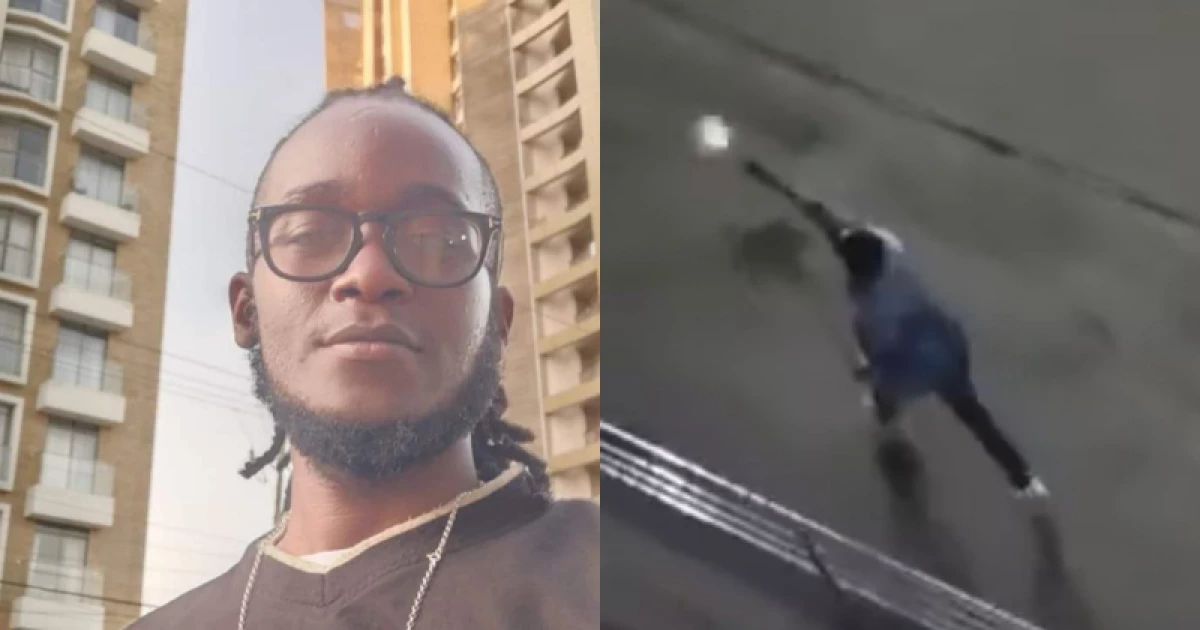
A side-by-side image showing 24-year-old Rex Kanyike and a police officer opening fire that shot the deceased.

Audio By Vocalize
The inquest into the death of protester Rex Masai heard
testimony on Thursday after the lead investigating officer told the court that
detectives were unable to identify the firearm that fired the fatal bullet,
citing a lack of cooperation from police officers involved in the June 2024
anti-Finance Bill demonstrations.
Principal Investigating Officer Justin Nyatete, a detective
with 22 years of service, testified before the court and outlined the
challenges investigators faced while probing Masai’s fatal shooting near the
Absa Bank Kenya area in Nairobi’s Central Business District.
Nyatete told the court that investigations established that
Masai was the only person injured at the Absa Bank scene, while other
casualties reported during the demonstrations were injured in separate
locations.
He said detectives reviewed witness statements, video clips
and photographs taken during the protests, including material supplied by a
protected witness identified as a journalist.
According to Nyatete, the journalist captured images along
Uhuru Highway showing an officer in plain clothes among uniformed police
officers.
The officer seen in the images was armed with a police radio
and baton and appeared to be operating alongside officers dressed in full
police uniform.
Nyatete told the court the individual appeared similar to a
person captured in another video recorded near Absa Bank.
The court heard that Murangiri was working undercover and had
been issued with a tear gas launcher. Investigators also established that he
was armed with a small firearm.
However, Nyatete said forensic investigations did not connect
Murangiri’s weapon, or those of other officers who testified, to the bullet
that killed Masai.
“The ballistic report showed the cartridge recovered had been
fired from a revolver and not from the pistols issued to the officers under
investigation,” Nyatete told the court.
He added that detectives could not recover the bullet that
struck Masai because it exited his body, making it difficult to conclusively
identify the weapon used.
“We could not link the pistols to the bullet. We were also
unable to recover the firearm that discharged the fatal shot,” Nyatete
testified.
Nyatete further revealed inconsistencies in Murangiri’s
account.
In his statement to investigators, Murangiri indicated he was
not on duty on June 18. He, however, stated that on June 20, he reported at
5:20a.m and had been assigned guard duties at the gate of the Kenyatta
International Convention Centre.
The investigating officer said detectives also sought to
establish the identity of individuals seen chasing protesters during the
demonstrations.
But officers who appeared before the court, including
Murangiri, denied responsibility and claimed those pursuing demonstrators were
criminals and not police officers.
“Our investigations could not verify who the people chasing
demonstrators were,” Nyatete said.
“We did what we could, but we encountered non-cooperation from
the police.”
His testimony laid bare major gaps in the investigation, with
the court hearing that despite witness accounts, video footage and ballistic
analysis, detectives were unable to trace the weapon responsible for Masai’s
death.
The inquest continues, with the court expected to determine
whether more officers will be summoned to testify over the circumstances
surrounding Masai’s killing during the demonstrations.
Join the Discussion
Share your perspective with the Citizen Digital community.
No comments yet
This discussion is waiting for your voice. Be the first to share your thoughts!