
Chatham House: Kalonzo pledges audit of Gov't funds within 60 days if elected President

Audio By Vocalize
Wiper Patriotic Front leader Kalonzo Musyoka has pledged to audit all government funds, loans and contracts within 60 days of taking office if elected President in the August 2027 General Election, promising to tighten public financial controls and end what he describes as the misuse of public resources.
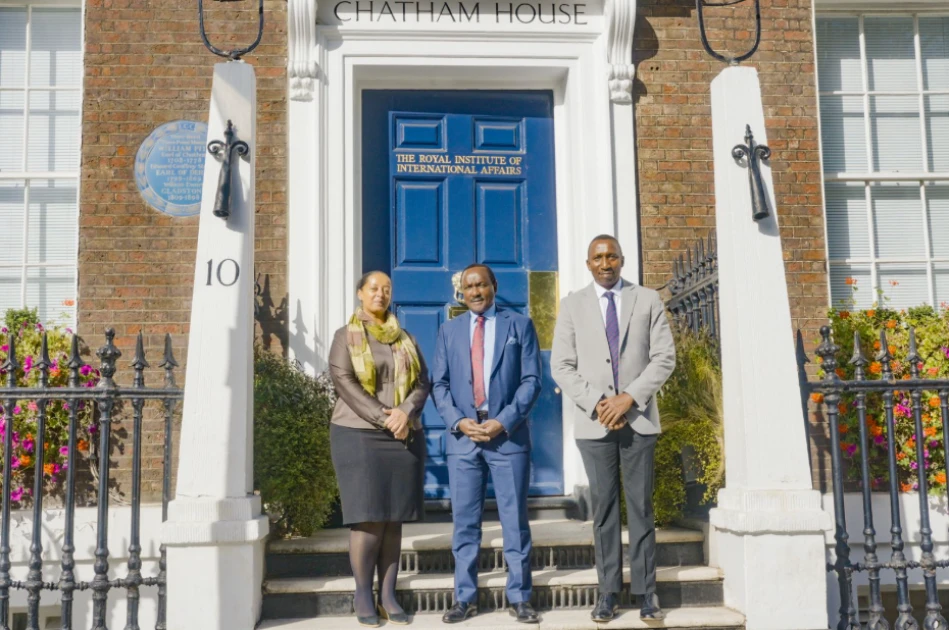
In his keynote address at Chatham House in London on Tuesday,
October 13, Kalonzo said his proposed government would begin by publishing
details of public funds, levies, securitised assets and financial guarantees,
starting with proceeds from the sale of government assets and the digital
system supporting the national health scheme.
He singled out approximately USD 2.6 billion (about Ksh.337
billion) in proceeds from the sale of shares in Safaricom and Kenya Pipeline,
as well as USD 800 million (Ksh.103 billion) committed to a digital system for
the health scheme, arguing that public funds must be subject to independent
oversight.
“Every fund and levy goes under the Controller of Budget. No
more off-budget Kenya,” Kalonzo declared, outlining the first phase of his
proposed economic and governance programme, which he has branded ‘Rescue, Restore, Renew.’
The former Vice President said the proposed audit would form
part of a broader effort to restore public confidence in government
institutions, reduce waste and address the country’s mounting debt burden
without introducing additional taxes or taking on new loans.
He argued that Kenya’s economic difficulties stem not only
from public debt but also from a system in which government spending and
contracts are shielded from adequate scrutiny.
“The disease is a State that borrows before it builds, spends
where nobody can see, and sells what it should not,” he said.
Kalonzo used the address to paint a picture of an economy
weighed down by debt servicing, rising household costs and declining
development expenditure.
Citing figures in government documents, he said Kenya’s public
debt stood at USD 100 billion (Ksh.12.98 trillion) as of June 2026, equivalent
to 68.5 per cent of gross domestic product (GDP), against a statutory debt
anchor of 55 per cent.
He further claimed that interest payments consumed 43 cents of
every shilling collected in ordinary revenue during the 2025/2026 financial
year, with the proportion rising above half when pension obligations were
included.
According to Kalonzo, development spending had declined from
27 per cent of ordinary revenue in 2016 to 12.4 per cent, limiting the
resources available for infrastructure and other public investments.
The Ukombozi Alliance (TUA) leader also criticised the
government’s reliance on domestic borrowing, arguing that interest payments on
domestic debt alone were projected to exceed the entire education budget.
“These are not opposition figures. They are in the government’s
own papers,” he said, insisting that the next administration must address the
debt burden through tighter controls on spending and greater transparency.
Kalonzo pledged to publish a comprehensive debt register,
including securitised and collateralised obligations, and present it to
Parliament.
He also proposed legislation to bind future administrations to
a fiscal consolidation path, reduce the debt-to-GDP ratio towards the statutory
limit and bring interest payments down towards 30 per cent of ordinary revenue.
Rather than seek fresh loans, he said his administration would
prioritise recovering outstanding tax arrears, reducing the cost of government
borrowing and improving the collection of existing revenues.
“The Auditor-General put uncollected tax arrears at USD 18
billion, in 2024. Collecting what is already owed comes before asking anyone
for a new dollar,” he said.
Kalonzo added that the government would seek to widen the tax
base by formalising informal businesses, closing tax exemptions and digitising
revenue collection and customs operations.
He also promised a more predictable tax regime, with proposed
changes published alongside impact assessments and subjected to meaningful
public participation before implementation.
The opposition leader also renewed his criticism of recent
government asset sales, particularly the disposal of a 15 per cent stake in
Safaricom and the planned privatisation of Kenya Pipeline.
Kalonzo said his coalition had challenged the Safaricom transaction
in court and welcomed a High Court ruling issued on September 15, 2026, which
found the sale unconstitutional over inadequate public participation,
concealment of material information and arbitrary pricing.
He further announced that the Court of Appeal had declined the
government's application to suspend the High Court order, while noting that the
Treasury had challenged the ruling.
The Wiper leader maintained that his objection was not to
privatisation itself but to the manner in which public assets were being
disposed of.
“We are not against privatisation; we are against secret
privatisation,” he said.
He cited Safaricom’s 2008 listing on the Nairobi Securities
Exchange (NSE) as an example of what he considers a more transparent approach,
arguing that future divestitures should involve open price discovery, stock
exchange listings and opportunities for ordinary Kenyan investors to
participate.
Kalonzo also pledged to reverse the sale of Kenya Pipeline,
while promising that any disputes arising from previous transactions would be
handled through the courts.
“We will deal with court orders by due process and refund,
never by expropriation. We will honour every lawful contract,” he said.
Kalonzo further criticised the proposed leasing of Jomo
Kenyatta International Airport (JKIA) to a foreign conglomerate, claiming the
transaction was abandoned only after the conglomerate's owner faced prosecution
in another country.
He called for mandatory electronic procurement, a public
register of beneficial owners of companies receiving government contracts and
parliamentary approval for major deals awarded without competitive bidding.
Kalonzo identified the offices of the Auditor-General and the
Controller of Budget as central to his proposed reforms, arguing that their
findings on public expenditure had repeatedly gone unanswered.
He promised to ensure the two offices receive adequate funding
and require government agencies to respond publicly to adverse audit findings
within 90 days.
The proposed administration would also publish a quarterly
scorecard tracking progress on public debt, interest payments, development
spending, competitive procurement, health insurance claims, manufacturing, job
creation and corruption.
“Trust is not asked for. It is measured,” he said, adding that
his coalition would publicly acknowledge any targets it failed to meet.
Kalonzo argued that transparency would help restore investor
confidence and reduce the cost of borrowing, while enabling the government to
settle pending bills owed to suppliers.
He said national government pending bills exceeded Ksh.500
billion, arguing that clearing the outstanding payments would help businesses
resume operations and support economic activity.
Using the analogy of a leaking bucket, he said the government
should first stop financial losses before seeking additional resources.
“You do not answer a leaking bucket by walking back to the
river for more water. Mend the bucket first,” he said.
Beyond fiscal reforms, Kalonzo outlined plans to increase
manufacturing's contribution to the economy from approximately seven per cent
of GDP to 10 per cent by 2032.
He proposed establishing a National Economic and Social
Council bringing together government, businesses and labour unions to agree on
economic priorities before the national Budget is prepared.
His administration would also seek to reduce electricity costs
by reviewing expensive power purchase agreements, streamline business licensing
and address illicit imports that undermine local manufacturers.
Kalonzo said about one million young Kenyans enter the labour
market annually, with only a fraction securing formal employment, arguing that
economic growth must be driven by production rather than taxation.
“No nation has taxed its way to prosperity; Kenya must produce
its way there,” he said.
On healthcare, he pledged to establish an exchequer-supported
financing model that would make services accessible across the country, ensure
no hospital is excluded from the national scheme and require insurance claims
to be settled within 30 days.
He also promised to increase health spending towards the 15
per cent target under the Abuja Declaration.
In education, Kalonzo proposed free and compulsory schooling
through secondary level, adequately funded public universities and greater
recognition of technical and vocational training as an alternative to
university degrees.
He said development spending would be restored to at least 25
per cent of ordinary revenue by 2031.
On governance and security, he pledged to strengthen judicial
independence, adequately fund constitutional commissions and end the practice
of governing through executive notices where legislation was required.
He also promised independent investigations into deaths in
custody, an end to enforced disappearances and protection of the right to
peaceful protest.
Kalonzo's address also sought to present the opposition as a
credible alternative ahead of the August 10, 2027 General Election, with unity
and electoral integrity forming key pillars of his pitch.
He said the Wiper Patriotic Front, The Ukombozi Alliance and
the United Alternative Government would work towards a common programme under
the banner Komboa Kenya, or
liberate Kenya.
The former Vice President said the opposition would publish
its coalition agreement and ruled out joining a government it had not won
through an election.
“Three platforms, one purpose: one written programme, Komboa
Kenya, and one rule: no handshake, no nusu-mkate, not before the vote and not
after it,” he said.
Kalonzo argued that previous opposition divisions had helped
incumbents retain power, citing the 1992 and 1997 elections before the
opposition united to defeat KANU in 2002.
He also called for electoral reforms ahead of the next
election, including a trusted Independent Electoral and Boundaries Commission
(IEBC), a publicly audited voter register, access to registration for eligible
Kenyans living abroad and the publication of results at polling stations.
He further demanded safeguards against interference with the
transmission of results, an electoral dispute resolution process with clear
timelines and security agencies that protect voters rather than intimidate
them.
Kalonzo called on diplomats and international election
observers to publish their assessment benchmarks ahead of the election and
deploy long-term observers from January 2027, including at polling stations
outside Kenya.
He also linked electoral credibility to the treatment of young
people, recalling the 2024 anti-Finance Bill protests and the subsequent demonstrations
in which young Kenyans were killed, abducted or injured.
“A government that answers its children with bullets has
forfeited the right to lecture them on patriotism,” he said.
He claimed that he had represented families of abducted
Kenyans in court and vowed that those responsible for ordering unlawful actions
would be held accountable.
On foreign policy, Kalonzo promised to restore Kenya's
tradition of non-alignment, arguing that the country’s diplomatic influence
depends on its ability to engage rival parties without being perceived as
taking sides.
He criticised the government's handling of Sudan's conflict,
referring to the February 2025 signing in Nairobi of a charter for a parallel
government by the Rapid Support Forces (RSF).
Kalonzo said the move had damaged Kenya's relations with
Sudan, including the recall of Khartoum's ambassador and the suspension of
Kenyan imports, threatening trade and Kenya's role in regional mediation.
He pledged that his administration would not deploy Kenyan
soldiers or police officers abroad without parliamentary approval and a funded,
internationally sanctioned mandate.
Regionally, he proposed integrating East African capital
markets to enable investors to purchase securities across borders without
waiting for the stalled monetary union.
Under the plan, pension funds in Nairobi could invest in bonds
issued in Kampala, while companies in Kigali could list on the Nairobi
Securities Exchange, with each market retaining its own currency.
He also called for stronger economic ties with the United
Kingdom through investment partnerships, infrastructure financing and
regulatory cooperation, arguing that Kenya should engage foreign partners on
terms that benefit both sides.
“We are inviting Britain to build with us, as partners, not
patrons; through investment, not extraction,” he said.
Addressing questions about his long political career, Kalonzo
defended his experience, saying his record in government and diplomacy would be
an advantage in navigating the country's economic and governance challenges.
He has previously served as Vice President, Foreign Affairs
Minister and in other Cabinet positions, including Education, Tourism,
Environment and Home Affairs.
Kalonzo said his campaign was not based on novelty but on
experience, a written policy programme and measurable commitments.
“I am not offering novelty. I am offering what Kenya has not
had in a decade: experience that has been tested, and a written promise that
can be measured,” he said.
He acknowledged that an incoming administration would face a
strained Treasury, declining public confidence and increased competition for
investment, but maintained that institutional reforms could help restore
economic stability.
The opposition leader concluded by urging investors,
diplomats, journalists and Kenyans in the diaspora to scrutinise his proposals
rather than accept them at face value.
He said the coalition would publish its programme's full
costing and allow the public to assess its performance against quarterly
targets.
Join the Discussion
Share your perspective with the Citizen Digital community.
No comments yet
This discussion is waiting for your voice. Be the first to share your thoughts!