
By land and sea: How is Ankara contributing to attacks on civilians in Sudan?
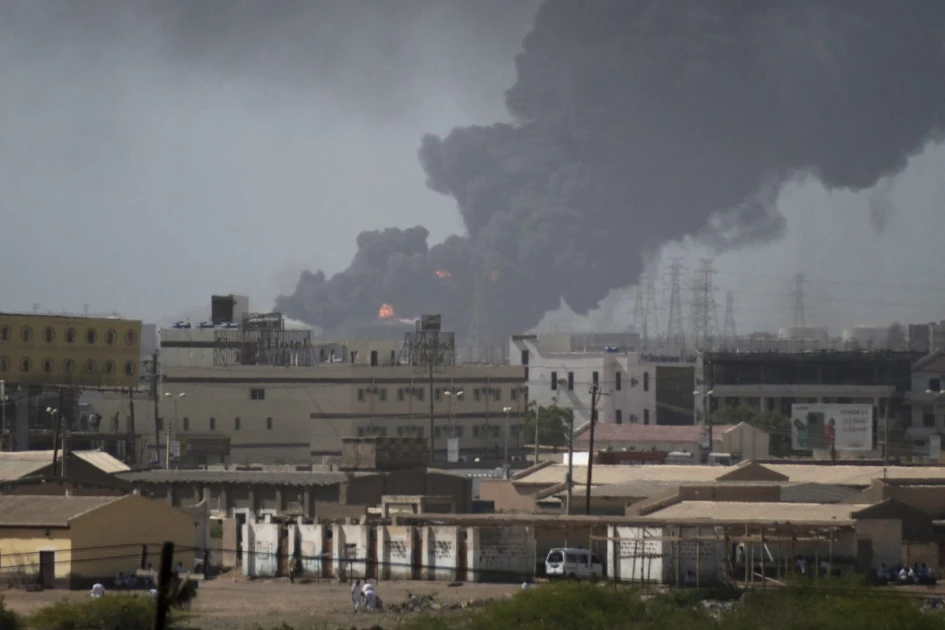
Smoke billows after a drone strike on the port of Port Sudan on May 6, 2025.

Audio By Vocalize
As the Sudanese Armed Forces continue to conduct aerial operations using foreign-made drones, their military partnership with Türkiye is expanding into the maritime domain through specialised military visits to Port Sudan's naval base and inspections of maintenance facilities and shipbuilding infrastructure. This trajectory places Sudan's coastline within Ankara's strategic calculations in the Red Sea.
Turkish Drones in the Service of Offensive Operations
The Sudanese army's relationship with Türkiye's arms industry is underpinned by documented deals, details of which were revealed by The Washington Post in an investigation published in March 2025, based on internal documents and correspondence between officials at Turkish company Baykar and its representatives stationed in Sudan.
The investigation uncovered an arms deal worth at least $120 million, involving eight Bayraktar TB2 drones, hundreds of warheads, control stations, and a 48-member Turkish technical team tasked with providing support and overseeing the operation of the systems.
Türkiye's role was not limited to delivering equipment. Correspondence reviewed by the newspaper revealed technical monitoring of the initial operations involving the use of the drones and newly supplied weapons, as well as the exchange of footage of airstrikes between company employees and its officials.
These details reveal that Turkish support provided the Sudanese army with more than just combat aircraft. It encompassed an integrated system of armaments, operational capabilities and technical support, helping introduce advanced aerial capabilities into the battlefield.
Akinci: Turkish Weapons at the Heart of the Attacks
As aerial operations evolved, a more advanced model of Turkish drone emerged on Sudan's battlefields: the Bayraktar Akinci, which is capable of conducting long-range strikes and carrying a variety of munitions.
In its September 2026 report, the Independent International Fact-Finding Mission for the Sudan documented images and footage of drones that had crashed in Kordofan and Darfur. It conducted a technical analysis of the wreckage components, identifying characteristics consistent with Türkiye's Akinci system.
The report identified components associated with its twin-turboprop propulsion system, parts of the propellers and munitions-release mechanisms, in addition to manufacturer markings on some of the wreckage. It also referred to footage from Nyala in South Darfur, dated 8 January 2026, and from Al-Farshaya in South Kordofan, dated 24 January, which it assessed as likely showing this model.
These findings reinforce the conclusions reached by Sudan Witness, an initiative of the Centre for Information Resilience, in its monitoring report published on 15 October 2026. The report identified the Akinci among the foreign-made drones used by the Sudanese Armed Forces, alongside Bayraktar TB2 drones and loitering munitions manufactured by Baykar.
Turkish involvement in the Sudanese army's aerial operations is therefore no longer confined to a single model. It has extended to more advanced offensive systems, enhancing the army's ability to carry out long-range airstrikes.
Civilians Pay the Price for Aerial Escalation
The danger posed by these capabilities lies in their use within a war marked by an expansion of aerial attacks on civilian areas. In its September report, the UN Fact-Finding Mission said it had reasonable grounds to believe that the Sudanese Armed Forces had used foreign-supplied drones and loitering munitions in attacks that struck civilian objects, including Yabus Market in Blue Nile State.
The mission concluded that these attacks may amount to serious violations of international humanitarian law and war crimes, noting that foreign-made drones had enhanced the army's reconnaissance and precision-strike capabilities.
The Office of the United Nations High Commissioner for Human Rights also documented the killing of more than 1,000 civilians in drone strikes between January and May 2026. The attacks hit hospitals, schools, markets, places of worship, displacement sites and electricity networks.
In July, UN High Commissioner for Human Rights Volker Türk warned of escalating drone attacks on civilian areas in Kordofan, noting that his office had documented 15 airstrikes on El Obeid and its surrounding areas between 6 and 28 June, killing at least 45 civilians and injuring another 41.
These incidents place external military support under direct scrutiny over the risks associated with the continued supply of advanced weapons to parties using them in a war that has claimed large numbers of civilian lives. They also raise questions about the obligations of manufacturers and supplying countries to monitor the end use of military equipment, particularly when technical assistance is provided alongside operational support.
Ankara Expands Its Presence from the Air to the Sea
Alongside cooperation in the field of drones, Ankara is working to expand its military relations with the Port Sudan authorities into the maritime domain, capitalising on the strategic location of Sudan's Red Sea coastline.
On 9 November, the Turkish Ministry of National Defence announced that a delegation from the Naval Forces Command and the General Directorate of Shipyards had visited Sudan from 2 to 5 November. The visit included Port Sudan Naval Base, where the delegation inspected maintenance workshops and ship-lifting facilities and discussed ways to strengthen the Sudanese Navy's shipbuilding and maintenance capabilities.
The visit reflects the expansion of military cooperation between the two sides beyond aerial arms deals towards the development of maritime infrastructure, which would provide the Sudanese Armed Forces with additional capabilities to maintain and operate vessels, while opening up broader avenues for Ankara to extend its influence along the Red Sea coast.
These moves build on Türkiye's longstanding interest in Sudan's strategic location, as reflected in the 2017 agreement to develop Suakin Port, which granted Ankara a role in restoring facilities at the historic port and sparked debate at the time over the strategic and military dimensions of Türkiye's presence in the Red Sea.
In a parallel development, Italy's Nova news agency reported details of the Turkish delegation's visit, linking the maritime moves to efforts to establish a Turkish military base on the Sudanese coast, as part of broader arrangements in which Turkish and Russian interests intersect.
These developments take on added significance given Sudan's location along one of the world's most important maritime corridors. Its extensive Red Sea coastline offers an opportunity to strengthen military and logistical presence and monitor international shipping and trade routes.
Turkish interests also intersect with Russia's longstanding project to establish a naval and logistical support facility on the Sudanese coast, a project dating back to an agreement concluded with Omar al-Bashir's government in 2017, which has remained subject to negotiations and competing interests since his ouster.
These moves indicate that relations between Ankara and the Port Sudan authorities go beyond meeting urgent military needs imposed by the war. They encompass the building of long-term influence in both the aerial and maritime domains through arms deals, the development of military facilities and technical cooperation.
Who Is Monitoring Turkish Arms?
These questions are becoming increasingly pressing as foreign-made drones continue to be used in military operations across Sudan, while the United Nations documents attacks that have caused harm to civilians and civilian objects.
Responsibility does not rest solely with the party that presses the button to release a munition. It extends to arms supply networks, technical support and the entities providing the equipment and technology required to sustain military operations.
In Türkiye's case, the Baykar deal reveals the supply of drones, munitions and operational equipment, as well as the presence of company technicians in Sudan. Meanwhile, UN evidence confirms the appearance of advanced Turkish systems in the Sudanese army's aerial operations.
As maritime cooperation with the Port Sudan authorities expands, Turkish drones remain part of a military landscape that has contributed to enhancing the army's capacity to conduct aerial attacks. Thus, Türkiye's role in Sudan is taking shape along two parallel tracks: strengthening combat capabilities in the air and expanding its military and logistical presence along the Red Sea coast.
Join the Discussion
Share your perspective with the Citizen Digital community.
No comments yet
This discussion is waiting for your voice. Be the first to share your thoughts!