
Breastfeeding and undetectable: Kenya's drive to give HIV-positive mothers healthy babies
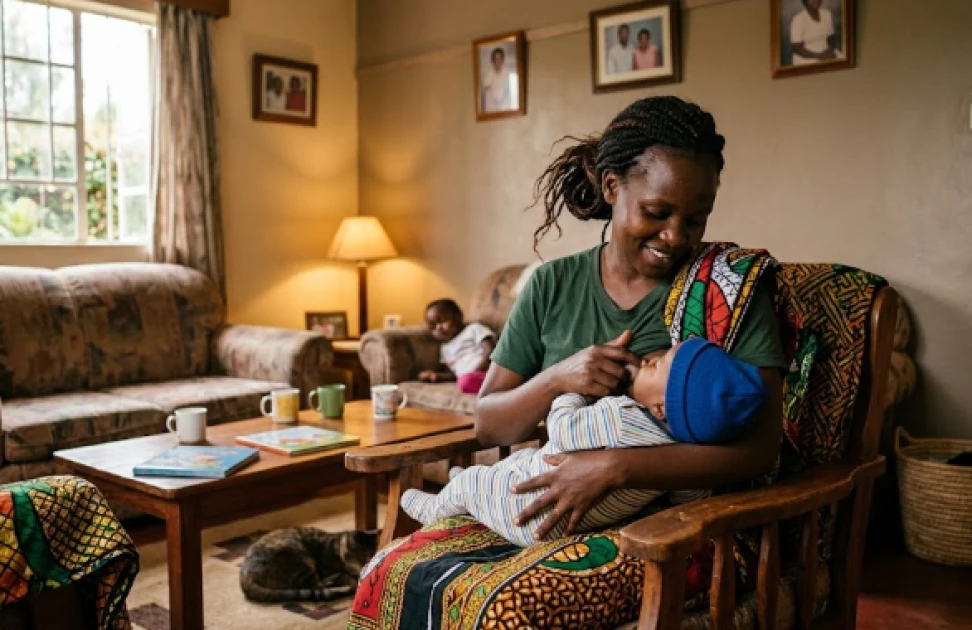
AI-generated image depicts a mother breastfeeding an infant.

Audio By Vocalize
For decades, an HIV diagnosis during pregnancy filled mothers with dread, not just for their own health, but for the child growing inside them.
Today, that fear is largely unfounded if the system around a pregnant woman works the way it's designed to.
As the world marked World Breastfeeding Week from August 1-7, health workers across Kenya renewed a message that: a mother living with HIV can breastfeed safely, and her baby can be born and stay HIV-free.
"That era is long gone," says Doughlas Bosire, CEO of the National Syndemic Disease Control Council (NSDCC). "No one should think of it as a prison or a death sentence."
The Science of Prevention
For a woman who does not yet know her HIV status, protection begins the moment she learns she is pregnant.
She is urged to attend at least four antenatal care visits before delivery, during which she is tested and, if HIV-positive, placed on antiretroviral (ARV) medication to suppress her viral load.
"When she gets tested, it becomes known whether she has the virus or not. If it is found that the virus went up a little, her medication can be adjusted slightly so that we reduce the chance of the virus passing to the baby,” Bosire explains.
At birth, protection continues on two fronts. The mother stays on her own ARVs, while the newborn is given prophylactic medication commonly Nevirapine syrup in Kenya to guard against transmission during the vulnerable breastfeeding period.
Of children born to mothers living with HIV, roughly 96% test negative for the virus when checked between 18 and 24 months of age.
A mother's journey
For a woman who already knows she is living with HIV and wants to have a child, nurse Rahab Kashu of Ololulung'a Sub-County Hospital in Narok County walks through a process that starts long before conception.
"When a mother comes to the hospital living with HIV and wishes to conceive or become pregnant, our primary advice is first to know whether she and her husband have been adhering to their antiretroviral medications," Kashu says.
Both partners are tested for viral load through the Comprehensive Care Center (CCC) clinic. Only once the viral load is low is it considered an ideal time to conceive, alongside broader preconception care to keep both mother and baby healthy through pregnancy.
Once pregnant, the mother continues her ARVs to keep the virus suppressed and attends antenatal clinic every month for testing and guidance.
Kashu says nurses also use this window to teach hygiene and "danger signs" symptoms that should send a woman straight to hospital rather than waiting it out at home.
That guidance carries through to delivery itself. Mothers are told that when labour starts, they should deliver at a health facility, where the risk of transmitting HIV to the baby during birth can be minimized.
Breastfeeding in HIV+ mums
After birth, the child is immediately started on preventive medication, and the mother is guided into exclusive breastfeeding, breast milk only, for the first six months.
"She must breastfeed because breast milk contains nutrients that prevent the child from contracting other problems," Kashu says.
"For a child like this, we don't want them to get reinfected, nor do we want them to face any other complications,” she adds.
Bosire holds that mother's milk is vital for the baby because it provides immunity.
"A newborn does not have their own immune system yet, so breast milk gives them the antibodies needed to protect against other illnesses,” he says.
Introducing other foods too early, he warns, can damage a baby's still-developing digestive system. For mothers living with HIV, the guidance is the same, with one addition: stay on treatment, keep every clinic appointment, and make sure the baby receives their prophylaxis.
Family-centred follow-up
The care doesn't end at discharge. Kashu describes a system built around continuous monitoring of both mother and child at the child welfare clinic, vaccinations, nutrition checks and periodic blood draws for the baby to rule out transmission.
"These are people who need close follow-ups at the clinic until two years are complete," she says.
Increasingly, hospitals are trying to bring fathers into that process too. "Let the father bring the mother and child to the clinic so we can test everyone, counsel them, and ensure we have a healthy family."
Cost of getting it right
None of this comes free. According to Bosire, Kenya spends between Ksh.15,000 and Ksh.20,000 annually per person on HIV medication.
With an estimated 1.481 million Kenyans living with the virus, that adds up to roughly Sh25 billion a year in ARV costs alone an investment health officials describe as essential to keeping families healthy and the virus suppressed.
Where the gaps remains
Progress against HIV has not been even across the country. In high-prevalence counties like Migori, Homa Bay, Kisumu, and Siaya, stigma has fallen sharply, and open conversations about testing and protection are now common.
The picture is different in parts of North Eastern Kenya; Garissa, Wajir, Mandera, Turkana, Samburu, and Isiolo, where stigma remains high and testing rates lag.
The consequence, Bosire says, is that lower-prevalence counties are now recording higher rates of mother-to-child transmission than some high-prevalence ones, simply because fewer mothers are getting tested or getting tested too late.
On the ground, Kashu points to other, more practical barriers: poverty that makes "eat a balanced diet" a difficult instruction to follow, long distances to the nearest hospital, and periodic health worker strikes that shut clinic doors.
Hospitals have adapted where they can. Nutrition advice is tailored to locally available foods rather than expensive alternatives. Mobile clinics and community volunteers reach mothers in hard-to-reach areas.
And during strikes, Kashu says, exceptions are made: "When such patients come to the hospital, they must be attended to regardless of whether there is a strike or not, so that we do not expose the children, cause drug resistance, or leave mothers without medication."
Stigma at home is its own battle. Some mothers hide their status even from close family, fearing disclosure.
To counter the isolation, hospitals connect them to support networks table banking groups, mother support groups, and church groups that double as both emotional and financial lifelines.
Kenya’s target
Kenya has set itself a target: eliminating HIV as a public health threat by 2030. Getting there, health workers say, depends less on new science and more on closing the gaps that already exist reaching the counties where stigma still silences people, keeping clinics open during strikes, and making sure every pregnant woman, regardless of where she lives, gets to that first antenatal visit.
"It is our responsibility first as parents, because we brought these children into the world you will have a family, and your children will be born HIV-free,” Bosire submits.
Join the Discussion
Share your perspective with the Citizen Digital community.
No comments yet
This discussion is waiting for your voice. Be the first to share your thoughts!