
Bolivian president declares state of emergency after weeks of protests
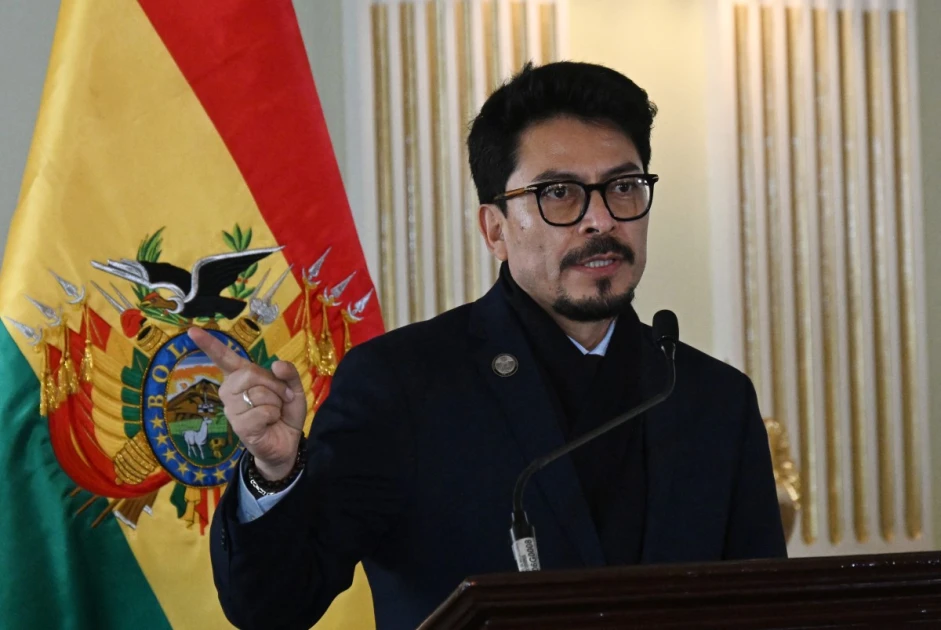
Bolivia's Foreign Minister Fernando Aramayo speaks during a press conference with international correspondents in La Paz on June 19, 2026. (Photo by Aizar RALDES / AFP)

Audio By Vocalize
Bolivian President Rodrigo Paz declared a state of emergency
across the Latin American country on Saturday after more than six weeks of road
blockades and protests demanding his resignation, saying he had exhausted
"all avenues of dialogue."
The decision came hours after Paz signed an agreement with
the country's main trade union federation, Bolivian Workers' Central (COB),
ending the protests sparked by Paz's plans for the economy.
But not all sectors were covered by the agreement, and some
unions continued protesting.
"After exhausting all avenues of dialogue, reaching
agreements with those whose demands were legitimate, and identifying those who
used violence in an attempt to destabilise Bolivia, we made the decision to
declare a state of emergency across the entire national territory," Paz
said in a televised speech.
COB launched the protest movement in early May to reject
US-backed Paz's ideas for ending the country's worst economic crisis in 40
years.
Demonstrators -- mainly blue-collar workers, farmers,
miners, truck drivers and teachers -- called for an end to
the center-right president's economic reforms and demanded his
resignation.
Paz has been in power only seven months, and his arrival
ended 20 years of socialist rule.
Roadblocks across Bolivia have led to shortages of fuel,
food and medicine in the country's main cities, including La Paz.
The government reached an agreement with COB on Friday,
after negotiations began last week.
"From now on, pressure measures are lifted
nationwide," announced Mario Argollo, leader of COB.
Paz defended the agreement, saying, "dialogue is
stronger than force itself."
Labor groups and coca farmers in the Chapare region, former
president Evo Morales' stronghold, continued protesting.
"We have decided to harden the roadblocks,"
Antonio Mallku, leader of one of the main workers' unions, told the television
channel Unitel.
"Our Indigenous brothers felt betrayed" by the
agreement, he said.
The number of road blockades, which exceeded 100 at the
height of the protests, has decreased, but around 50 remained in place.
Paz said he had ordered the police and armed forces "to
restore freedom of movement, regain control of the roads, and guarantee the
security of the population," warning that those who continue the blockades
or resort to violence would face "the full force of the law."
Under the terms of Friday's agreement, the government
promised not to privatize public companies -- a key demand of the unions.
The agreement also provides for working groups bringing
together ministers and union leaders to discuss the protest movement's demands.
The government now has 90 days to make progress on several
union demands, according to Argollo.
Paz has claimed that the protests were driven by
"narcoterrorists" he links to Morales.
Morales is in hiding while facing charges of alleged
trafficking of a minor, which he denies.
Join the Discussion
Share your perspective with the Citizen Digital community.
No comments yet
This discussion is waiting for your voice. Be the first to share your thoughts!