
Beyond the CBD: How infrastructure and satellite towns are redefining Nairobi’s real estate dominance

Audio By Vocalize
The skyline of
Nairobi, dotted with towering cranes and architectural marvels, tells a
compelling story of economic resilience and visionary development.
Over the past
decade, Kenya's real estate sector has emerged as a cornerstone of national
economic growth, driven by an ambitious middle class, rapid urbanization, and a
deliberate shift toward institutionalized real estate practices.
While
macroeconomic shifts present a dynamic operating landscape, the industry
continues to anchor significant local and foreign investment.
Kenya’s real
estate trajectory is uniquely defined by a massive structural supply-demand
mismatch.
Urban areas face a
persistent housing deficit, with an estimated annual demand of 200,000 units
compared to a formal supply of roughly 50,000 units (Onduko, 2020).
Speaking to
Citizen Digital, Moses Muriithi, the CEO of Fanaka Real Estate, noted that Kenya
currently faces an accumulated housing deficit of over 2 million units, with
Nairobi alone absorbing nearly three-quarters of that gap.
"The numbers
tell an uncomfortable truth. With the country's population set to grow from 53
million today to over 85 million by 2050, and Nairobi projected to reach 14
million residents in that same window, we are not dealing with a manageable gap
— we are dealing with a structural emergency," Muriithi says.
"If supply
stays at its current pace of 50,000 units per year against a demand of 250,000,
we will have added another 5 million unmet units to the deficit by 2051."
He further notes
that this is precisely why land in counties like Kajiado, Machakos, and Kiambu
is no longer a secondary bet. "It is the most rational hedge against an
urbanisation wave that is already here."
This gap has
turned the market into a fertile ground for developers targeting the mid-market
and affordable housing tiers.
Furthermore,
development has decentralized far beyond the boundaries of Nairobi’s
traditional commercial zones.
Enhanced public
infrastructure, such as the expansion of bypasses and the continuous
development of commuter rail networks, has unlocked massive value in satellite
towns.
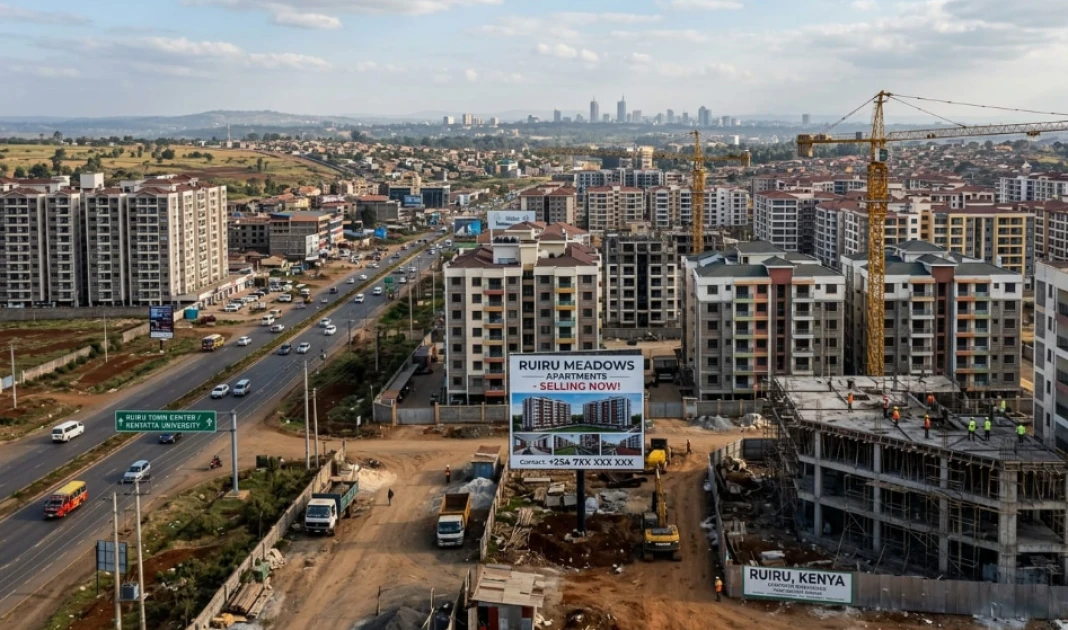
Locations like
Ruiru, Kikuyu and Athi River have transitioned from rural outposts into
bustling residential hubs, delivering capital gains for early investors.
Muriithi went on
to remark that the Nairobi Metropolitan area is becoming one of the
fastest-urbanising corridors on the continent.
"Kajiado is
growing at 5.5% annually, Machakos is home to 1.5 million and rising, and
Kiambu, already at 2.7 million, sits directly in Nairobi's expansion
path," he said.
"By 2051,
this metro region could house upwards of 25 million people. Investors who secure
land in these three counties today are not speculating - they are positioning
ahead of infrastructure, ahead of demand, and ahead of the next decade of
satellite town development that will define Kenya's housing story."
The government’s
strategic interventions have also reshaped the landscape. The
institutionalization of the Affordable Housing Programme (AHP), supported by
framework policies like the housing levy, has successfully mobilized both
public and private capital to fund mass scale developments.
This has
lower-income strata effectively participating in the formal property market
through public-private partnerships (PPPs).
To understand the
mechanics driving this boom, leading developers point to shifting consumer
preferences and the necessity of structural adaptation.
In analyzing the
momentum of the market, the Chief Executive Officer of Mi Vida Homes, Samuel
Kariuki, noted: "The real estate market in Kenya is undergoing a
structural shift where buyers are increasingly demanding quality, timely
delivery, and sustainable living spaces. Growth is no longer just about brick
and mortar; it is about building integrated communities that offer long-term
asset value and match the lifestyle aspirations of a discerning middle
class."
This focus on
delivery and trust has allowed institutional developers to thrive even as
older, speculative market models fade away.
The expansion of
the industry is evident through several tangible successes across distinct real
estate sub-sectors.
The evolution of
the commercial segment has positioned Nairobi as the definitive corporate hub
of East Africa.
The city has seen
a major influx of Grade A office spaces and mixed-use developments that
seamlessly integrate retail, residential, and corporate entities. This
institutional infrastructure continues to successfully attract multinational
corporations and regional headquarters.
Simultaneously,
the industrial real estate sector has undergone a massive modernization phase.
Driven by the rise
of e-commerce and regional logistics requirements, developers have established
specialized industrial parks and modern warehousing facilities outside the
traditional industrial areas.
These spaces offer
logistics efficiencies that are critical to the execution of regional trade
frameworks like the African Continental Free Trade Area (AfCFTA) (Kariuki,
2026).
Finally, real
estate has successfully diversified its financial instruments. The market has
matured from relying purely on traditional bank debt and off-plan cash buyers
to adopting institutional private equity and real estate investment trusts
(REITs).
This transition
injects much-needed liquidity and transparency into a historically opaque
market, ensuring that the industry remains well-capitalized to sustain its next
phase of growth.
Join the Discussion
Share your perspective with the Citizen Digital community.
No comments yet
This discussion is waiting for your voice. Be the first to share your thoughts!